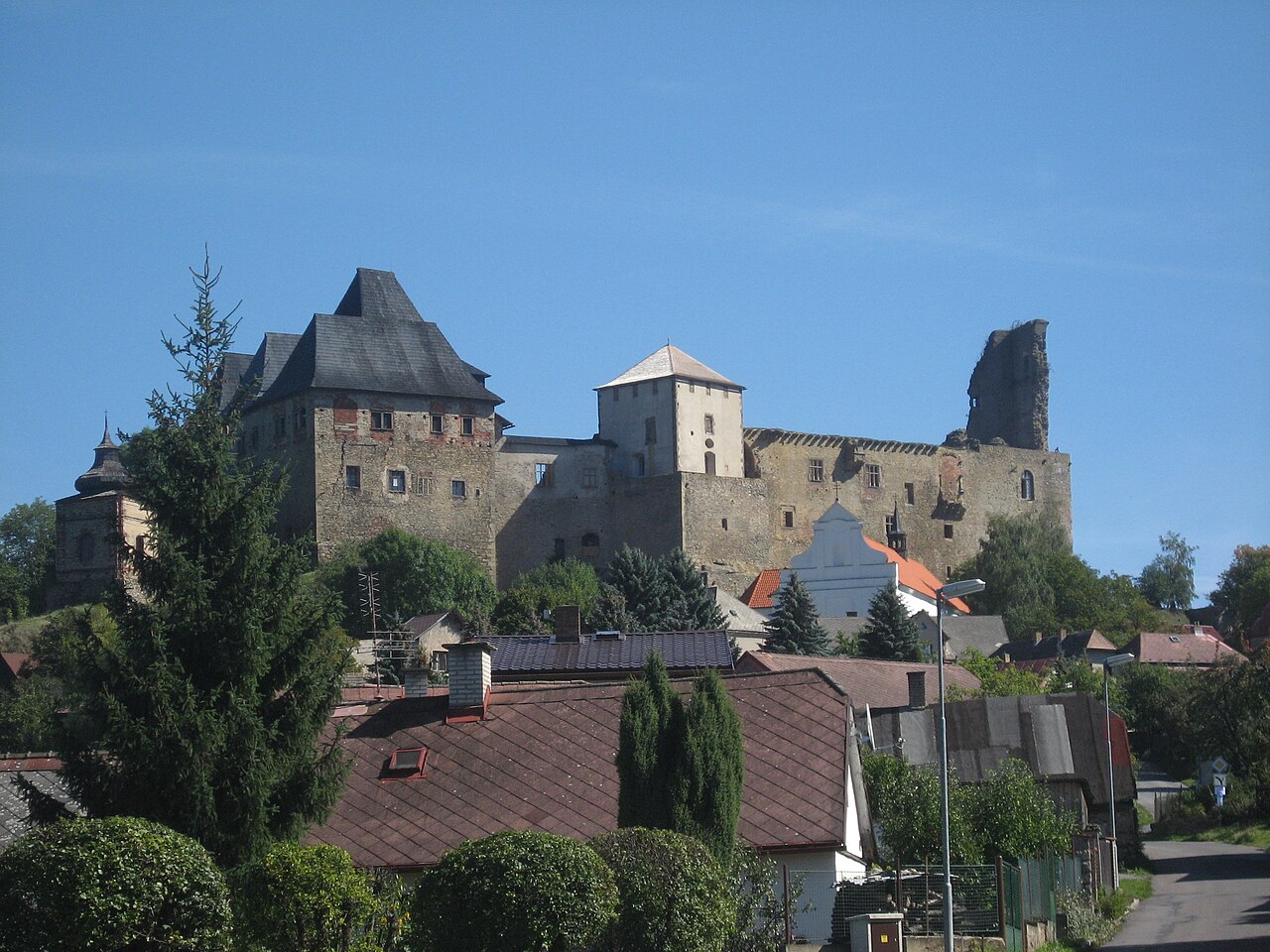
Ronovec Castle
Ronovec Castle stands as a significant example of a 13th-century hill castle in the Czech Republic, embodying the medieval heritage and territorial dynamics of the region. Situated near the village of Dolní Krupá, the castle was strategically established in a silver-rich mining area, reflecting its role in medieval territorial administration and resource control.
The castle was founded by Smil of Lichtenburk, a noble figure documented in 1262 issuing official documents from Ronovec. Although primarily an administrative center rather than a permanent residence, the castle marked the Lichtenburk family's influence in the region. Control passed through generations, notably to Hynek of Lichtenburk and his son Čeněk, before the property transferred to the Lords of Lipé in 1345 after an exchange with King John of Luxembourg. The estate then came under the ownership of Ješek of Zlíchov, progenitor of the Anděl family of Ronovec, who renamed the castle from its original names Sommerburg or Žumburg to Ronovec, inspired by the emblem of the Lords of Lipé.
Historical significance and ownership transitions
The castle's history is marked by turbulent ownership changes and involvement in regional conflicts. After Ješek's death circa 1392, his sons Jan and Petr, known for engaging in coin counterfeiting, resided at Ronovec. The Anděl family's tenure ended around 1406, followed by contested ownership during the Hussite wars. A likely siege or capture around 1424 contributed to Ronovec's decline, with the castle eventually abandoned by the mid-16th century.
Subsequent owners included notable figures such as Jindřich Špetle of Prudice and Jan Haugvic of Biskupice, with the Lords of Lipé briefly reclaiming it as a seasonal retreat. The final historical mention of Ronovec dates to 1572, after which it fell into ruin.
Architectural layout and defensive features
Ronovec Castle's ruins occupy a commanding promontory overlooking the Břevnický stream near Havlíčkův Brod. The castle's bipartite plan comprised an outer forecourt and an inner fortified core, a common design in medieval hill castles. The forecourt was protected by earthwork ramparts and a ditch on the southern and eastern sides, serving as the initial defensive barrier.
Access to the inner enclosure was through a western gate leading directly into the core, which was roughly square in layout. Buildings lined the perimeter walls, providing living quarters and functional spaces. A prominent tower projected from the western curtain wall above the gate, serving both defensive and surveillance purposes. The castle likely featured a shield wall, a thick and robust fortification typical of 13th-century noble castles, though the ruinous state limits detailed study.
Unique architectural elements and archaeological finds
Among the rare architectural features discovered at Ronovec are metal-plated wooden doors fastened with numerous rivets, a notable rarity in Czech medieval architecture. Archaeological excavations also uncovered a shell-shaped protective guard for a stabbing or cutting weapon, linked to early Hussite conflicts. These artifacts suggest that Ronovec experienced military action that contributed to its deterioration.
Post-medieval history and preservation efforts
Following abandonment, the castle ruins served as shelter for marginalized groups, including religious minorities and criminals. In the late 19th century, Wenzel Welz conducted extensive explorations that, despite causing some damage, preserved knowledge of the castle's layout. The mid-20th century saw renewed interest through the efforts of local historian Josef Čapek, who founded a club dedicated to Ronovec's history. A commemorative plaque was installed in 1988 within the castle remains to honor his contributions.
Today, Ronovec Castle is a protected cultural monument since 1963 and remains freely accessible to visitors. The site features a natural monument—a large spruce tree measuring approximately 360 centimeters in circumference and 41 meters in height—adding to the landscape's historical ambiance.
Visiting ronovec castle
Visitors to Ronovec Castle can explore the evocative ruins set on a scenic hilltop, offering insights into medieval fortification design and the region's turbulent history. The freely accessible site allows for self-guided tours, where one can observe the remains of defensive earthworks, the castle's bipartite layout, and surviving architectural elements like the tower base and perimeter walls.
The castle's location near Havlíčkův Brod makes it an attractive destination for history enthusiasts and hikers alike. While the ruins are in a partially preserved state, they provide a tangible connection to the High Medieval period and the noble families that shaped the region's history.
Frequently asked questions (FAQ)
- When was Ronovec Castle built and by whom?
- Ronovec Castle was established in the latter half of the 13th century by the Czech noble Smil of Lichtenburk as an administrative center in a silver mining region.
- What architectural features characterize Ronovec Castle?
- The castle features a bipartite plan with an outer forecourt protected by earthwork ramparts and a ditch, and an inner fortified core with perimeter buildings and a defensive tower.
- Is Ronovec Castle open to the public?
- Yes, the ruins of Ronovec Castle are freely accessible to visitors and are protected as a cultural monument since 1963.
- What historical events affected Ronovec Castle?
- Ronovec Castle was likely besieged during the Hussite wars around 1424, contributing to its decline and eventual abandonment by the mid-16th century.
- Are there any unique artifacts found at Ronovec Castle?
- Archaeologists uncovered metal-plated wooden doors and a shell-shaped protective guard for weapons, indicating the castle's involvement in medieval military conflicts.
Information
Loading map...
Visitor reviews
No reviews yet. Been here? Write the first review and help other travelers!
Write the first reviewVisited this castle? Share your experience
Your review helps other travelers and adds first-hand knowledge to our encyclopedia.