Roman defensive walls of Tarragona
The Roman defensive walls of Tarragona, known locally as the Muralla de Tarragona, are a significant example of ancient military architecture located in Tarragona, Catalonia, Spain. These walls were part of the city's fortifications during the Roman period, designed to protect the settlement known historically as Tarraco, a key administrative and military center in the Roman province of Hispania. The fortifications reflect the strategic importance of Tarragona as a hub of Roman power and influence on the Iberian Peninsula.
Historical background and significance
The construction of the walls dates back to the late 3rd century BC and continued through the Roman Republican and Imperial periods. They were built primarily to defend the city against external threats, including invasions and local uprisings. Tarragona's walls are among the best-preserved examples of Roman military engineering in Spain and provide valuable insight into the defensive strategies employed by the Romans in provincial cities.
Declared a Bien de Interés Cultural (Cultural Heritage Site) in 1884, the walls have been recognized for their historical and cultural importance. They contribute to Tarragona's designation as a UNESCO World Heritage Site, highlighting the city's rich Roman legacy.
Architectural features of the walls
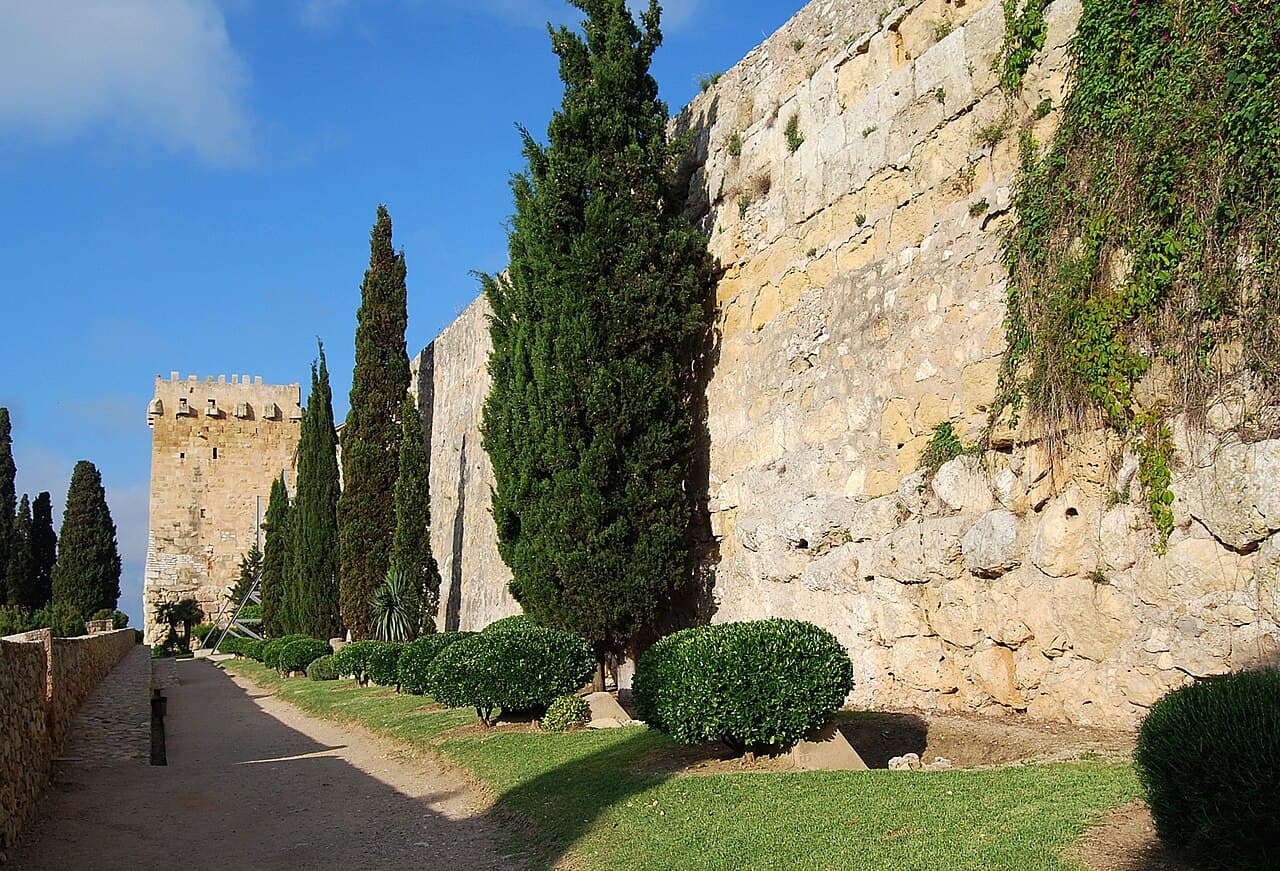
The walls extend for approximately 4.5 kilometers, enclosing the ancient city with a series of bastions, towers, and gates. The construction technique primarily involves large blocks of local limestone, carefully cut and fitted without mortar, a hallmark of Roman masonry known as . The walls vary in height, reaching up to 6 meters in some sections, with a thickness designed to withstand siege engines and assaults.
Bastioned fortress elements are evident in the design, with projecting bastions allowing defenders to cover adjacent wall sections and reduce blind spots. Several towers punctuate the walls, serving as lookout points and defensive strongholds. The main gates, such as the Praetorian Gate, exhibit complex architectural detailing, including semicircular arches and decorative stonework.
Defensive structures and innovations
The walls incorporate moats and ramparts in certain areas, enhancing their defensive capabilities. The use of bastions was an advanced feature for the period, predating the widespread adoption of bastioned fortifications in the Renaissance by many centuries. This indicates the Romans' sophisticated understanding of military architecture and their ability to adapt to evolving warfare tactics.
The walls in the context of Roman Tarragona
Tarragona, or Tarraco, was the capital of the Roman province of Hispania Citerior and later Hispania Tarraconensis. The walls protected a city that was not only a military stronghold but also a center of administration, commerce, and culture. Inside the walls, one can find remnants of Roman forums, temples, and public baths, which together with the fortifications, illustrate the city's urban complexity.
The defensive walls played a crucial role during various historical events, including the Roman civil wars and later during the Visigothic and Moorish periods. Although modified over the centuries, the core Roman structure remains largely intact, offering a tangible link to Tarragona's ancient past.
Preservation and current status
Today, the Roman defensive walls of Tarragona are well preserved and accessible to visitors. Conservation efforts have focused on stabilizing the structure and preventing deterioration caused by urban development and natural weathering. The walls form part of the city's extensive archaeological park, which attracts scholars, tourists, and history enthusiasts.
Visitors can walk along certain sections of the walls, gaining panoramic views of Tarragona and the Mediterranean coast. Informational signage and guided tours provide context about the walls' construction, historical role, and architectural features.
Visiting information and cultural impact
The walls are open to the public year-round, with no entrance fee for most outdoor sections. They are situated near other prominent Roman sites in Tarragona, including the amphitheater and the provincial forum, making them an integral part of a comprehensive exploration of Roman heritage in the region.
The Roman defensive walls of Tarragona continue to be a symbol of the city's enduring legacy and its importance in the broader narrative of Roman history in Spain.
Frequently asked questions (FAQ)
- What is the historical significance of the Roman defensive walls of Tarragona?
- The walls were built to protect the ancient Roman city of Tarraco, serving as a military and administrative stronghold in Hispania. They are among the best-preserved Roman fortifications in Spain and reflect advanced Roman military engineering.
- Can visitors walk along the walls?
- Yes, several sections of the walls are accessible to the public, allowing visitors to experience panoramic views of Tarragona and the Mediterranean coast while exploring the ancient fortifications.
- Are there guided tours available for the walls?
- Guided tours are offered by local authorities and heritage organizations, providing detailed historical and architectural information about the walls and their role in Roman Tarragona.
- Is there an entrance fee to visit the Roman walls?
- Most outdoor sections of the walls can be visited free of charge, making it accessible for all visitors interested in Roman history and architecture.
- What other Roman sites can be visited near the walls?
- Nearby Roman sites include the Tarragona Amphitheatre, the Provincial Forum, and the Roman Circus, which together with the walls offer a comprehensive view of the city's Roman past.
Photo gallery

Information
Opening hours
Open year-round, outdoor access
Ticket prices
Free
Current owner
Municipality of Tarragona
Loading map...
Visitor reviews
No reviews yet. Been here? Write the first review and help other travelers!
Write the first reviewVisited this castle? Share your experience
Your review helps other travelers and adds first-hand knowledge to our encyclopedia.