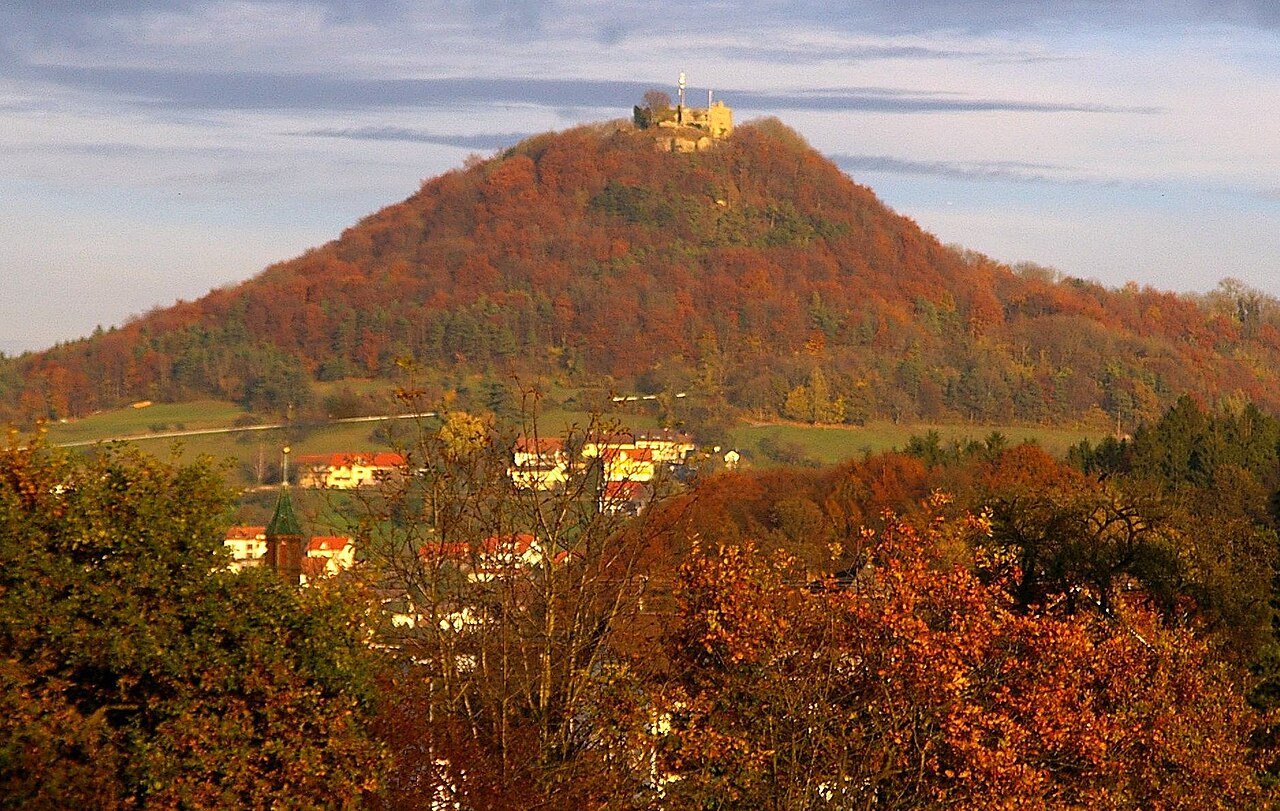
Roggenbach Castle
Roggenbach Castle stands as a significant medieval hill castle ruin located near the district of Wittlekofen in Bonndorf im Schwarzwald, Germany. Constructed around 1200 by the Counts of Nellenburg, this fortress was strategically positioned on a ridge approximately 675 meters above sea level, offering commanding views of the surrounding landscape. The castle’s remains today include two prominent bergfrieds (fortified towers) and a well-preserved courtyard, which collectively reflect the architectural and military design typical of high medieval fortifications in the region.
Historical background and ownership
The earliest documented mention of Roggenbach Castle dates to 1288, linked to a recorded sale, though its origins trace back to before 1100 under the auspices of the medieval Counts of Nellenburg. Over the centuries, the castle changed hands among several noble families, notably the Freiherren von Krenkingen, who used the fortress as a base for raids against the nearby monastery of St. Blasien. These aggressive actions prompted the Basel Council to impose a formal church ban, underscoring the castle’s role in regional conflicts.
In the mid-15th century, ownership passed to Wolf von Lichtenstein, who acquired the castle and the surrounding Vogtei of Riedern am Wald through purchase and family ties. However, in 1438, the castle suffered a significant assault by Austrian troops led by Werner von Staufen, resulting in its destruction. A partial reconstruction was undertaken in 1443 by the son of Johann von Krenkingen, aiming to restore some defensive functionality.
By 1482, when acquired by the Counts of Lupfen, Roggenbach Castle was already described as a Burgstall, indicating a site largely in ruins. The remaining economic buildings were destroyed during the 1525 Peasants’ War, an uprising that also devastated the nearby Burg Steinegg. Following the extinction of the Lupfen family’s male line in 1582, the property passed to the Pappenheim family, who held it until selling it in 1609 to the monastery of St. Blasien. The monastery retained ownership until secularization in 1806, when church properties were transferred to state control.
Local tradition sometimes groups Roggenbach Castle with nearby Burg Steinegg under the collective name "Rogèbacher Schlösser" or "Roggebach." Earlier assumptions linking the castle to the Freiherren von Roggenbach have been disproved by research, which suggests the Roggenbach family’s ancestral seat was a different, now-lost castle in Unterkirnach.
Architectural features and layout
The ruins of Roggenbach Castle reveal a complex primarily built of stone masonry, arranged along a hill ridge to maximize natural defenses. The site comprises two main enclosures, each dominated by a bergfried—a tall, square fortified tower characteristic of medieval German castles. These towers served as both defensive lookout points and refuges during attacks.
The bergfrieds
Both bergfrieds share a similar design, with square bases approximately nine meters across and walls about 2.5 meters thick, rising to roughly ten meters in height. The northern bergfried is the taller and better-preserved of the two, retaining its outer walls up to the former battlements. It features an internal spiral staircase that historically allowed defenders to move between floors and access the tower’s summit.
The southern bergfried is smaller and was originally accessed via an external wooden staircase, a feature now considered unsafe for visitors. Historical modifications appear to have sealed off the upper section of this tower, though the exact reasons for this alteration remain unclear.
Courtyard and defensive structures
Between the two towers lies a well-preserved courtyard area, where stone foundations mark the locations of former residential buildings and essential castle structures. A dividing wall separates the two main sections of the fortress, reinforcing the castle’s layered defensive design.
The castle’s thick stone walls and elevated position exemplify typical high medieval hill castle architecture, designed to withstand sieges and provide strategic control over the surrounding territory. Although the wooden roofing and interior wooden structures have not survived, the remaining stonework offers valuable insight into the castle’s original form and function.
Destruction and legacy
Roggenbach Castle’s history is marked by conflict and destruction. Its initial destruction by Austrian forces in 1438 and subsequent partial rebuild illustrate the turbulent political landscape of the region during the late medieval period. The final devastation occurred during the Peasants’ War of 1525, when the castle’s economic buildings were destroyed alongside neighboring fortifications.
Despite its ruined state, Roggenbach Castle remains an important cultural and historical landmark within the Black Forest region. The ruins provide a tangible connection to the feudal past and the complex interplay of noble families, military conflicts, and ecclesiastical power that shaped the area.
Archaeological research and preservation
Ongoing archaeological investigations at Roggenbach Castle continue to shed light on its construction phases, defensive features, and the daily life of its medieval inhabitants. Preservation efforts focus on maintaining the structural integrity of the surviving bergfrieds and courtyard walls to ensure the site remains accessible and informative for visitors and scholars alike.
Local interest in the castle’s history is reflected in the collective naming of Roggenbach and Burg Steinegg as the "Rogèbacher Schlösser". This highlights the intertwined histories and geographical proximity of these two medieval sites, enriching the cultural heritage of Bonndorf im Schwarzwald.
Frequently asked questions (FAQ)
- How do I get to Roggenbach Castle in Bonndorf im Schwarzwald?
- Roggenbach Castle is accessible via local hiking trails from Bonndorf im Schwarzwald. The castle ruins are located on a hill ridge near the district of Wittlekofen and can be reached by foot from the town center.
- What remains can I see at Roggenbach Castle?
- Visitors to Roggenbach Castle can explore the ruins of two stone bergfrieds and the courtyard foundations. The northern tower is the taller and better preserved, featuring an internal spiral staircase, while the southern tower is smaller and less accessible.
- When was Roggenbach Castle built and by whom?
- Roggenbach Castle was built around 1200 by the Counts of Nellenburg. It served as a strategic hill castle in the Black Forest region during the high medieval period.
- Is Roggenbach Castle open to the public?
- The castle ruins are open to the public year-round as an outdoor historic site. There are no entrance fees, but visitors should be cautious as some areas, especially the southern tower, are unsafe for climbing.
- Why was Roggenbach Castle destroyed?
- Roggenbach Castle was destroyed during military conflicts, notably by Austrian troops in 1438 and later during the Peasants’ War in 1525. These events reflect the turbulent political and social struggles of the region in the late medieval and early modern periods.
Information
Current owner
Private owner
Loading map...
Visitor reviews
No reviews yet. Been here? Write the first review and help other travelers!
Write the first reviewVisited this castle? Share your experience
Your review helps other travelers and adds first-hand knowledge to our encyclopedia.