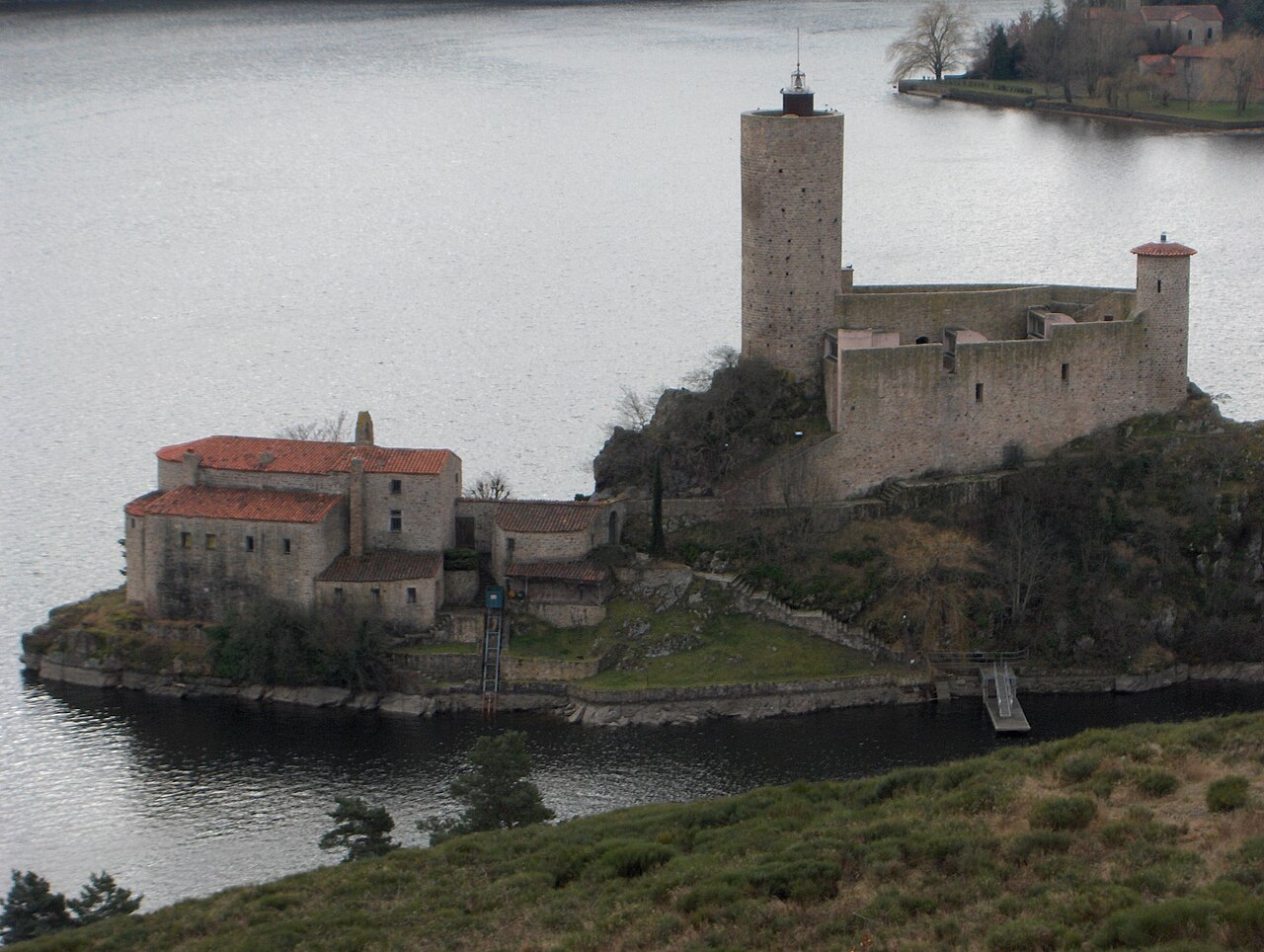
Rochetaillée Castle
Rochetaillée Castle, also known as Château de Rochetaillée, is a medieval fortress ruin situated in the village of Rochetaillée in the Loire department of France. Positioned on a prominent quartz promontory rising over 13 metres above the surrounding landscape, the castle commands strategic views over the Pilat slopes and the watershed dividing the Loire and Rhône basins. This location was carefully chosen for its defensive advantage and control over regional routes.
Early history and feudal origins
The castle's earliest documentation dates back to 1173, when a feudal agreement was recorded between the Count of Forez and the Archbishop of Lyon. This agreement established that the castle's warden owed direct homage to the count, indicating Rochetaillée's importance within the feudal hierarchy of the region. Although first mentioned in the late 12th century, the castle was likely founded in the early 11th century, making it one of the older medieval fortifications in the area.
Ownership and architectural evolution
During the 12th century, ownership of Rochetaillée Castle was held by the Abbey of Valbenoîte, a religious institution that controlled significant lands in the region. By the 13th and 14th centuries, the castle passed into the hands of the vassal Jarez family, who maintained it as a feudal stronghold. Throughout the 15th century, the castle underwent architectural improvements that reflected a gradual shift from purely military functions toward enhanced residential comfort. These modifications likely included the enlargement of living quarters and the addition of more refined interior spaces.
Sieges and conflict during the french wars of religion
Rochetaillée Castle played a role in the turbulent French Wars of Religion in the 16th century. In 1562, the castle was attacked and razed by Huguenot leader Sarras, reflecting the widespread violence between Protestant and Catholic factions. Later, in 1589, the castle was retaken after a prolonged 19-day siege led by the Catholic Ligue under commanders Jacques Mitte de Chevrières and Anne d’Urfé. This siege demonstrated the castle's continued strategic importance during this period of religious conflict.
Later ownership and decline
Following the Wars of Religion, ownership transferred to the Badol de Forcieu family and then to Jacques Bernou de Nantas around 1668. By the early 19th century, the castle came under the possession of the Baron of Rochetaillée. However, after the French Revolution, the castle had already fallen into serious disrepair. Over time, it was gradually abandoned and became a ruin, reflecting the diminished military and residential value of such medieval fortifications in the modern era.
Architectural features and current condition
The castle ruin occupies a terrace of approximately 500 square meters, enclosed by curtain walls that once formed a strong defensive perimeter. A notable feature is the semi-circular barbican protecting the western entrance, which leads toward the main gate. This barbican would have served as an additional defensive structure to delay attackers. Of the original four towers, three remain standing today, providing insight into the castle's original layout and defensive capabilities.
The castle's location on a quartz outcrop not only provided a natural defensive advantage but also a commanding vantage point over the surrounding terrain. This strategic positioning was typical of High Medieval hill castles designed to control important routes and oversee regional territories.
Visiting rochetaillée castle today
Today, Rochetaillée Castle is freely accessible to visitors who wish to explore its ruins and enjoy panoramic views of the Pilat hills and the surrounding landscape. While the southern keep's entry is generally closed to the public, access may be possible by obtaining a key from the local town hall, allowing a closer look at this significant medieval structure.
The castle's ruins offer a tangible connection to the region's feudal past and the architectural evolution of medieval fortifications in France. Visitors can appreciate the blend of military and residential elements that characterize Rochetaillée, as well as its role in the complex history of the Loire region.
Frequently asked questions (FAQ)
- How do I get to Rochetaillée Castle?
- Rochetaillée Castle is located in the Loire department in France, accessible via Rue du Parc in the village of Rochetaillée. Visitors can reach the site by car or local transport to the village, followed by a short walk to the castle ruins.
- What is the historical significance of Rochetaillée Castle?
- Rochetaillée Castle dates back to the 11th century and played a key role in regional feudal politics and the French Wars of Religion. It was involved in sieges and ownership changes that reflect the turbulent history of medieval and early modern France.
- Can I enter all parts of Rochetaillée Castle?
- The castle ruins are freely accessible, but entry to the south keep is usually closed. Visitors interested in accessing this area may request a key from the local town hall for a closer exploration.
- When was Rochetaillée Castle built?
- The castle was likely founded in the early 11th century, with the first documented mention in 1173. Its architecture reflects the High Medieval period.
- What architectural features are notable at Rochetaillée Castle?
- Notable features include the castle's location on a quartz promontory, the semi-circular barbican protecting the western entrance, the curtain walls enclosing a terrace, and three surviving towers from the original four.
Information
Address
Rue du Parc, France
Loading map...
Visitor reviews
No reviews yet. Been here? Write the first review and help other travelers!
Write the first reviewVisited this castle? Share your experience
Your review helps other travelers and adds first-hand knowledge to our encyclopedia.