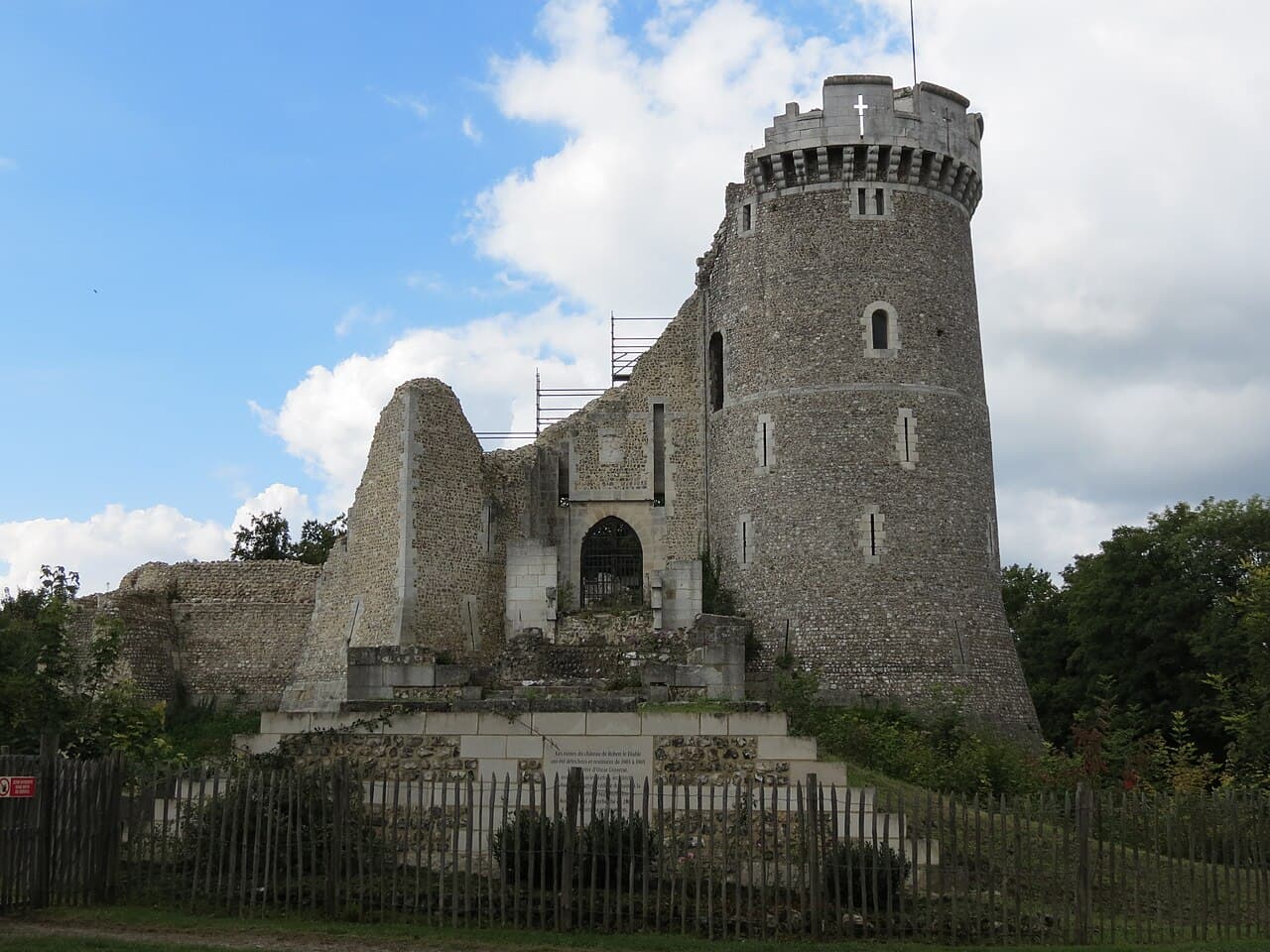
Robert le Diable Castle
Robert le Diable Castle, also known as Château de Robert le Diable or Château de Moulineaux, is a striking medieval fortress perched on a steep ridge overlooking the River Seine in the Seine-Maritime department of France. This hill castle commands sweeping views of the river’s two branches and the city of Rouen, emphasizing its strategic importance since the High Medieval period. Its evocative name derives from the legendary Norman figure "Robert the Devil," a cruel knight said to be the son of Satan, though historical evidence linking the castle's construction to any specific Robert remains elusive.
Legend and historical origins
The castle’s name is associated with several historical figures named Robert, including Robert I, Duke of Normandy (father of William the Conqueror), Robert of Bellême, and Robert Curthose, William's son. Despite these associations, there is no concrete evidence that any of these men commissioned or inhabited the castle. The earliest reliable records indicate that the site was developed in the 11th century, consistent with the Norman expansion and fortification efforts in Normandy.
The castle’s location atop a ridge overlooking a bend in the Seine made it a vital defensive stronghold. Its position allowed control over river traffic and surveillance of the surrounding region, including the important urban center of Rouen.
Construction and medieval significance
Early construction and royal involvement
Historical documentation credits King John of England (reigned 1199–1216), also known as John Lackland, with building or rebuilding a small castle on this site in the early 13th century. This construction was part of the ongoing conflicts between England and France during the Anglo-Norman period. John's interest in the castle reflected its strategic importance in controlling Normandy and the Seine valley.
Later, the castle was reportedly demolished by King John during his struggles with the French crown. Subsequently, Philip II Augustus of France (reigned 1180–1223) took control of the site and rebuilt the fortress, reinforcing its role as a French royal stronghold.
Role during the Hundred Years’ War
During the turbulent Hundred Years’ War (1337–1453), the castle’s military significance continued. In 1418, as the English laid siege to Rouen, the townspeople deliberately slighted (partially destroyed) the castle’s towers to prevent it from being used as a stronghold by the English forces. This act highlights the castle’s strategic value and the desperate measures taken to deny its use to enemies.
Architectural features and restoration efforts
Original medieval architecture
The castle was originally designed as a typical Norman hill castle with defensive walls, towers, and deep moats. The moats, or defensive ditches, surrounded the complex, creating formidable obstacles for attackers. Most of these moats were filled in during the mid-19th century, altering the original defensive landscape.
Notable architectural elements include the main tower known as the "Rouen tower," which was the largest and most prominent structure within the castle. This tower, along with the curtain walls and gatehouses, exemplified medieval military architecture designed for defense and control.
20th-century restoration and preservation
In the early 20th century, between 1903 and 1905, the castle underwent partial restoration under the guidance of architect Lucien Lefort, a pupil of the renowned restorer Viollet-le-Duc. Commissioned by the then-owner Oscar Cosserat, this restoration focused on clearing the site of overgrowth and stabilizing the ruins while respecting the medieval fabric.
Further restoration occurred in the 1950s when Roger Parment, the mayor of Moulineaux, acquired the castle. He enhanced the site by furnishing it with medieval artifacts, life-size historical figures, and a replica of a Viking ship built in Norwegian style, creating an immersive educational experience reflecting Norman history and culture.
Unfortunately, the castle suffered a severe fire in 2007 that damaged the north tower’s wooden floors, leading to its closure. Since then, access has been limited, with occasional openings on national heritage days.
Cultural significance and current status
The Château de Robert le Diable is a protected historical monument listed since 1935, covering over 48 hectares. It is recognized for its archaeological and cultural value, representing Norman medieval fortifications and regional history.
Today, the castle remains in a partially preserved and partially ruined state. Visitors can view the dramatic ruins, including the stone walls, the main tower remains, and the former moat areas from outside the site. Its proximity to the E-46 highway makes it easily visible, though interior access is restricted.
The castle’s rich history, architectural remnants, and evocative setting continue to attract interest from historians, architects, and tourists alike. Its story reflects the complex Anglo-French relations of the medieval period and the enduring legacy of Norman heritage in northern France.
Notable historical figures associated with the castle
- Robert I, Duke of Normandy (Robert the Magnificent) – legendary figure linked to the castle’s name, father of William the Conqueror.
- King John of England (John Lackland) – credited with building or rebuilding the castle in the early 13th century.
- Philip II Augustus – French king who rebuilt and fortified the castle after its demolition by King John.
- Lucien Lefort – early 20th-century architect who partially restored the castle under Oscar Cosserat’s ownership.
- Roger Parment – mayor of Moulineaux who restored and opened the castle to the public in the mid-20th century.
Visiting information
Currently, Robert le Diable Castle is closed to the public due to its condition and past fire damage. Visitors can view the castle from outside, particularly from the nearby E-46 highway and the surrounding area. Occasionally, the interior is accessible during national heritage days, offering a rare glimpse into its medieval interiors and architectural features.
The castle is located in the Hauts-de-France region near the village of Moulineaux, making it a notable historical landmark within the Seine-Maritime department. A small war memorial near the road below the castle adds to the site's commemorative atmosphere.
Frequently asked questions (FAQ)
- How do I get to Robert le Diable Castle?
- Robert le Diable Castle is located in Moulineaux, France, easily accessible by car or public transport from nearby cities. The nearest train station is Rouen, from where you can take a bus or taxi to the castle. Ample parking is available for those driving.
- What is the historical significance of Robert le Diable Castle?
- Robert le Diable Castle dates back to the 11th century and is steeped in history, associated with the legendary figure Robert the Devil. It played a crucial role in the feudal system and showcases the architectural evolution of medieval fortifications. Visitors can explore its rich history through guided tours that highlight its significance.
- When was Robert le Diable Castle built?
- The construction of Robert le Diable Castle began in the early 11th century, although it has undergone several renovations throughout the centuries. Its original design reflects the military architecture of the time, intended to provide defense and residence for nobility. Today, it stands as a testament to medieval craftsmanship and history.
- Can I visit Robert le Diable Castle year-round?
- Yes, Robert le Diable Castle is open to visitors year-round, although hours may vary by season. It’s recommended to check the official website for specific opening times and any seasonal events. Guided tours are available, providing an in-depth look at the castle's history and architecture.
- Why is Robert le Diable Castle considered a must-visit attraction?
- Robert le Diable Castle is a must-visit due to its stunning architecture and rich historical background. The castle offers breathtaking views of the surrounding landscape and is a perfect spot for photography enthusiasts. Its connection to the legendary Robert the Devil adds a fascinating layer of intrigue for history buffs.
- Is it possible to explore the castle's interior?
- Yes, visitors can explore both the interior and exterior of Robert le Diable Castle. Guided tours are available, which provide insights into the castle's history and architectural features. Some areas may have restricted access due to preservation efforts, but there are plenty of fascinating rooms to see.
- What are the ticket prices for visiting Robert le Diable Castle?
- Ticket prices for Robert le Diable Castle vary based on age and tour type, with discounts available for children and seniors. Groups may also benefit from reduced rates, making it an affordable outing for families. It’s advisable to purchase tickets in advance online to avoid long queues.
- What is the best time to visit Robert le Diable Castle?
- The best time to visit Robert le Diable Castle is during the spring and early autumn when the weather is pleasant and ideal for outdoor exploration. These seasons also feature fewer crowds, allowing for a more enjoyable experience. Special events and festivals may occur during these times, enhancing your visit.
- Are there any nearby attractions to explore?
- Yes, the area around Robert le Diable Castle offers several attractions, including beautiful parks, quaint villages, and historical sites. Visitors can also explore the scenic Seine River and indulge in local cuisine at nearby restaurants. The castle serves as a perfect starting point for a day of exploring the rich culture of Normandy.
Photo gallery

Information
Sources & official resources
Verify the information above using these authoritative references.
Loading map...
Visitor reviews
No reviews yet. Been here? Write the first review and help other travelers!
Write the first reviewVisited this castle? Share your experience
Your review helps other travelers and adds first-hand knowledge to our encyclopedia.


