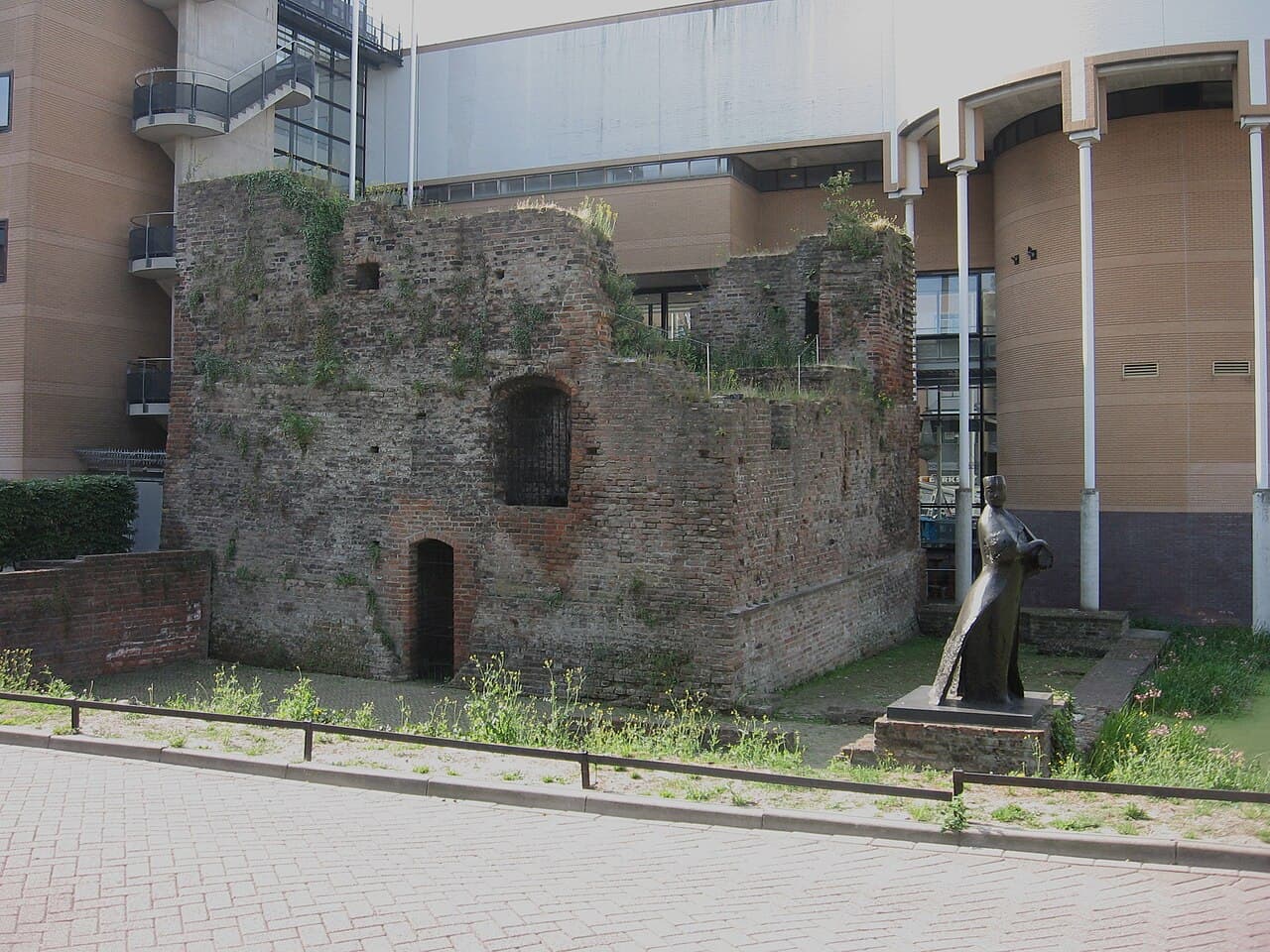
Riviere Castle
Riviere Castle, also known locally as Huis te Riviere or historically as Mathenesse Castle, is a significant medieval ruin located in the city of Schiedam, within the province of South Holland, Netherlands. Its origins date back to the 13th century, making it a notable example of a high medieval hill castle built in a polder landscape adjacent to the river Schie.
The castle was first documented in 1275, but archaeological and historical evidence suggests it was constructed slightly earlier, likely by Adelaide of Holland, Countess of Hainaut. The strategic location in the Mathenesse polder allowed the castle to control important waterways and land routes, which was crucial during the turbulent medieval period in the region.
Architectural features and layout
Originally, Riviere Castle was designed as a square keep situated within a rectangular moated enclosure. This layout was typical of hill castles of the period, combining defensive features with residential functions. The keep served as the main fortified residence, while the surrounding moat and enclosure walls provided protection against attackers.
Excavations conducted in the 1990s revealed the foundations and remnants of the castle's defensive structures, confirming its original design. Over time, additional residential wings were added against the old keep, reflecting the castle's evolution from a purely military fortress to a noble residence.
Historical significance and conflicts
Riviere Castle played a notable role during the Hook and Cod Wars, a series of civil conflicts in the County of Holland during the 14th and 15th centuries. The castle was originally owned by the Van Mathenesse family, who were aligned with the Hook faction. In 1351, the castle was destroyed by the townspeople of Delft, supporters of the Cod faction.
After its destruction, the castle was rebuilt on a smaller scale by the Van Mathenesse family, who later shifted allegiance to the Cod side. Despite this, the castle was again destroyed in 1426 by troops led by the Hook captain William Nagel. These repeated destructions highlight the castle's strategic importance and the intensity of local conflicts.
Later history and decline
During the 80 Years' War in 1574, the castle was garrisoned by Dutch troops. Unfortunately, during their occupation, two fires severely damaged the structure. After the troops left, the castle was deliberately dismantled by the townspeople of Schiedam to prevent its use by Spanish forces. By 1598, the castle was recorded as a ruin, marking the end of its active military and residential use.
Today, what remains of Riviere Castle are primarily the ruins of the keep and some connected foundations. The site is partially preserved but overshadowed by modern development, including an office building constructed adjacent to the ruins, which detracts from the historical ambiance.
Current condition and public access
The castle is classified as a hill castle in terms of type, dating from the high medieval period. Its current condition is described as ruins. The ruins are visible from the public road but are not accessible to visitors due to their location behind modern structures and a parking lot.
The treatment of the site by local authorities has been criticized for its lack of sensitivity to the castle's heritage value. Despite this, the ruins remain an important cultural monument, offering insight into medieval fortifications and the region's turbulent history.
Historical context within the region
Riviere Castle reflects the complex political and military landscape of medieval Holland. Its repeated destruction and rebuilding during the Hook and Cod Wars illustrate the shifting allegiances and power struggles that characterized the era. The castle's location in the polder lands near the river Schie also underscores the importance of controlling waterways for defense and trade.
The castle's decline during the 80 Years' War further connects it to the broader narrative of Dutch resistance against Spanish rule. Its deliberate dismantling to prevent enemy occupation is a testament to the strategic calculations made during this protracted conflict.
Architectural legacy and archaeological findings
Archaeological excavations have been crucial in understanding the castle's original form and subsequent modifications. The discovery of the moat, enclosure walls, and keep foundations has allowed historians and archaeologists to reconstruct its layout and appreciate the defensive innovations of the time.
Despite the limited remains, Riviere Castle serves as a valuable case study for medieval castle construction in the low-lying Dutch landscape, where water management and fortification had to be carefully balanced.
Visitor information and cultural importance
While the ruins are not open for direct access, they can be viewed from the nearby public road on Overschiesestraat. Visitors interested in medieval Dutch castles will find the site historically significant, though the modern surroundings limit the experience.
The castle's story is preserved in local history and through archaeological records, contributing to the cultural heritage of Schiedam and the South Holland region. Efforts to raise awareness of the site's importance continue among heritage groups.
Frequently asked questions (FAQ)
- How do I visit Riviere Castle?
- Riviere Castle ruins are visible from the public road on Overschiesestraat in Schiedam but are not accessible to visitors due to their location behind modern buildings.
- What is the historical significance of Riviere Castle?
- Riviere Castle played a key role during the Hook and Cod Wars and the 80 Years' War, reflecting the region's medieval political conflicts and military strategies.
- When was Riviere Castle built and by whom?
- The castle was likely built in the early 13th century, probably by Adelaide of Holland, Countess of Hainaut, and first mentioned in records in 1275.
- What remains of Riviere Castle today?
- Today, primarily the ruined keep and some foundations remain, with the site classified as ruins overshadowed by modern development.
- Is there public access to the castle ruins?
- No, the ruins are not open to the public, but they can be viewed from nearby public roads.
Photo gallery

Information
Address
Overschiesestraat, Schiedam, Netherlands
Loading map...
Visitor reviews
No reviews yet. Been here? Write the first review and help other travelers!
Write the first reviewVisited this castle? Share your experience
Your review helps other travelers and adds first-hand knowledge to our encyclopedia.



