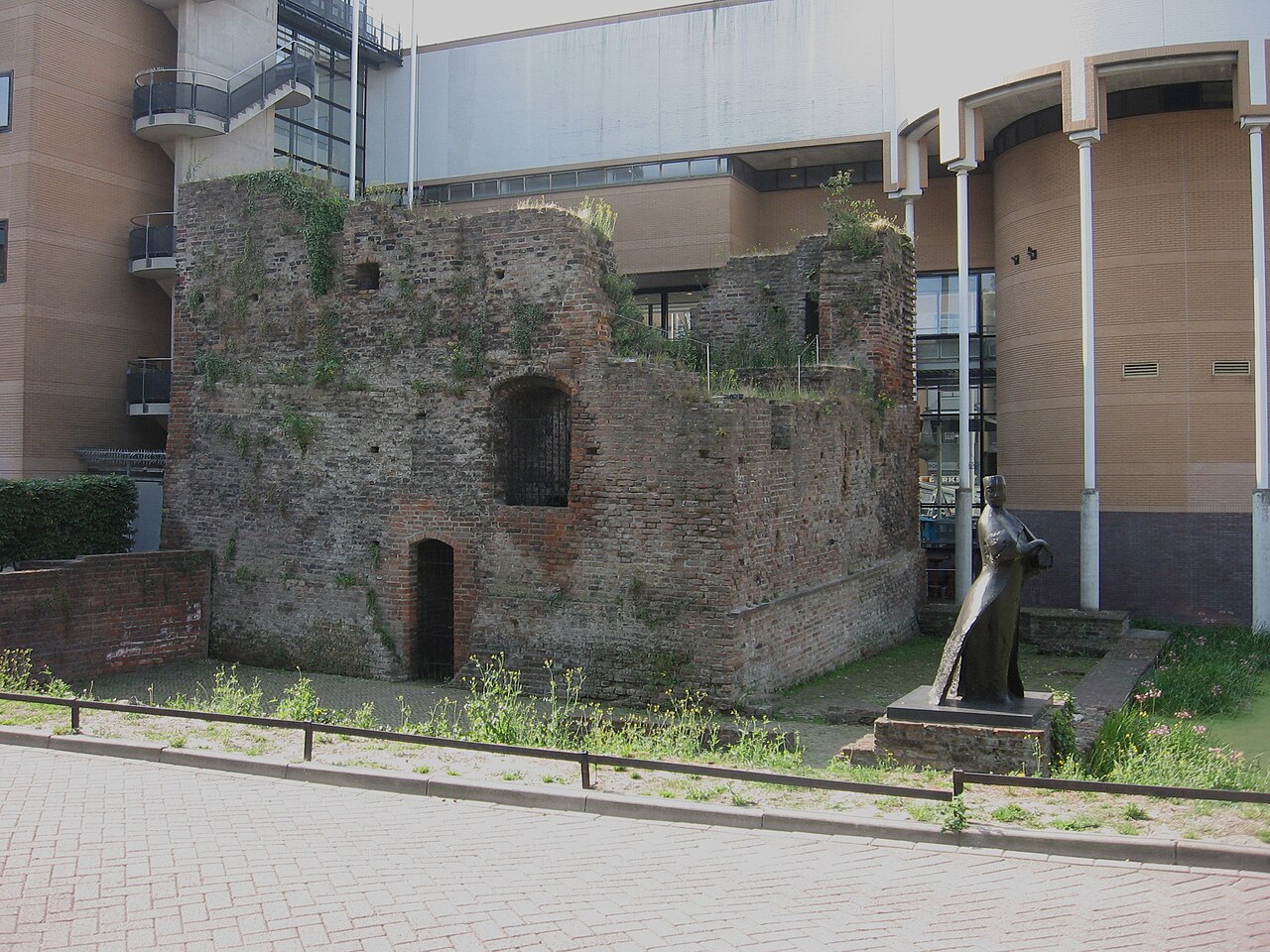
Spangen Castle
Spangen Castle was a significant medieval fortress located in the Overschie neighborhood of Rotterdam, within the province of South Holland, Netherlands. Originally constructed in the early 13th century by the Lord of Uiternesse, it stood as a stone tower on a motte, encircled by a defensive moat. The castle took its name from a nearby stream, reflecting the common medieval practice of naming fortifications after local geographical features.
Early construction and medieval architecture
The initial structure of Spangen Castle was typical of early medieval fortifications, featuring a sturdy stone keep atop an earthen mound or motte. This design provided a commanding vantage point and defense against attackers. The moat surrounding the motte added an extra layer of protection, making direct assaults difficult. Such features were characteristic of high medieval castles built during the 12th and 13th centuries in the Low Countries.
The hook and cod wars and castle transformations
During the turbulent period of the Hook and Cod Wars, a series of civil conflicts in the County of Holland, Spangen Castle suffered significant damage. In 1359, the castle was partially destroyed amid the fighting. Later, between 1385 and 1400, Philips of Spangen undertook a major reconstruction, transforming the castle into a fortified complex featuring five defensive towers. This expansion reflected the growing military importance of the site and the need for stronger defenses during ongoing regional conflicts.
Despite these efforts, the castle was again destroyed in 1426 by forces led by Willem Nagel, the bailiff of Alkmaar and Kennemerland. Subsequently, Philips II of Spangen rebuilt the castle between 1443 and 1460, restoring its role as a fortified residence and military stronghold.
Damage during the jonker frans war
In 1488, during the Jonker Frans War—the final phase of the Hook and Cod Wars—the castle was looted and damaged by troops under Frans van Brederode. Philips II of Spangen sought compensation from the Count of Holland for the damages but was awarded only a small sum, insufficient to cover the full cost of repairs. Nonetheless, the castle was evidently restored enough to remain habitable into the mid-16th century.
Occupation and destruction in the 16th century
In 1572, Spangen Castle was occupied by the Sea Beggar William II de la Marck, Lord of Lumey, and his forces during the Dutch Revolt against Spanish rule. Later that same year, the castle was attacked and destroyed by a group of criminals from Delft. The final destruction occurred in 1574 when Spanish troops deliberately set fire to the remains to prevent its future military use, effectively ending the castle's functional existence.
Decline and archaeological legacy
After its destruction, Spangen Castle fell into ruin and gradually disappeared from the landscape. By the mid-19th century, remnants of the castle walls were still visible in the surrounding fields, but by the early 20th century, no visible traces remained. The area was incorporated into the city of Rotterdam in 1941, and archaeological excavations that year uncovered the castle’s foundations. However, these were removed shortly afterward to make way for the construction of the Bornisse harbor and an industrial zone, erasing physical evidence of the castle.
Today, nothing remains of Spangen Castle above ground, and its memory survives only through historical records and archaeological findings. The site’s history reflects the complex medieval and early modern conflicts in the region and the evolution of castle architecture in the Netherlands.
Historical significance and architectural features
Spangen Castle exemplifies the transition from early medieval motte-and-bailey designs to more complex stone fortifications with multiple towers. Its repeated destruction and rebuilding during the Hook and Cod Wars illustrate the strategic importance of castles in regional power struggles. The castle’s final demise during the Dutch Revolt marks the end of its military relevance in a period of significant political and social upheaval.
The castle’s architectural evolution, from a simple stone tower to a fortified complex with five towers, highlights the adaptation of medieval defensive architecture to changing warfare tactics and technologies. While no physical structures survive, the archaeological record provides insight into its layout and construction techniques.
Spangen castle in the context of dutch medieval fortifications
Within the broader context of Dutch medieval castles, Spangen Castle was a typical example of a high medieval fortification adapted to local geographic and political conditions. Its location near waterways and the Bornisse harbor would have been strategically chosen for defense and control of trade routes. The castle’s destruction and rebuilding phases reflect the intense factional conflicts in Holland during the Middle Ages.
Spangen Castle’s story is intertwined with the history of the County of Holland and the shifting allegiances and power struggles that shaped the region’s medieval landscape. Its repeated targeting during the Hook and Cod Wars underscores its military and symbolic significance.
Frequently asked questions (FAQ)
- How do I get to Spangen Castle?
- You can reach Spangen Castle by using public transportation to Breevaartstraat or by car, with ample parking available nearby. The castle is well-signposted, making it easy for visitors to find.
- What is the historical significance of Spangen Castle?
- Spangen Castle dates back to the medieval period and was originally built for defense purposes. Over the centuries, it has witnessed numerous historical events that have shaped the region.
- When was Spangen Castle built?
- Construction of Spangen Castle began in the late 14th century, making it a remarkable example of medieval architecture. Its enduring structure has preserved many features from that era.
- Can I take guided tours of Spangen Castle?
- Yes, guided tours are available at Spangen Castle, providing visitors with in-depth knowledge about its history and architecture. Be sure to check the schedule in advance as tour times may vary.
- Why is Spangen Castle a popular tourist destination?
- Spangen Castle is popular for its rich history, stunning architecture, and picturesque surroundings. It offers visitors a glimpse into the past, along with beautiful views of the nearby Bornisse harbor.
- Is it possible to host events at Spangen Castle?
- Yes, Spangen Castle offers facilities for hosting events like weddings and corporate gatherings. The unique setting and historical ambiance make it a memorable choice for any occasion.
- What are the opening hours for Spangen Castle?
- Spangen Castle is open to visitors from Tuesday to Sunday, typically from 10 AM to 5 PM. It is recommended to check the official website for any seasonal changes to the hours.
- Are there any ticket prices for entering Spangen Castle?
- Yes, there is a nominal entrance fee to visit Spangen Castle, which helps maintain the site. Discounts are often available for students and seniors, so be sure to inquire at the ticket counter.
- What is the best time to visit Spangen Castle?
- The best time to visit Spangen Castle is during the spring and early autumn when the weather is pleasant and the gardens are in full bloom. Additionally, these seasons tend to have fewer crowds, allowing for a more enjoyable experience.
- What nearby attractions can I visit after Spangen Castle?
- After visiting Spangen Castle, you can explore the charming Bornisse harbor and enjoy scenic walks along the waterfront. There are also several local cafes and shops nearby, perfect for a relaxing afternoon.
Loading map...
Visitor reviews
No reviews yet. Been here? Write the first review and help other travelers!
Write the first reviewVisited this castle? Share your experience
Your review helps other travelers and adds first-hand knowledge to our encyclopedia.