Riom Castle
Riom Castle is a significant medieval fortress located in the Surses region of Switzerland. Its origins trace back to the High Medieval period, with construction around 1226 by the Knights of Wangen-Burgeis. The castle stands as a testament to the strategic importance of the area, situated near the vital Julier Pass, a key trade and transit route through the Alps.
The site of Riom Castle has a long history of human habitation, beginning in the Roman era from the 1st through the 4th centuries. During Roman times, the location served as a mansion or way-station along the Julier Pass road, facilitating movement and commerce across the region. After the fall of the Western Roman Empire, the area remained inhabited by farmers and herders throughout the Early Middle Ages.
Early history and ownership
By 840, Riom was under the personal ownership of the king of Raetia Curiensis, functioning as a local administrative center and the site of a major church. This church was granted by King Arnulf to his vassal Ruotpert, who later traded it to Lorsch Abbey in 904. The surrounding lands and the settlement eventually passed to the Knights of Wangen-Burgeis in the early 13th century, who constructed the castle as a fortified residence and administrative hub.
Architectural features and construction
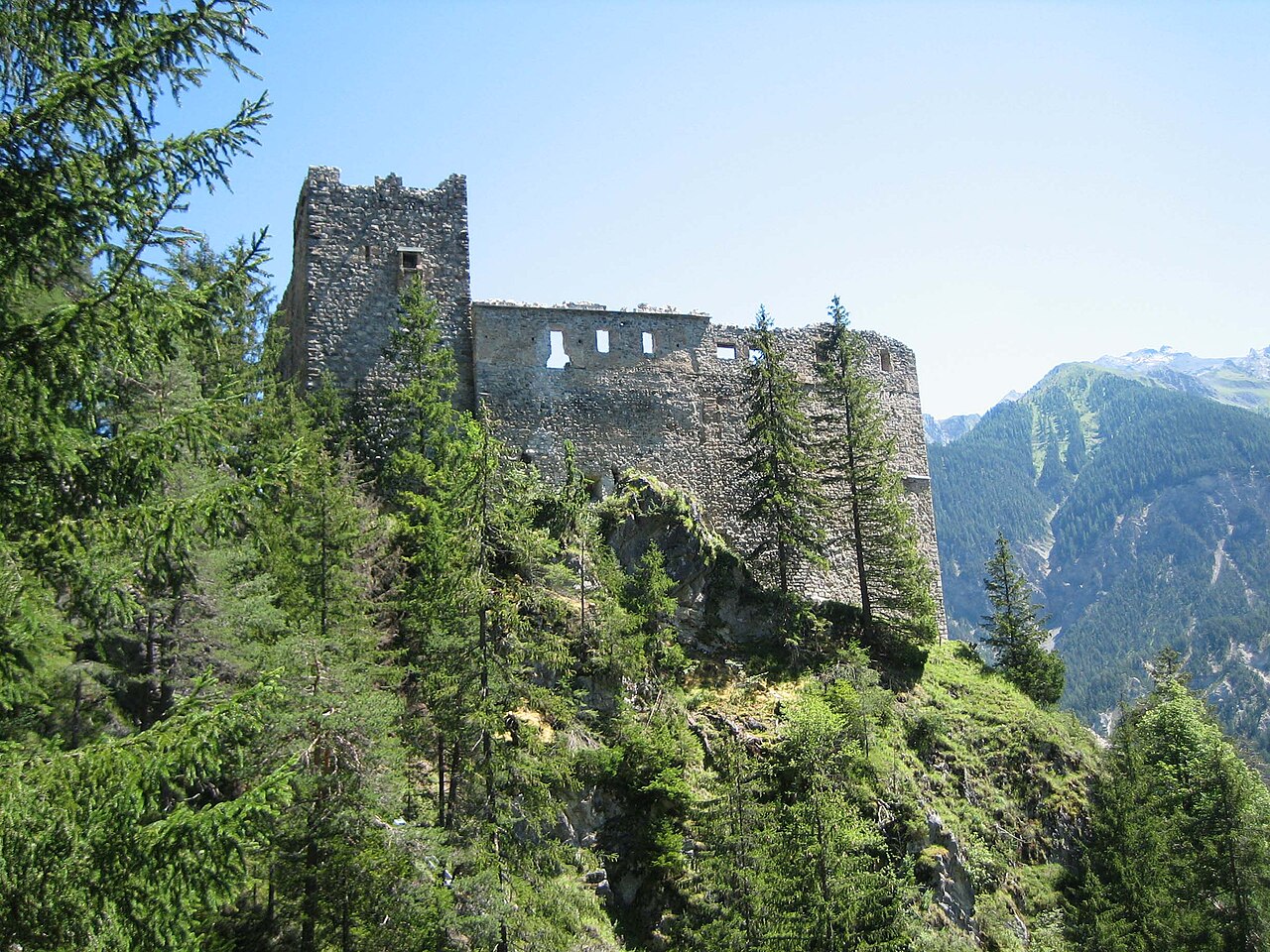
The original castle complex consisted of a slender, tall bergfried and an attached two-story palas. Shortly after initial construction, a third story was added to the palas, enhancing its residential and defensive capabilities. These primary structures were enclosed within a ring wall, providing protection and defining the castle's footprint. Unfortunately, the gatehouse was demolished in the past few centuries, and no physical traces of it remain today.
The palas measures approximately 12 by 34 meters and originally featured walls crowned with merlons, typical of medieval fortifications. After a devastating fire in 1867, the castle's roof and floors were stripped to provide reconstruction materials for the village, leaving the building exposed to the elements. This led to significant deterioration until the 20th century, when restoration efforts replaced the roofs on both the palas and bergfried. In 1977, a gable roof was added to the palas to protect the walls, resulting in the removal of the original merlons.
The bergfried is a six-story defensive tower measuring only 7 by 7 meters at ground level. Its design prioritized defense over comfort, with thick walls and narrow firing slits making the interior cramped and unsuitable for permanent habitation. The tower's roof was lost in the 1867 fire and replaced in 1936.
Political and administrative significance
In 1258, the castle and surrounding estates were sold by Berall von Wangen to the Bishop of Chur for 300 silver Marks. However, the bishop had to use the castle as collateral to secure a loan from the Freiherr von Vaz. By 1275, the loan was repaid, and Riom became the center of the bailiwick of Oberhalbstein. This position brought steady income through tolls and taxes from trade over the Julier and Septimer Passes.
By the early 14th century, the Marmels family served as bailiffs of Riom, a role they held until 1426. Throughout the 15th and 16th centuries, various noble families from Graubünden took on the bailiff position. In 1468, Bishop Ortlieb von Brandis's conflict with the League of God's House led to the temporary occupation of Riom Castle by the League's forces. The city of Zürich mediated the dispute, resulting in the castles being returned to the bishop.
The Ilanzer Article of 1526 curtailed the bishop's secular power, but local change was gradual. In 1552, the communities of Surses purchased their freedom from the bishop, ending the need for a bailiff at the castle. Subsequently, Riom Castle served as the meeting place for the Landsgemeinde, the local assembly, and the site of the Surses high court. During witch trials, accused individuals were detained and tortured within the castle.
Modern history and cultural use
The village of Riom suffered a destructive fire in 1867, but the castle itself survived. However, the urgent need for building materials led to the removal of the castle's roofs and floors, accelerating its decline. Restoration efforts in the 20th century stabilized the structure, replacing the roofs on the palas and bergfried to protect the masonry.
In 2006, the palas was adapted to house a theater with 220 seats, enhancing the castle's role as a cultural venue. Every summer, the castle hosts the Origen Festival Cultural, a celebration of Romansh culture that draws visitors and performers to the historic site.
Architectural description of the castle site
The castle's large three-story palas dominates the site, measuring approximately 12 by 34 meters. The original entrance was on the second story of the south side, accessed by a wooden stairway. A ground-level entrance was added in the 1930s to improve accessibility. The walls, once topped with merlons, now have a protective gable roof installed in the late 20th century.
The six-story bergfried tower is notable for its compact footprint and defensive design. Its thick walls and narrow firing slits reflect its primary function as a stronghold rather than a residence. The tower's roof, replaced in 1936, protects the interior from weather damage.
Riom Castle's combination of medieval military architecture and later adaptations illustrates the evolution of castle functions from feudal fortresses to administrative centers and cultural landmarks. Its preservation and adaptive reuse continue to highlight its significance in the history and culture of the Surses region.
Frequently asked questions (FAQ)
- How do I get to Riom Castle?
- Riom Castle is located in the Surses region of Switzerland, accessible by local roads from nearby towns. Visitors can reach the site by car or public transport to the village of Riom, followed by a short walk to the castle.
- What is the historical significance of Riom Castle?
- Riom Castle served as a medieval administrative center and defensive stronghold near the important Julier Pass. It was the seat of the bailiwick of Oberhalbstein and played a key role in regional politics and trade from the 13th to 16th centuries.
- Can I visit the theater inside Riom Castle?
- Yes, the castle's palas houses a theater with 220 seats that hosts the annual Origen Festival Cultural, celebrating Romansh culture. Visitors can attend performances during the summer festival season.
- When was Riom Castle built?
- Riom Castle was constructed around 1226 by the Knights of Wangen-Burgeis during the High Medieval period.
- Is Riom Castle well preserved?
- The castle is partially preserved, with significant restoration work done in the 20th century to replace roofs and protect the structure after deterioration caused by a fire in 1867.
Information
Loading map...
Visitor reviews
No reviews yet. Been here? Write the first review and help other travelers!
Write the first reviewVisited this castle? Share your experience
Your review helps other travelers and adds first-hand knowledge to our encyclopedia.