Riegersburg Castle
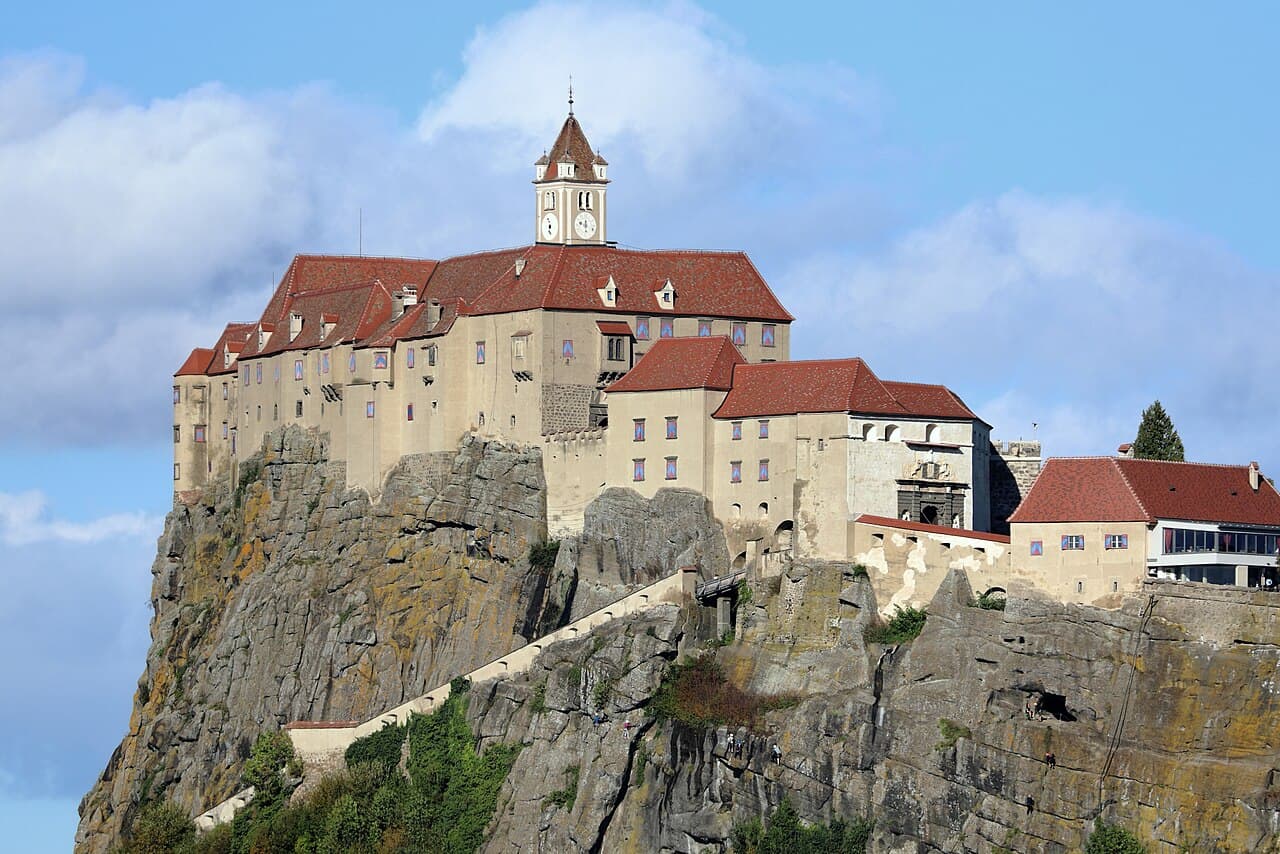
Riegersburg Castle is a striking medieval hill castle perched atop a dormant volcanic cone in the Austrian state of Styria. This imposing fortress overlooks the town of Riegersburg and stands as a testament to centuries of military architecture, noble lineage, and regional history. Owned by the Princely Family of Liechtenstein, the castle today serves as a museum with a rich collection of exhibitions that highlight its multifaceted past. Visitors can explore 25 of its 108 rooms, including those dedicated to the castle's history and the darker chapters involving witches and sorcerers.
Early history and strategic location
The origins of Riegersburg Castle date back to the 12th century, with the first official mention occurring in 1138 under the name "Ruotkerspurch," meaning "Rüdiger's castle." The exact date of initial construction remains uncertain, but it is known that a knight named Rüdiger von Hohenberg established a small keep on the volcanic hill around 1122. The castle's location on a basalt volcanic cone rising to 484 meters above sea level provided natural defensive advantages, with steep cliffs on three sides and access only from the south, making it a formidable stronghold.
The volcanic neck, a petrified remnant of an ancient stratovolcano extinct for approximately two million years, supplied the basalt stone used in building the castle's robust walls and structures. The site has been inhabited for around 6,000 years, with evidence of a large village dating back to the 9th century BC. Throughout antiquity, the region experienced Roman occupation, Bavarian migration, and Hungarian invasions, all contributing to the area's turbulent history and the need for a strong fortress.
Architectural evolution and fortifications
Castle complex and layout
Riegersburg Castle comprises two main sections: the Upper Castle (Obere Feste or Kronegg) and the Lower Castle (Niedere Feste or Lichtenegg). The Upper Castle, likely built before 1100, is situated on the northern summit of the volcanic cone and consists of two to three-story buildings arranged around two narrow inner courtyards. The southern courtyard features elegant arcades supported by columns and vaults, while the northern courtyard, known as the Brunnenhof, contains a well dating to 1640 with an ornate wrought-iron canopy. A small chapel near the entrance adds to the religious and cultural significance of the site.
The Lower Castle was constructed around 1140–1150 by Margrave Otakar III to limit the influence of local nobles. Over the centuries, the castle's fortifications were expanded and modernized, especially during the 17th century under the guidance of Baroness Katharina Elisabeth von Wechsler, also known as the "Gallerin." She transformed the fortress into one of Austria's largest and strongest castles, adding extensive walls, five gates, and two trenches, enclosing an area of about 15 hectares.
Defensive features
The castle's defensive system is renowned for its complexity and strength. It includes a three-kilometer-long wall with six gates and eleven bastions named after saints and historical figures. The gates, constructed between 1678 and 1690 by master builder Bartholomeus Ebner, feature elaborate portals, with the Wenzeltor (Vaclav Gate) distinguished by statues of the Roman war gods Mars and Bellona. Access to the castle involves crossing a wooden bridge over a deep moat, enhancing its impregnability.
An independent stairway called the Eselsteig (Donkey Path), carved into the western rock face around 1420, provides a separate route to the Upper Castle, bypassing the Lower Castle. The fortress also includes trenches and bastions designed to repel attacks, reflecting the military architectural advancements of the late medieval and early modern periods.
Notable historical figures and events
Throughout its history, Riegersburg Castle was owned by various noble families, including the Aribonids, von Riegersburg-Wildon, Kuenring-Dürnstein, von Walsee, von Stubenberg, von Reichenburg, von Stadl, von Ursenbeck, and von Wechsler. The castle endured a notable siege in 1412 during the "Walseer Fehde," a feud involving the von Walsee family and the sovereign of Styria.
The most influential owner was Baroness Katharina Elisabeth von Wechsler, who took control in the 17th century and significantly expanded and fortified the castle. Known for her strong will in a male-dominated society, she protected her estate fiercely. Under her tenure, the castle acquired its current form and grandeur, with lavish interiors and formidable defenses.
Her era was also marked by the tragic Styrian witch hunts from 1673 to 1675, during which one of her handmaidens, Katharina Paldauff, known as the "Flower Witch," was accused of sorcery and executed. This dark chapter is commemorated in the castle's museum exhibitions.
After the extinction of the Purgstall family around 1800, the castle was purchased in 1822 by Prince Johann Josef von Liechtenstein, whose family has maintained ownership ever since. The castle was briefly occupied by Soviet forces in 1945 during World War II but survived without significant damage.
Interior highlights and cultural significance
Visitors to Riegersburg Castle can explore a variety of historically significant rooms, including princely chambers, a picture gallery, the Roman Hall, Turkish Hall, Knight’s Hall, and a princely dining room. The White Hall, a richly decorated Baroque summer dining room completed in 1658 by master builder Antonio Solari, stands out for its elaborate ornamentation and an inscription noting the high cost of construction.
The castle also hosts exhibitions dedicated to its history and the witch trials, providing insight into the social and cultural dynamics of the region during the medieval and early modern periods. The museum's displays offer a comprehensive narrative of the castle's role as a military fortress, noble residence, and cultural landmark.
Modern preservation and visitor experience
Today, Riegersburg Castle is a well-preserved monument attracting visitors interested in history, architecture, and folklore. The castle is accessible via diagonal glass elevators for those seeking convenience, while more active visitors can ascend on foot through the town center, passing through the fortress's seven gates to experience the authentic medieval atmosphere.
The castle grounds continue a tradition of viticulture dating back to the 17th century. The surrounding vineyards, covering about 10 hectares, are leased to the Bernhart winery, which produces wine under the "Riegersburg" label. This blend of historical heritage and living tradition enhances the castle's unique appeal.
Additionally, the steep rock faces surrounding the castle offer several via ferrata climbing routes of moderate to difficult levels, making it a unique destination that combines medieval architecture with outdoor adventure.
Preservation efforts have been overseen by Prince Emanuel von und zu Liechtenstein since 2014, ensuring that the castle remains a vibrant cultural and historical site for future generations.
Frequently asked questions (FAQ)
- How do I get to Riegersburg Castle?
- Riegersburg Castle is located above the town of Riegersburg in Styria, Austria. Visitors can reach the castle by car or public transport to the town and then either take the diagonal glass elevators or walk up through the town center, passing the seven fortress gates.
- What are the opening hours of Riegersburg Castle?
- The castle is generally open to visitors daily from 9:00 AM to 5:00 PM, but it is recommended to check the official website for seasonal variations and special events.
- What can I see inside Riegersburg Castle?
- Visitors can explore 25 rooms of the castle, including historical chambers, a picture gallery, and exhibitions on the history of the castle and the witch trials that took place in the region during the 17th century.
- Is Riegersburg Castle accessible for visitors with mobility issues?
- The castle offers diagonal glass elevators to assist visitors with mobility challenges. However, the medieval terrain and some areas may still pose difficulties, so it is advisable to contact the castle administration beforehand.
- Why is Riegersburg Castle known as the 'impregnable fortress'?
- Riegersburg Castle earned its reputation as an 'impregnable fortress' due to its strategic location on a steep basalt volcanic cone with natural cliffs and extensive fortifications, including multiple gates, bastions, and moats, making it nearly impossible to conquer.
Photo gallery

Information
Sources & official resources
Verify the information above using these authoritative references.
Loading map...
Visitor reviews
No reviews yet. Been here? Write the first review and help other travelers!
Write the first reviewVisited this castle? Share your experience
Your review helps other travelers and adds first-hand knowledge to our encyclopedia.