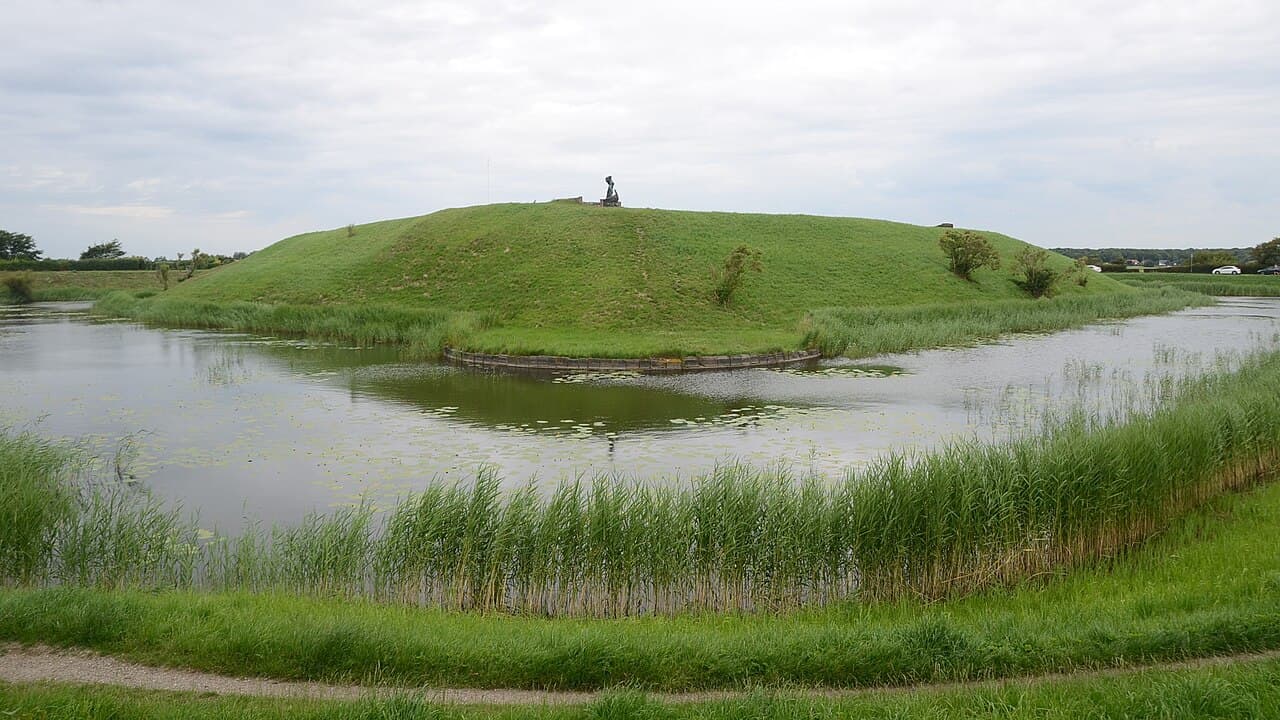
Riberhus Castle Ruins
Riberhus Castle Ruins stand as a testament to the rich medieval history of Ribe, Denmark. This historic site, located on a raised earthwork known as Slotsbanken, offers a glimpse into the strategic and administrative importance of the castle throughout the High Medieval period. Although only ruins remain today, the site preserves the memory of a royal fortress that played a crucial role in the governance and defense of southwestern Jutland for several centuries.
Archaeological evidence shows that the area around Slotsbanken was inhabited as early as the 10th century, though the castle itself was established later, in the 12th century. Historical sources confirm the presence of a royal castle in the early 1200s, serving as a residence for the bailiff or vassal appointed by the king to oversee the region. This position was vital for maintaining royal authority, collecting taxes, and managing the extensive Riberhus fief, which covered much of West Jutland up to Nymindegab.
Medieval origins and royal significance
The foundation of Riberhus Castle dates back to the early 12th century, likely under the reign of King Niels, who established it as a border fortress to protect Denmark's western frontier. Initially conceived as a defensive stronghold, the castle evolved into a royal residence and administrative center, regularly hosting monarchs and their officials.
In the mid-13th century, significant fortification efforts were undertaken, probably during the reign of King Eric V (Erik Klipping). These enhancements included expanding the castle's structures and strengthening its defenses, reflecting its growing importance within the kingdom. The earliest surviving mention of Riberhus appears in a royal charter circa 1320, issued by Christopher III, which exempted it from demolition orders applied to other Jutland castles, underscoring its strategic value.
Political shifts and ownership changes
Throughout the 14th century, Riberhus experienced shifts in ownership amid regional conflicts. In 1330, it was pawned to Gerhard III, Count of Holstein, a powerful noble with territorial ambitions. The castle returned to Danish royal control in 1383 under King Valdemar Atterdag, illustrating the contested nature of power in Jutland during this era.
Architectural features and defensive structures
While the exact original appearance of Riberhus Castle remains unknown, archaeological excavations have revealed key details about its construction. The castle consisted of multiple interconnected buildings arranged around a central courtyard, fortified by round towers at each corner equipped with cannons for defense. The thick stone walls and a surrounding moat created formidable barriers against attackers.
Entry to the castle was controlled through a gatehouse and a drawbridge, which spanned the moat. Excavations in 1792 uncovered remains of a gate with two parallel thick walls, likely serving as the main entrance. A defensive tower at the southern corner overlooked a channel connecting the moat to a nearby canal, enhancing the castle’s water defenses.
Reuse of materials and later modifications
In the 16th century, during renovations ordered by King Christian III, bricks salvaged from the nearby St. John’s Priory were incorporated into the castle’s construction. This reuse of religious building materials reflects the changing priorities following the Reformation in Denmark. Unfortunately, the castle’s military significance waned over time, particularly after the Swedish Wars in the 17th century, when it sustained damage and gradually fell into disrepair.
Decline and legacy
By the early 17th century, Riberhus Castle was in poor condition. The last royal governor, Otte Krag, served until 1658, after which the castle ceased to function as an administrative center. The dilapidated buildings were eventually dismantled, with stones repurposed for local church repairs and road construction in the 18th century, physically dispersing the castle’s remains into the surrounding community.
Today, only fragments of walls and the castle bank remain visible, surrounded by the restored moat filled with water, reminiscent of its original defensive design. The castle bank, approximately 8 meters high and measuring about 90 by 90 meters, preserves the footprint of this once formidable fortress.
Cultural significance and commemorations
Riberhus is closely linked to the story of Queen Dagmar, who was married to King Valdemar Sejr and is traditionally believed to have died at the castle in 1212 at the age of 23. This association has imbued the site with cultural and historical resonance in Danish heritage.
A bronze statue of Queen Dagmar, created by the renowned sculptor Anne Marie Carl-Nielsen and unveiled in 1913, stands at the southern corner of the castle bank. The statue depicts Queen Dagmar in front of a boat, symbolizing her journey to Ribe and commemorating her legacy.
Modern preservation efforts
Restoration work carried out in 1940-1941 focused on cleaning and refilling the moats to their historic water levels and restoring the castle bank to its approximate original height. These efforts have helped preserve the site as a cultural landmark and a tangible link to Denmark’s medieval past.
Visiting riberhus castle ruins
Visitors to Riberhus today can explore the castle bank and surrounding moats, which clearly outline the castle’s original defensive perimeter. Interpretive signage and the Queen Dagmar statue provide context to the site’s historical importance. Although only ruins remain, the location offers a compelling insight into medieval Danish castle architecture and royal history.
The site’s proximity to Ribe, one of Denmark’s oldest towns, makes it accessible for those interested in exploring the broader historical landscape of the region, including Ribe Cathedral and other medieval landmarks.
Frequently asked questions (FAQ)
- What is Riberhus Castle Ruins known for?
- Riberhus Castle Ruins is known for its historical significance as an important stronghold in Denmark during the Middle Ages. The site offers visitors a glimpse into the architectural style of the era and the strategic importance of Ribe in the region's history.
- When was Riberhus Castle originally built?
- Riberhus Castle was originally built in the late 12th century, making it one of the oldest fortifications in Denmark. It served various purposes over the centuries, including as a royal residence and military fortress.
- How do I get to Riberhus Castle Ruins?
- Riberhus Castle Ruins is easily accessible by foot from the center of Ribe, as it is located within the city limits. Visitors can also reach the site by car, with nearby parking options available for convenience.
- What are the opening hours for Riberhus Castle Ruins?
- Riberhus Castle Ruins is generally open to visitors year-round, with specific opening hours that may vary seasonally. It is advisable to check the official website or local resources for the most current hours before planning your visit.
- Can I enter the ruins of Riberhus Castle?
- While visitors can explore the site of Riberhus Castle Ruins, access to some areas may be limited due to preservation efforts. However, the surrounding grounds and the remains of the castle offer a fascinating insight into its historical context.
- Why is Riberhus Castle significant to Danish history?
- Riberhus Castle played a crucial role in the political and military landscape of Denmark during the Middle Ages, serving as a royal stronghold. Its ruins serve as a testament to the region's tumultuous history and the evolution of fortifications in Denmark.
- What are some nearby attractions to visit when at Riberhus Castle Ruins?
- Nearby attractions include the Ribe Viking Center and the charming old town of Ribe, which is known for its well-preserved medieval architecture. Visitors can also explore the Ribe Cathedral and enjoy local shops and cafes in the area.
- Is it possible to take guided tours at Riberhus Castle Ruins?
- Yes, guided tours may be available at Riberhus Castle Ruins, providing visitors with deeper insights into the history and architecture of the site. It is recommended to check in advance for tour availability and to book if necessary.
- What are the ticket prices for visiting Riberhus Castle Ruins?
- Entry to Riberhus Castle Ruins is typically free, allowing visitors to explore the site without a ticket fee. However, donations are appreciated to support ongoing preservation efforts and maintenance of the historical site.
Photo gallery

Information
Website
Visit websiteSources & official resources
Verify the information above using these authoritative references.
Loading map...
Visitor reviews
No reviews yet. Been here? Write the first review and help other travelers!
Write the first reviewVisited this castle? Share your experience
Your review helps other travelers and adds first-hand knowledge to our encyclopedia.



