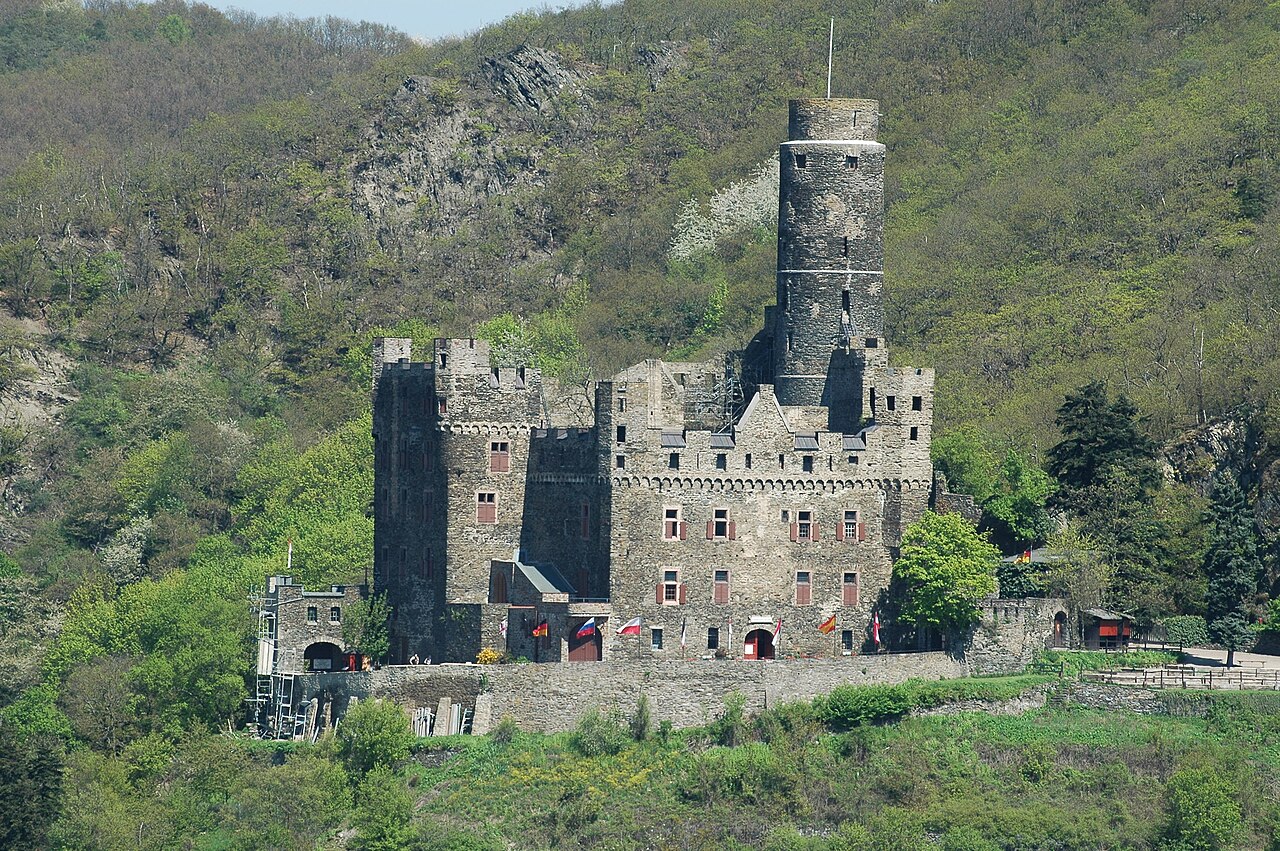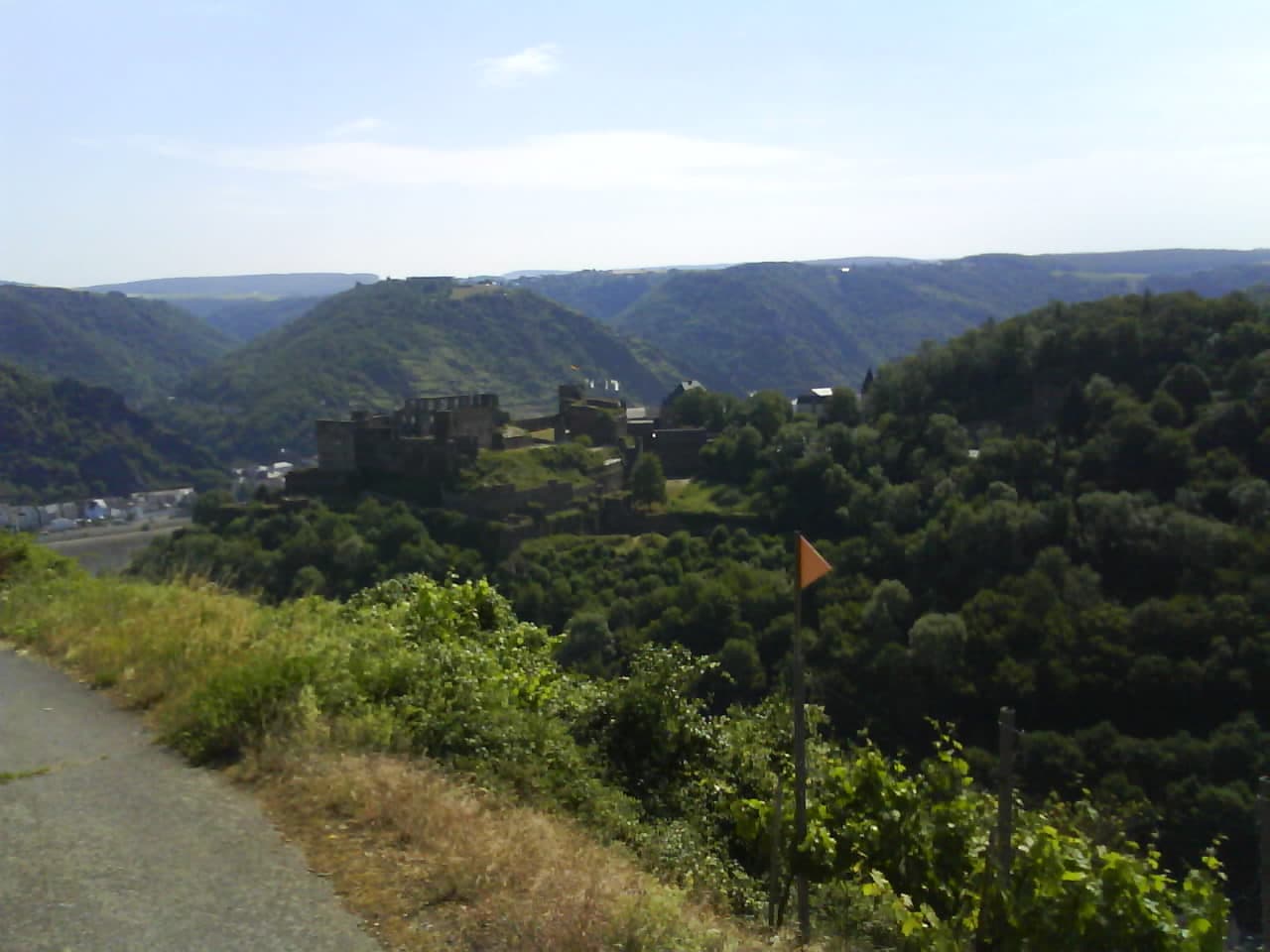
Rheinfels Castle
Rheinfels Castle stands as a monumental testament to medieval military architecture and noble power in the Upper Middle Rhine Valley. Located on a strategic ridge overlooking the left bank of the Rhine River in Sankt Goar, Germany, this hill castle was originally built in 1245 by Count Diether V of Katzenelnbogen to control river traffic and levy tolls. Over centuries, it evolved into the largest fortress overlooking the Rhine, covering an area five times larger than the present-day ruins.
The castle's significance is deeply intertwined with the history of the County of Katzenelnbogen, which split into Upper and Lower counties in the 13th century, with Rheinfels serving as the residence of the Lower County. The castle's early reputation for strength was cemented when it withstood a year-long siege in 1256 by the Rhenish Cities League, a feat that underscored its formidable defenses.
Medieval origins and architectural evolution
Between 1360 and 1370, under Count Wilhelm II of Katzenelnbogen, Rheinfels underwent extensive expansions, including the construction of a massive round bergfried or keep. This tower was notable for its extraordinary height of 54 meters, making it the tallest known bergfried in Germany during the 15th century. The bergfried's walls were an impressive 3.5 meters thick, with a diameter of 10.5 meters, and it was topped by a narrow round tower called the Butterfassturm.
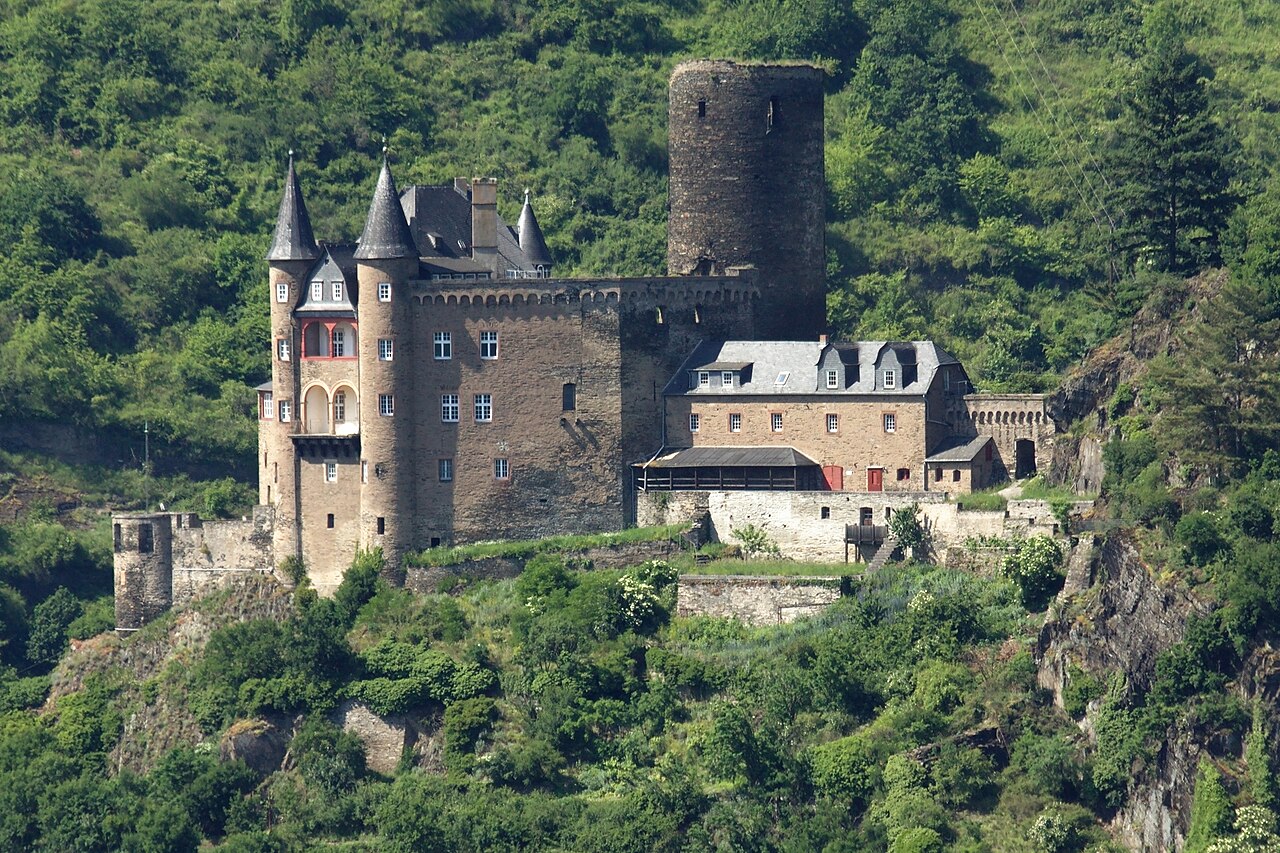
Simultaneously, on the opposite side of the Rhine, Burg Katz was constructed, creating a double toll system that enhanced the counts' control over river commerce. Rheinfels also became the cultural and administrative center of the Lower County, especially during the 15th century under Counts Johann IV and Philipp, who contributed to its architectural and social prominence.
Castle layout and key structures
Rheinfels Castle occupies a natural spur between the Rhine and the Gründelbachtal valley, with a complex layout reflecting centuries of construction phases. The main entrance is marked by a tall square clock tower or gate tower built around 1300, standing approximately 21 meters tall. Adjacent to the clock tower is the Darmstädter Bau, a three-story residential palas featuring Tudor-style pointed gables, which served as the noble living quarters.
A notable architectural marvel is the Große Keller or Great Cellar, constructed between 1587 and 1589. This vaulted cellar is the largest self-supporting cellar in Europe, measuring about 24 meters long and 16 meters wide and high. Its walls are up to four meters thick, capable of sheltering up to 400 people during sieges. Historically, it housed a massive masonry wine barrel with a capacity of approximately 180,000 liters, sealed with tallow and used until the mid-17th century.
The castle's inner courtyard once contained essential facilities such as stables, kitchens, a bakery, an herb garden, and a brewery, enabling it to sustain a large population during extended sieges. Remnants of these structures survive in varying states of ruin, offering insight into medieval castle life.
Fortification and military history
Rheinfels Castle was continuously fortified to meet evolving military challenges. Between 1657 and 1674, under Landgrave Ernst I of Hesse-Rheinfels, the castle was transformed into a formidable fortress with thick shield walls and artillery batteries, including the Hohe Batterie built around 1660. These enhancements were designed to resist the powerful artillery of the era, reflecting advances in military engineering during the High to Late Medieval periods transitioning into early modern fortification styles.
The castle's defensive prowess was notably demonstrated during the Nine Years’ War (1688–1697). In the winter of 1692-1693, a garrison of approximately 3,000 defenders successfully withstood a siege by 28,000 French troops under King Louis XIV. Despite heavy casualties, the defenders inflicted significant losses on the attackers and maintained control of the fortress, making Rheinfels the only stronghold on the Rhine's left bank to resist French advances at that time.
During the Thirty Years’ War and subsequent conflicts, the castle changed hands multiple times but remained a key military and administrative center under Hessian control. However, in 1758 during the Seven Years’ War, French forces captured Rheinfels without resistance due to overwhelming odds. Later, in 1794, it was handed over to the French Revolutionary Army, and between 1796 and 1797, the French systematically demolished much of the fortifications, including the iconic bergfried and several outer defenses.
Underground defenses and water supply
As part of its defensive strategy, Rheinfels features extensive mining galleries or tunnels excavated around 1600. These approximately 200 meters of tunnels were intended to be detonated beneath enemy forces during sieges, a sophisticated form of subterranean warfare. Though access to these galleries is now restricted, they remain a remarkable example of early modern military engineering.
The castle's water supply was secured by a deep well approximately 60 meters in depth, critical for sustaining the garrison and inhabitants during prolonged sieges. This well exemplifies the essential logistical planning of medieval fortress design.
Decline, restoration, and modern use
Following its destruction by French forces, Rheinfels fell into ruin. In 1812, the ruins were sold, and many stones were repurposed for construction projects such as the Ehrenbreitstein Fortress near Koblenz. To prevent further dismantling, Prince Wilhelm of Prussia acquired the site in 1843. Since 1925, ownership has rested with the town of Sankt Goar, which has overseen extensive restoration efforts in the 20th century, notably in the 1960s and 1990s.
Today, Rheinfels Castle is recognized as part of the UNESCO World Heritage Upper Middle Rhine Valley. Restoration has preserved much of the castle's outer walls, gate towers, and the remarkable Große Keller, which now serves as a venue for concerts and cultural events. The castle museum, housed in the former chapel, offers visitors detailed insights into the castle's history and architecture, including a model reconstruction of the original fortress.
Adjacent to the ruins, the Romantik Hotel Schloss Rheinfels operates since 1973, integrating hospitality with heritage. The castle grounds also feature the Rheinfelspfad, a nature trail that combines historical interpretation with local flora, including rare mosses, lichens, and Mediterranean plants introduced from a former noble garden.
Architectural materials and legacy
The castle was primarily constructed using local quartzite and slate sedimentary rocks from the Devonian period, materials chosen for their durability and availability. Though only about one-fifth of the original castle area remains, the ruins of Rheinfels Castle provide a vivid window into medieval and early modern fortress construction, noble life, and military history along the Rhine.
Its legacy as the largest fortress on the Rhine and its impressive history of resistance and adaptation make Rheinfels Castle a significant cultural and historical landmark in Germany and Europe.
Frequently asked questions (FAQ)
- How do I get to Rheinfels Castle in Sankt Goar?
- Rheinfels Castle is located above the town of Sankt Goar on the left bank of the Rhine River. It is accessible by car, public bus, or ferry from the opposite bank, with parking available near the castle entrance.
- What are the opening hours for visiting Rheinfels Castle?
- The castle grounds, including the museum and cellar, are generally open daily from 10:00 to 18:00, with seasonal variations. It is advisable to check current hours before planning your visit.
- Is there an admission fee to enter Rheinfels Castle?
- Yes, there is an admission fee to access the museum and cellar areas, typically around €5 for adults and reduced rates for children and groups. The castle grounds outside may be accessible for free.
- What can I see inside Rheinfels Castle?
- Visitors can explore the restored gate tower, the Darmstadt Building, the Große Keller (Great Cellar), and the castle museum housed in the former chapel. Exhibits include historical artifacts, a model reconstruction, and information on medieval life and military history.
- Can I stay overnight at Rheinfels Castle?
- Yes, the Romantik Hotel Schloss Rheinfels operates adjacent to the castle ruins, offering luxury accommodations and wellness facilities, allowing guests to experience the castle's historic ambiance overnight.
- Why is Rheinfels Castle historically significant?
- Rheinfels Castle is historically significant as the largest fortress on the Rhine River and for its successful defense against French sieges, notably in 1692 during the Nine Years’ War. It also played a key role in regional toll collection and medieval politics.
Photo gallery

Information
Sources & official resources
Verify the information above using these authoritative references.
Loading map...
Visitor reviews
No reviews yet. Been here? Write the first review and help other travelers!
Write the first reviewVisited this castle? Share your experience
Your review helps other travelers and adds first-hand knowledge to our encyclopedia.