Katz Castle
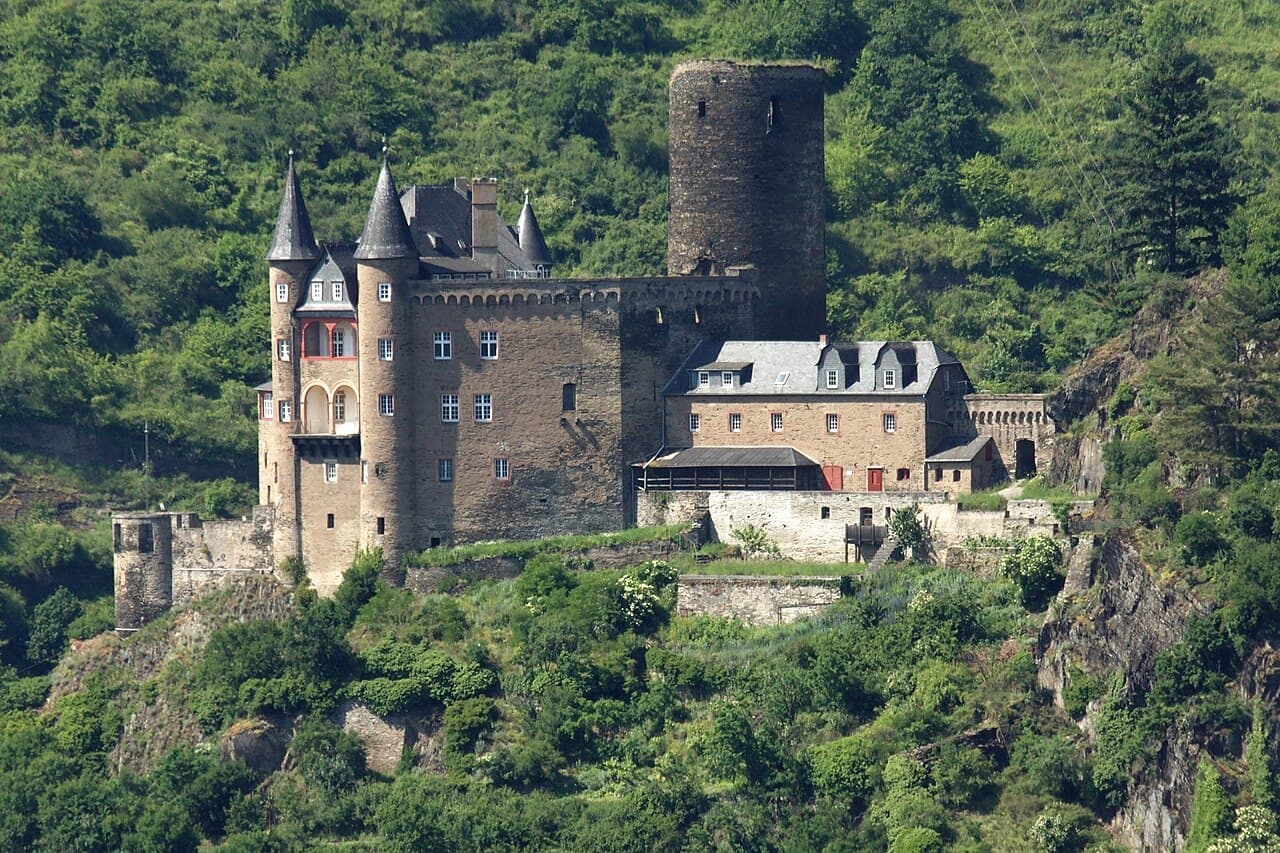
Katz Castle is a striking medieval fortress perched on a steep hillside above the town of Sankt Goarshausen in the Rhineland-Palatinate region of Germany. Built around 1371 by Count Wilhelm II of Katzenelnbogen, this hill castle was strategically designed to control and protect the vital Rhine River trade route. Its commanding position on a rocky ridge allowed it to serve as a bastion and military base in conjunction with the nearby Rheinfels Castle, forming a fortified bulwark that enforced toll collection along the river. The castle’s location also provided an extended view towards the famous Loreley rock, an important vantage point for overseeing salmon fishing rights and river traffic.
Medieval origins and strategic significance
The castle was originally named Neukatzenelnbogen, reflecting its founders, the Counts of Katzenelnbogen, a prominent noble family in the region. Over time, the name was shortened to Katz, which paired symbolically with the nearby Maus Castle (meaning "Mouse Castle") across the river in the Electorate of Trier. This proximity and name pairing earned the two castles the nickname "cat and mouse," highlighting their rivalry and strategic opposition.
Constructed in the late medieval period, Katz Castle was built primarily as a fortified military stronghold to protect Rheinfels Castle and enforce tolls on passing river traffic. Its location on the mountain ridge made it nearly impregnable from the valley below, a deliberate choice to maximize defense. The castle’s key defensive features included a bergfried (a tall keep or donjon) raised to approximately 40 meters (about 197 feet) to maintain visual contact with Reichenstein Castle nearly two miles away. This allowed for coordinated defense and communication along the Rhine corridor.
Architectural features and fortifications
Katz Castle was designed with a compact layout adapted to the limited space on the rocky slope. The main entrance was protected by a deep neck ditch carved directly into the rock, which served as a formidable obstacle to attackers. A drawbridge once spanned this ditch, controlling access to the castle. In front of the entrance stood a triangular bastion, adding an extra layer of defense.
The castle’s residential buildings originally rose three stories high and were integrated with the defensive walls. The bergfried tower was the dominant feature, serving both as a lookout and a last refuge during sieges. The castle also featured a shield wall on the uphill side to protect against assault from higher ground, and a zwinger or outer ward, which was a narrow enclosed area between two walls designed to trap attackers.
Historical conflicts and transformations
After the extinction of the Katzenelnbogen male line in 1479, Katz Castle passed to the Landgraves of Hesse through marriage. This inheritance sparked prolonged disputes between the Hesse-Kassel and Hesse-Darmstadt branches, leading to multiple sieges and partial destruction of the castle. Notably, the castle was besieged in 1626 and 1647 during the Thirty Years' War, suffering significant damage.
In 1692, French forces under King Louis XIV inflicted further damage during the War of the Palatine Succession. The castle was again captured by the French in 1758 during the Seven Years’ War but was returned in 1763 after the conflict ended. Despite repairs made around 1800, Napoleon ordered the demolition of the castle’s outer defenses in 1806, leaving it largely in ruins.
19th and 20th century restorations and uses
In 1896, the castle was acquired by District Administrator Ferdinand Berg, who initiated a reconstruction aimed at restoring the castle as closely as possible to its original medieval design. The reconstruction was carried out by the Cologne firm Schreiterer & Below, which replaced much of the medieval structure with a palace-style residence. Only fragments of the original bergfried, the shield wall, and the zwinger were preserved.
During the early 20th century, Katz Castle served various functions. It operated as a training camp for the Reich Labour Service in the 1930s. After World War II, from 1946 until 1951, it was used as a local high school, the Institut Hofmann, including boarding facilities. Later, it functioned as a social services recreation center until it was closed in 1987 due to fire safety concerns.
Modern ownership and cultural significance
Since 1989, Katz Castle has been privately owned by a Japanese proprietor who intended to convert it into a hotel, although this project has not been fully realized. The castle remains closed to the public but continues to dominate the landscape of the Upper Middle Rhine Valley, a region recognized as a UNESCO World Heritage Site since 2002.
Today, Katz Castle stands as a testament to the complex history of medieval fortifications along the Rhine. Its combination of military architecture, strategic location, and layered history of conflict and restoration make it an important cultural landmark in the Rhineland-Palatinate. Though much of the original medieval fabric was lost during 19th-century reconstruction, the castle’s silhouette and remaining structures continue to evoke its historic role as a guardian of the Rhine tolls and a symbol of regional power struggles.
Architectural legacy and preservation challenges
The castle’s surviving medieval elements, including the bergfried ruins and defensive walls, provide valuable insight into late medieval military architecture. The deep neck ditch and bastion remain notable features illustrating the castle’s defensive ingenuity. However, the extensive 19th-century rebuilding has complicated efforts to preserve authentic medieval fabric, blending historical reconstruction with neo-medieval stylistic elements.
Its position on a steep hillside poses ongoing challenges for conservation, requiring careful maintenance to prevent erosion and structural damage. Despite these challenges, Katz Castle’s striking presence continues to attract interest from historians, architects, and visitors who appreciate its historical and architectural significance, even though it is not open for public tours.
Frequently asked questions (FAQ)
- How do I get to Katz Castle?
- Katz Castle is located in the picturesque Rhineland-Palatinate region of Germany. The easiest way to reach the castle is by car, with parking available nearby, or by taking a train to the nearest station and then a short bus ride or walk to the castle.
- What is the historical significance of Katz Castle?
- Katz Castle, built in the 14th century, served as a strategic fortress guarding the Rhine River. Its rich history includes being a residence for noble families and playing a role in various regional conflicts during the Middle Ages.
- When was Katz Castle last renovated?
- Katz Castle underwent significant renovations in the late 20th century, restoring many of its original features. These efforts have made the castle accessible to visitors while preserving its historical charm and architectural integrity.
- Can I enter Katz Castle?
- Yes, visitors are welcome to explore Katz Castle. Guided tours are available, allowing you to learn about its history and architecture while enjoying stunning views of the surrounding landscape.
- Why is Katz Castle a popular tourist attraction?
- Katz Castle is popular for its stunning views of the Rhine Valley and its well-preserved medieval architecture. The combination of history, scenic beauty, and engaging tours makes it a must-visit for tourists and history enthusiasts alike.
- Is it possible to visit Katz Castle year-round?
- Yes, Katz Castle is open to visitors year-round, though hours may vary by season. It's recommended to check the official website for the most current opening hours and any seasonal events that may enhance your visit.
- What are the ticket prices for visiting Katz Castle?
- Ticket prices for Katz Castle are reasonably priced, with discounts available for students and seniors. Children under a certain age often enter for free, making it an affordable outing for families.
- What is the best time to visit Katz Castle?
- The best time to visit Katz Castle is during the spring and early fall when the weather is mild, and the surrounding landscapes are particularly beautiful. Additionally, visiting during weekdays can help you avoid crowds and enjoy a more intimate experience.
- Are there any nearby attractions to explore after visiting Katz Castle?
- Yes, there are several nearby attractions, including the charming towns of St. Goar and Bacharach, known for their medieval architecture and scenic river views. Additionally, the Rhine Gorge, a UNESCO World Heritage site, offers beautiful hiking trails and vineyards to explore.
Photo gallery

Information
Website
Visit websiteSources & official resources
Verify the information above using these authoritative references.
Loading map...
Visitor reviews
No reviews yet. Been here? Write the first review and help other travelers!
Write the first reviewVisited this castle? Share your experience
Your review helps other travelers and adds first-hand knowledge to our encyclopedia.