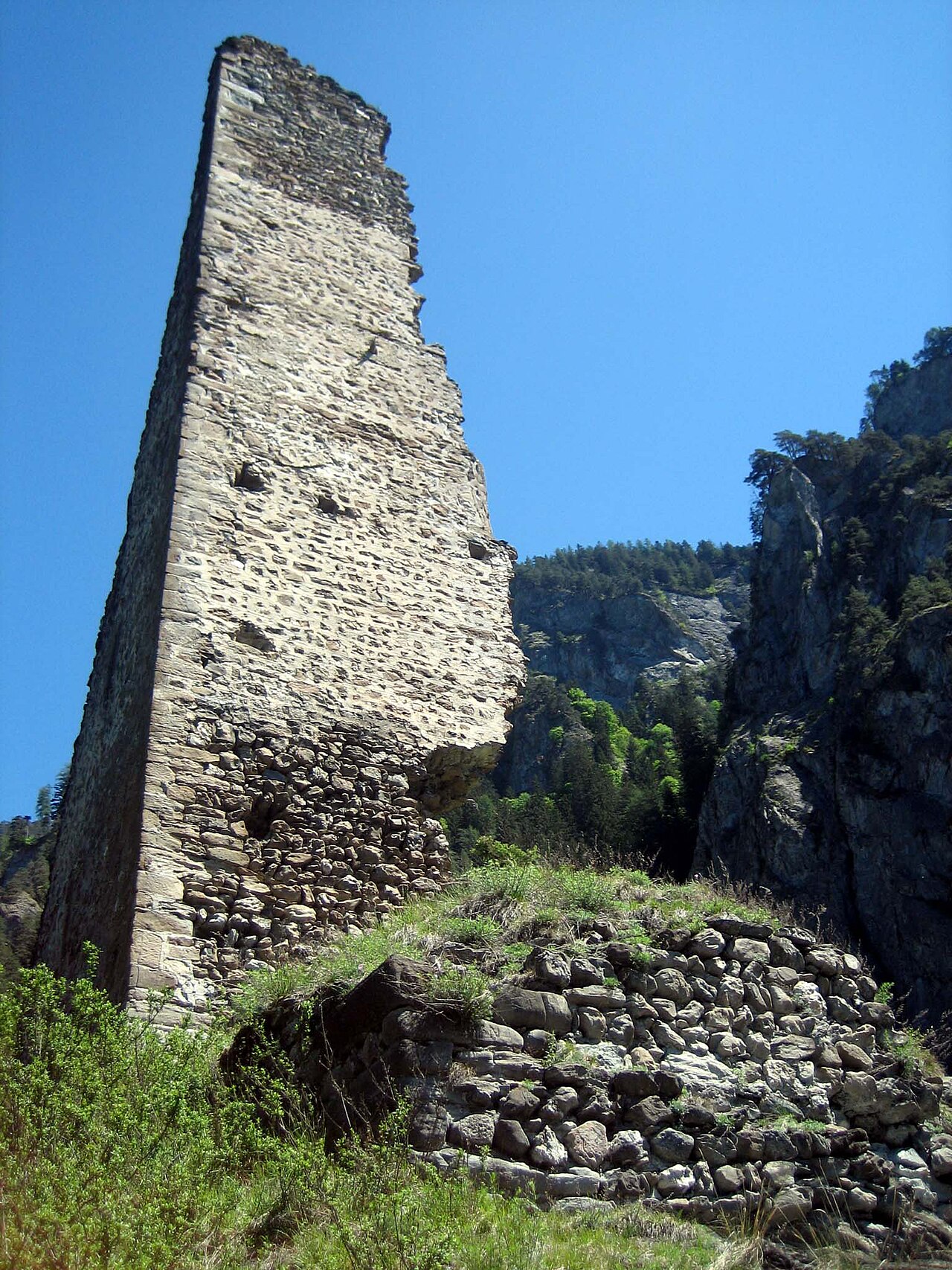
Innerjuvalt Castle
Innerjuvalt Castle stands as a remarkable example of a high medieval hill castle strategically perched on a narrow rocky outcrop above the entrance to the Domleschg Valley in the municipality of Rothenbrunnen, Switzerland. Constructed around 1250 by the noble Freiherr von Juvalt family, this castle played a significant role in controlling the valley and served as a fortified residence for the family for nearly two centuries. Its location about two kilometers southeast of the older Hochjuvalt Castle reflects a deliberate choice for enhanced defense and oversight of the surrounding landscape.
The castle complex is divided into two main sections: the upper castle built on the rocky plateau and the lower castle situated at the foot of the cliff. The upper castle was initially constructed as a two-story palas, likely used to house workers during the early phases of construction. Around 1273, significant expansions included the addition of a two-story main tower with a high entrance, a defensive architectural feature designed to hinder direct assault. Adjacent to this tower, a residential wing was built on the northeast side, completing the primary living quarters.
Architectural features and defensive design
The castle's architecture reflects the practical and strategic needs of the high medieval period. The upper castle benefits from natural defenses, with steep cliffs protecting most sides, while a stone curtain wall was constructed along the lower western side of the outcrop. This wall enclosed essential facilities including a bakery and a cistern, the latter crucial for water storage during sieges. The main tower was further enhanced in the late 15th century by adding a third story and a defensive gallery along its east and north sides, improving vantage points for surveillance and defense.
The lower castle featured a ring wall with a southern gatehouse guarding entry. A large palas or residential hall was built along this wall, while the northern courtyard was terraced for agricultural use. Today, only fragments of the lower castle remain, notably a surviving wall segment approximately twenty meters long and four meters high.
Historical context and family legacy
Innerjuvalt Castle's history is closely tied to the fortunes and internal dynamics of the von Juvalt family. In 1342, family members Albrecht and Bertram von Juvalt settled inheritance disputes, with Bertram relinquishing his claim to Innerjuvalt. Later, in 1372, the estate was divided between Eglof and Friedrich von Juvalt, with Eglof receiving the castle along with its meadows, mill, and vineyards. By 1382, Eglof's wife Ursula was recorded as residing at the castle.
In the early 15th century, the castle remained a significant family seat. In 1423, Rudolf von Juvalt was mandated to continuously reside there, underscoring its strategic importance. However, by around 1440, the family shifted residence to the more accessible lower castle, reflecting changing priorities or practical considerations. Despite this move, defensive improvements continued, including the late 15th-century addition of the tower's third story.
Ownership changed in 1462 when Barbara von Juvalt sold Innerjuvalt to her brother-in-law Pedrutt von Wannis. The castle was abandoned a few decades later and was described as a ruin by 1570. The decline of Innerjuvalt reflects broader regional shifts in military technology, residence preferences, and political power during the late medieval period.
Archaeological excavations and restoration efforts
Interest in Innerjuvalt Castle was revived in the late 20th century. Excavations took place in 1980, 1982, and 1990, uncovering significant artifacts such as two 15th-century helmets found in the cistern area, highlighting the castle's military role during its final active centuries. These archaeological efforts provided valuable insights into the castle's construction phases, daily life, and defensive features.
Beginning in 1979, the local communities of Domleschg and the Burgenvereine Graubünden undertook restoration projects. These included installing a new roof on the main tower and repairing structural elements to stabilize the ruins. Today, the castle grounds are accessible to visitors, and the restored tower is available for rent by small groups, offering a unique historical experience.
Access and visitor experience
Visitors to Innerjuvalt Castle reach the site via a steep, narrow path ascending through forested terrain to an elevation of approximately 780 meters above sea level. The journey itself reflects the castle's original defensive positioning, emphasizing its commanding view over the Domleschg Valley. The open grounds allow exploration of the upper castle's remains, including the tower, residential wing, and defensive walls.
While the lower castle has largely vanished, the surviving upper castle ruins provide a tangible connection to the region's medieval past and the architectural ingenuity of the von Juvalt family. The site offers an evocative glimpse into the life of a high medieval noble family and their strategic efforts to control and protect their domain.
Frequently asked questions (FAQ)
- How do I get to Innerjuvalt Castle?
- Innerjuvalt Castle is accessible via a steep, narrow hiking path through forested terrain near Rothenbrunnen. Visitors should be prepared for a moderate climb to reach the castle at about 780 meters elevation.
- What is the historical significance of Innerjuvalt Castle?
- Innerjuvalt Castle was built around 1250 by the noble von Juvalt family to control the Domleschg Valley. It served as a fortified residence and administrative center during the high medieval period, reflecting strategic military and familial importance.
- Can I visit the tower at Innerjuvalt Castle?
- Yes, the restored tower at Innerjuvalt Castle is open to visitors and can also be rented by small groups for private events, offering a unique historical setting.
- When was Innerjuvalt Castle built and by whom?
- The castle was constructed around 1250 by the Freiherr von Juvalt family, a noble lineage that played a key role in the region's medieval history.
- Is there an entrance fee to visit Innerjuvalt Castle?
- Visiting Innerjuvalt Castle is free of charge. The site is open daily from sunrise to sunset, allowing visitors ample time to explore the ruins and surrounding grounds.
Information
Opening hours
Open daily, sunrise to sunset
Ticket prices
Free
Current owner
Communities of Domleschg and Burgenvereine Graubünden
Loading map...
Visitor reviews
No reviews yet. Been here? Write the first review and help other travelers!
Write the first reviewVisited this castle? Share your experience
Your review helps other travelers and adds first-hand knowledge to our encyclopedia.