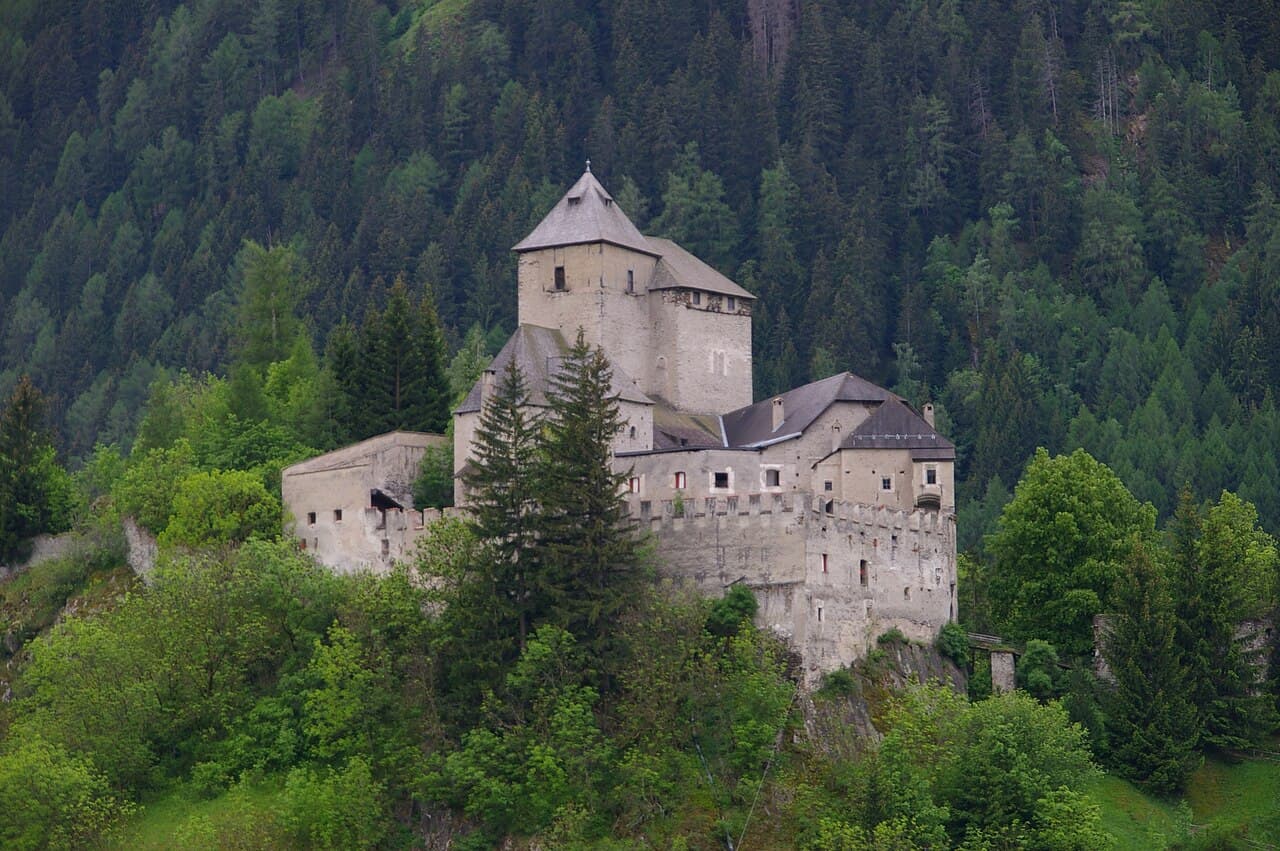
Reifenstein Castle
Reifenstein Castle, also known in Italian as Castel Tasso, stands as one of the most remarkable and well-preserved medieval hill castles in South Tyrol, northern Italy. First documented in the early 12th century, around 1100–1110 AD, this fortress was initially established as a strategic stronghold to oversee and control the vital Alpine trade routes crossing the region. Built atop a rocky hill approximately 30 meters high and nearly 980 meters above sea level, Reifenstein Castle commands panoramic views of the Wipptal valley, underscoring its military and administrative significance during the High Medieval period.
The castle's origins trace back to its initial enfeoffment to the Lords of Stilves following its first mention as a fief under the Bishopric of Brixen. Over the centuries, Reifenstein passed through the hands of several noble families, including the counts of Lechsgemünd and the knights of Trautson, before coming under the ownership of the Lords of Säben in the early 15th century. This succession of ownership reflects the complex feudal dynamics and shifting allegiances typical of the region during the Middle Ages.
Architectural features and layout
The bergfried and residential towers
The castle's central feature is its imposing bergfried or keep, a roughly square tower measuring approximately 9 by 8.5 meters with walls 2.2 meters thick. Dating from the 12th century, this tower originally stood taller than its current 22 meters, with its present pyramid-shaped roof added during restoration efforts in 1899. Adjacent to the bergfried is a substantial residential tower about 20 meters high and three stories tall, measuring 10.5 by 15 meters. This tower served as the main living quarters and is integral to the castle's core structure.
Defensive structures and fortifications
Reifenstein Castle is fortified by three concentric baileys or outer wards, a defensive design that enhanced its security. The innermost walls remain well preserved, while the outer two show signs of gradual decay. The first bailey is protected by a rock-cut half-moat and a drawbridge at the main gate, emphasizing the castle's defensive readiness. The second bailey features a Gothic-style gate equipped with a portcullis, arrow slits, and partial battlements. A half-round tower at the northwest corner provided flanking fire to defend the walls, illustrating the castle's strategic military architecture.
Interior rooms and medieval furnishings
The castle's interior boasts a palace complex with ten restored rooms that retain their medieval wooden interiors. Among these are 12th-century sleeping chambers originally used by soldiers and servants, a 13th-century kitchen with an open fireplace, and a 12th-century great hall that served as a chapter room. The great hall is adorned with late Gothic painted mountain pine panels, showcasing exquisite craftsmanship from the period. The Green Hall is particularly notable for its late Gothic frescoes in shades of green and a magnificent late Gothic wooden latticework, making it a highlight of the castle's artistic heritage.
Additional features: dungeon, chapel, and amenities
Defensive and administrative functions are further evidenced by the presence of a dungeon approximately 8 meters deep located in the tower's cellar, a courtroom, and a wooden dansker (a projecting latrine) on the northwest wall. The castle complex also includes the small St. Zeno chapel, remodeled in Baroque style in 1660 but retaining historical significance due to archaeological finds of Bavarian wooden coffins dating from the 4th to 8th centuries. These ancient burial sites suggest the area held religious importance long before the castle's construction.
Historical significance and ownership
Feudal origins and noble families
Reifenstein Castle's history is deeply intertwined with the noble families of the region. Initially held by the Lechsgmünd counts and then the Lords of Stilves, the fortress was a symbol of feudal power and territorial control. The castle's name "Reifenstein" was adopted by the Lords of Stilves after they began expanding the structure. By the early 15th century, the Lords of Sabiona took possession, maintaining the castle's role as a regional stronghold.
Teutonic order period
A pivotal moment in Reifenstein's history occurred in 1470 when Archduke Sigismund of Austria sold the castle to the Teutonic Order, a military and religious organization. The Order fortified and expanded Reifenstein, using it as a commandery for over three centuries. During this period, the castle was never captured or destroyed, underscoring its strategic importance and robust defenses. The Teutonic Order's tenure ended with secularization in 1813.
Modern ownership and preservation
After the dissolution of the Teutonic Order, the castle was acquired by the Thurn und Taxis family from Regensburg, who remain its owners to this day. The family played a significant role in maintaining the castle's condition, preserving its medieval character. In the 1930s, the castle's name was Italianized to "Castel Tasso" during the Italianization policies of the period.
Cultural and archaeological importance
Reifenstein Castle is not only an architectural gem but also a site of considerable archaeological interest. The discovery of Bavarian tree trunk coffins near the St. Zeno chapel points to early medieval burial practices dating from the 4th to 8th centuries, indicating the area's longstanding sacred significance. The castle's uninterrupted preservation, having never been destroyed or taken in battle, makes it a rare example of a medieval fortress that retains original features such as portcullis gates, torture chambers, and subterranean dungeons.
Today, visitors can explore ten rooms within the castle, all in excellent condition, including the Green Hall with its ornate Gothic decorations and the great hall adorned with mountain pine panels. The castle's stepped battlements and embrasures remain prominent, illustrating its defensive military architecture. Reifenstein Castle stands as a testament to the region's medieval heritage and the evolution of castle construction in the Alpine area.
Frequently asked questions (FAQ)
- What is the historical significance of Reifenstein Castle?
- Reifenstein Castle, built in the 12th century, is a remarkable example of medieval architecture in the South Tyrol region of Italy. It served as a stronghold for the Counts of Reifenstein and played a significant role in the territorial disputes of the time.
- When was Reifenstein Castle built?
- Reifenstein Castle was constructed in the early 12th century, specifically around 1130. Its strategic location and robust design made it an important defensive structure throughout its history.
- Can I visit Reifenstein Castle?
- Yes, Reifenstein Castle is open to the public, allowing visitors to explore its well-preserved structures and stunning views of the surrounding landscape. Guided tours are available to enhance your experience and provide deeper insights into its history.
- What are the opening hours for Reifenstein Castle?
- Reifenstein Castle typically opens from April to October, with hours varying by season. It is advisable to check the official website or contact the castle directly for the most current information regarding specific visiting hours.
- Is it possible to access Reifenstein Castle by public transport?
- Yes, Reifenstein Castle is accessible by public transport, with regular bus services connecting nearby towns. From the bus stop, it is a short walk to the castle, making it convenient for visitors traveling without a car.
- What is the best time to visit Reifenstein Castle?
- The best time to visit Reifenstein Castle is during the spring and early autumn months when the weather is mild and the surrounding scenery is at its most beautiful. Additionally, visiting during these seasons helps you avoid the summer tourist crowds.
- Are there ticket prices for entering Reifenstein Castle?
- Yes, there is a small entrance fee for visiting Reifenstein Castle, which helps support its maintenance and preservation. Ticket prices may vary for adults, children, and senior citizens, so be sure to check the official site for the latest information.
- What nearby attractions can I explore while visiting Reifenstein Castle?
- While visiting Reifenstein Castle, you can also explore the nearby town of Freienfeld, known for its charming streets and local shops. Additionally, the beautiful landscapes of the Ahrntal Valley and the nearby hiking trails offer numerous outdoor activities for nature enthusiasts.
Photo gallery

Information
Website
Visit websiteSources & official resources
Verify the information above using these authoritative references.
Loading map...
Visitor reviews
No reviews yet. Been here? Write the first review and help other travelers!
Write the first reviewVisited this castle? Share your experience
Your review helps other travelers and adds first-hand knowledge to our encyclopedia.



