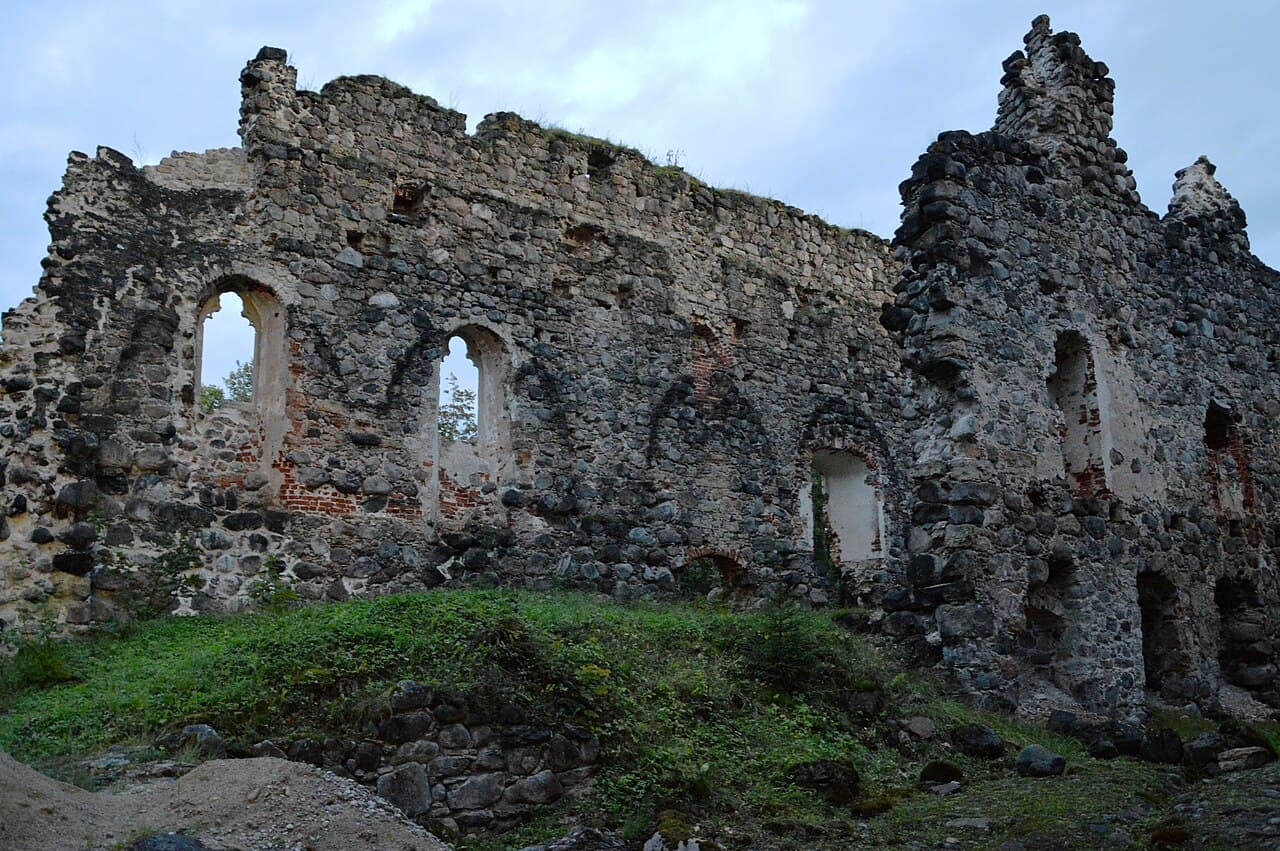
Rauna Castle ruins stand as a significant historical monument in Rauna, Latvia, representing the principal residence of the Archbishopric of Riga during the High Medieval period. This hill castle, strategically perched on a steep elevation overlooking the Rauna River valley, served as a religious, administrative, and military stronghold for centuries. Its origins trace back to the 13th century, with the first documented mention in 1381, though archaeological and historical evidence suggests construction began earlier, possibly around 1262 under the auspices of Archbishop Albert Suerbeer or his successors.
The historical significance of Rauna Castle
Rauna Castle was more than just a fortress; it was a center of ecclesiastical power and regional governance within the Riga Archbishopric. The castle's location was chosen for its commanding view of a vital trade route linking Riga and Pskov, underscoring its strategic importance. Over time, the castle became the nucleus of a small settlement that evolved into the modern village of Rauna, reflecting the castle's influence on local development.
Throughout the 14th to 16th centuries, Rauna Castle was embroiled in the complex power struggles of the Baltic region. It frequently changed hands between the Archbishopric of Riga and the Livonian Order, a military-religious order exerting territorial control. Notably, the castle hosted significant ecclesiastical meetings, including one in 1521 where Baltic bishops discussed early church reforms inspired by Martin Luther’s ideas.
The castle suffered considerable damage during the Livonian War (1558–1582) and later the Second Northern War (1655–1660). It was captured by Russian forces under Ivan IV in 1577 but was reclaimed by Polish-Lithuanian and Swedish troops. The Swedish king Karl XI ordered the demolition of the castle’s fortifications in 1683, leading to its decline and eventual abandonment as a military site.
Architectural features and construction
Rauna Castle exemplifies the characteristics of a High Medieval hill castle with a complex defensive system adapted to its topography. The castle is situated approximately 130 meters above sea level, with steepened slopes enhancing its natural defenses. Surrounding the castle were moats, artificial ponds, and earthworks including ramparts and a zwinger, a narrow enclosed area designed to trap attackers.
The core of the castle is a U-shaped convent house forming a roughly rectangular compound about 47.5 by 35.7 meters. The three wings are connected by a thick wall with an integrated main gate on the northeast side. Exterior walls reach about 1.8 meters in thickness, built using rough fieldstones bonded with lime mortar for interior walls and carefully dressed stone blocks for the exterior upper walls. Brickwork appears in later construction phases, particularly in vault ribs and decorative elements.
Within the convent house, the courtyard was originally surrounded by a wooden cloister, later replaced in the early 16th century by a two-story stone gallery with vaulted ceilings supported by ribbed arches. The ground floor housed functional spaces such as kitchens and cellars, while the upper floor contained representative rooms including a two-bay chapel, a chapter hall with portraits of 24 bishops and archbishops, two refectories, and dormitories including the archbishop’s private chambers. Large windows framed with carved limestone enhanced the prestige of these rooms.
A notable defensive feature is the rectangular tower in the northwest corner of the west wing, partially preserved today, and the original main gate protected by a portcullis similar to that of Kuressaare Castle, providing formidable security.
Outer bailey and additional defenses
After 1418, the castle’s defenses expanded to include an outer bailey enclosed by a robust wall with several large artillery towers, both round and semi-circular. The most prominent was the "Long Kaspar" tower, with a foundation about seven meters in diameter, located in the northeast corner. Archaeological excavations in the 1990s documented another semi-circular tower with walls over two meters thick constructed from limestone.
The outer bailey contained essential service buildings such as stables, workshops, dairies, and living quarters for knights and servants. These were modest, single-story structures with simple gable roofs, emphasizing functional support over comfort. The main entrance was distinctive, featuring an underground passage beneath the outer eastern wall, enhancing security and control.
Decline, destruction, and preservation efforts
The castle’s decline began with the Livonian War and accelerated during the Second Northern War, when it sustained severe damage. The Swedish king’s order in 1683 to demolish defensive structures led to the loss of most towers and fortifications. Subsequently, the castle was abandoned militarily and gradually fell into ruin, with locals repurposing stones for other constructions.
In the 20th century, archaeological excavations led by Professor Fratzis Balodis uncovered significant aspects of the castle’s history and architecture. The site also witnessed tragic events during the Estonian War of Independence and World War II, including executions carried out by Latvian collaborators.
Since Latvia's independence and integration into the European Union, preservation and restoration initiatives have been undertaken to stabilize and interpret the ruins. A partial restoration of one tower includes a new roof and a multi-level exhibition presenting the castle’s archaeological findings and history. This tower also offers panoramic views connecting visitors to the castle’s historic landscape.
Rauna Castle’s cultural and architectural legacy
Rauna Castle remains an important cultural heritage site in Latvia, reflecting the architectural and historical evolution of ecclesiastical fortifications in the Baltic region. Its combination of military, administrative, and religious functions illustrates the multifaceted role of medieval castles beyond mere defense.
The castle’s surviving structures, including thick stone walls, vaulted galleries, and defensive towers, provide valuable insights into High Medieval castle architecture. The presence of intricate vaulted ceilings, such as the star-shaped vault in the chapter hall, exemplifies the transition from wooden to stone construction and the influence of Gothic architectural elements in ecclesiastical buildings.
Today, Rauna Castle ruins attract visitors interested in medieval history, architecture, and archaeology. The site’s exhibitions and preserved features offer a tangible connection to the past, fostering appreciation for Latvia’s rich cultural heritage and the complex history of the Baltic region.
Frequently asked questions (FAQ)
- What is the historical significance of Rauna Castle Ruins?
- Rauna Castle Ruins date back to the 13th century and were constructed by the Livonian Order. This medieval fortress played a crucial role in the region's defense and trade, making it an important site in Latvian history.
- When was Rauna Castle originally built?
- Rauna Castle was built in the early 13th century, specifically around 1285. It was part of the Livonian Order's network of fortifications during the period of the Northern Crusades.
- Can I visit Rauna Castle Ruins year-round?
- Yes, Rauna Castle Ruins are open to visitors throughout the year. However, the best time to visit is during the warmer months, from May to September, when the weather is pleasant for outdoor exploration.
- What are the opening hours for Rauna Castle Ruins?
- Rauna Castle Ruins are typically accessible from 9 AM to 6 PM during the summer months. It’s advisable to check local resources for any seasonal changes in opening hours.
- Is there an entrance fee to visit Rauna Castle Ruins?
- Visiting Rauna Castle Ruins is free of charge, allowing everyone to explore this historical site without any financial barrier. Donations to help with the preservation of the ruins are appreciated.
- How do I get to Rauna Castle Ruins?
- Rauna Castle Ruins are located in the town of Rauna, which is accessible by car or public transport from major Latvian cities. The site is a short walk from the town center, making it convenient for visitors.
- Are there any nearby attractions to visit while at Rauna Castle?
- Yes, nearby attractions include the Rauna Church, known for its stunning architecture, and the picturesque Rauna Nature Reserve. Both sites offer additional opportunities for exploration and enjoyment of the local culture.
- Is the site accessible for individuals with mobility challenges?
- The ruins may present some challenges for individuals with mobility issues due to uneven terrain and the nature of the site. It is recommended for visitors to assess their comfort with outdoor walking before visiting.
- What architectural features should I look for at Rauna Castle Ruins?
- At Rauna Castle Ruins, you can observe remnants of fortified walls, towers, and a unique layout that reflects medieval military architecture. The ruins give insight into the construction techniques and defensive strategies of the time.
Photo gallery

Information
Website
Visit websiteSources & official resources
Verify the information above using these authoritative references.
Loading map...
Visitor reviews
No reviews yet. Been here? Write the first review and help other travelers!
Write the first reviewVisited this castle? Share your experience
Your review helps other travelers and adds first-hand knowledge to our encyclopedia.


