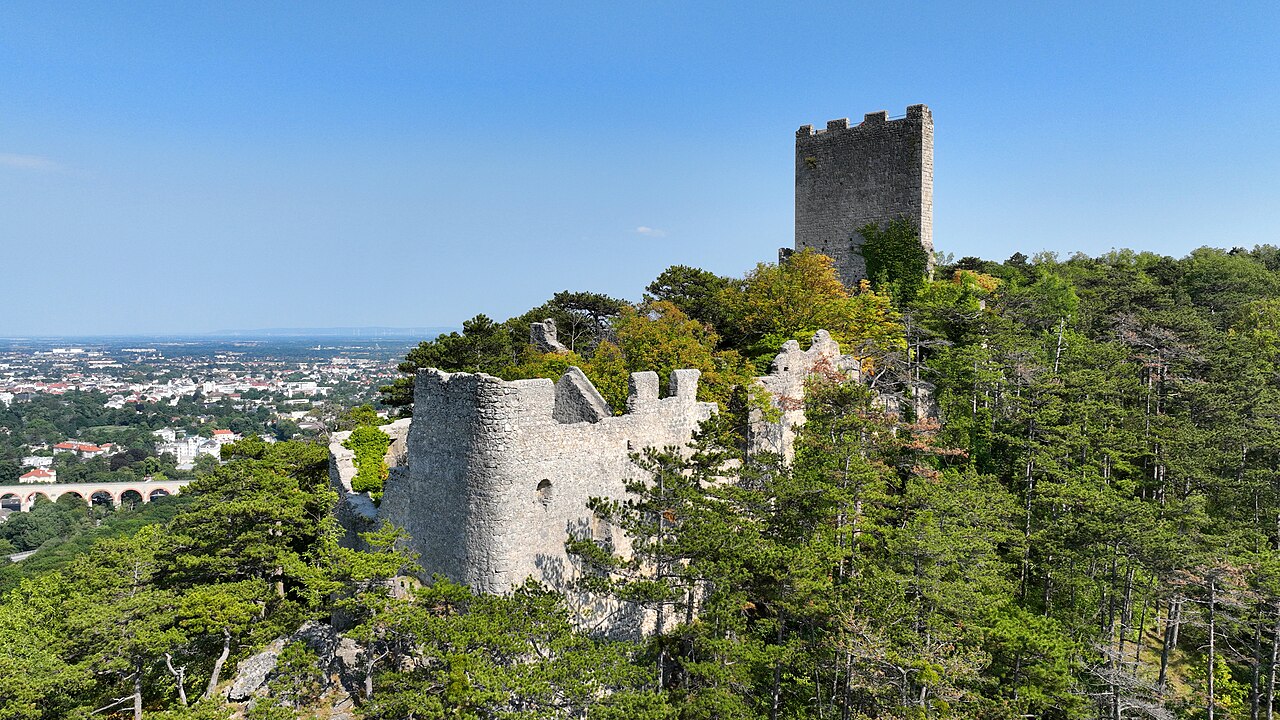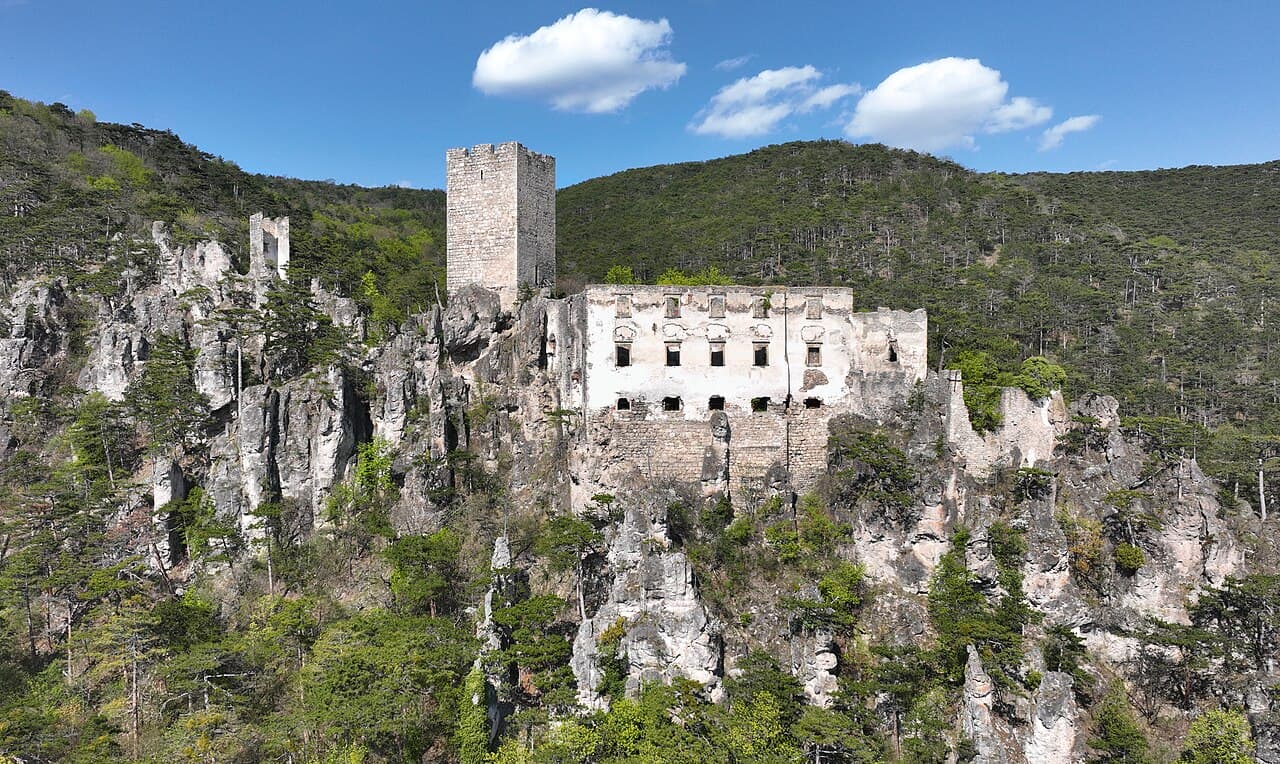
Rauhenstein Castle
Rauhenstein Castle, located near the town of Baden in Austria, is a significant medieval hill fortress with a rich history spanning several centuries. This castle was likely constructed in the 12th century by the knights of the Tursen family, a noble lineage serving the Babenberg dynasty. Strategically positioned in the Helenental valley, Rauhenstein was built alongside another fortress, Rauhenek, to control vital routes and assert regional dominance.
The castle's earliest recorded owner was Seyfried Turso von Rauhenstein in 1186, marking the site as the seat of the Turs family throughout the 12th and 13th centuries. After the Turs line ended in the late 1200s, ownership passed to the Pillihsdorfer family and later to Hans III Puchheim in 1386. Rauhenstein's history is marked by conflict and resilience, including a notable siege in 1408 when Johann Laun, a leader of roving knights often labeled as robbers, plundered the castle.
Historical conflicts and ownership changes
In 1466, under the ownership of Wilhelm Puchheim, Rauhenstein gained notoriety when he attacked the imperial cortege of Empress Eleonora, wife of Emperor Frederick III. This act provoked a punitive military response led by Georg Pottendorf, resulting in the castle's plunder and damage to its fortifications. Subsequently, Rauhenstein was incorporated into the imperial estate. The castle suffered further during the 1460s conflicts against King Matthias I of Hungary, alongside neighboring castles Rauhenek and Ror, leading to partial destruction.
Financial strains from ongoing wars compelled Emperor Frederick III to pawn Rauhenstein and other fortifications. In 1529, the castle was destroyed during a Turkish incursion, yet it continued to serve as an administrative center for a local district court into the 16th century, as documented in a 1534 land registry.
Throughout the 17th century, Rauhenstein changed hands multiple times. In 1635, Hans Paul Bauer was ennobled as Freiherr von und zu Rauhenstein by Emperor Ferdinand II, but he soon pawned the castle. By 1683, ownership had passed through more than eight different parties. The Austro-Turkish War of 1683 inflicted significant damage, leaving the castle largely in ruins.
Decline and industrial use
By the early 18th century, essential structural elements like roofs, doors, and windows had deteriorated or were deliberately removed, including a notable removal of the roof in 1713 by Franz Anton von Quarenti und Raal to avoid taxation on roofed buildings. In 1741, the castle was acquired by the Dobloff-Dir family, who remain owners to this day.
Between 1790 and 1808, the ruins were leased to the Mühlbeck and Hebenstreit company, which operated a turpentine factory on site. This industrial activity adversely affected the castle remains and nearby spa facilities. From 1808, Johann Ferdinand von Schönfeld, a Viennese entrepreneur and cultural collector, leased the site and initiated cleaning and partial restoration efforts. He opened the donjon and surrounding areas to visitors, enhancing public access to the historic ruins. At that time, the castle grounds featured an 18th-century ornamental park with statues, pavilions, and a pond inhabited by water turtles.
Architectural evolution and surviving features
The ruins of Rauhenstein Castle display a fascinating architectural evolution through four main periods: Romanesque, Gothic, Baroque, and later modern adaptations. The original structure was a compact, two-story stone palace built in the Romanesque style during the mid-12th century. It measured approximately 20 meters in length and 8 meters in width, perched on a cliff overlooking the Helenental valley, providing a commanding defensive position.
The Romanesque palace was characterized by solid masonry walls with no windows facing the courtyard, emphasizing defense. Narrow Romanesque-style windows on the valley side allowed light while maintaining protection. The courtyard wall featured two double doors: a main entrance about two meters wide and a smaller utility door 70 centimeters wide. Wall heights suggest the first floor had a ceiling height of about two meters, while the second floor rose to around three meters, accommodating living and representative spaces. Part of the original gable wall remains visible on the eastern side.
After partial destruction in 1299, the castle underwent significant Gothic reconstruction in the 14th century. Two new floors were added above the original structure, maintaining the room divisions. The third floor was about 4.5 meters tall and possibly featured a suspended ceiling, a common medieval technique to improve interior comfort. The top floor measured around three meters in height. Gothic windows, including rectangular and lancet-shaped, were introduced, with a surviving pointed arch door on the uppermost floor. Many Gothic windows were later partially walled up during subsequent alterations, but their outlines remain visible.
In the early 17th century, the castle was reorganized under Baroque influence into three floors. While the first floor's height remained unchanged, window arrangements were significantly altered. The courtyard-facing wall was divided vertically into four sections, each with new windows. On the valley side, first-floor windows were enlarged to the extent that the original Romanesque openings were entirely removed. Upper floors replaced older windows with long rectangular openings, while previous Gothic windows were bricked up. Multiple fireplaces were added during this period, altering the masonry and damaging some Gothic elements.
By the late 18th century, the castle had deteriorated considerably. After the collapse of the remaining roof sections, a protective canopy was installed over the ruin, with angled notches in the stone walls indicating attachment points. Despite its ruinous state, many original features such as masonry walls and window openings survive in situ. The layered architectural developments clearly illustrate the castle's continuous evolution from a fortified medieval residence through phases of decay and adaptation.
Cultural significance and preservation efforts
Rauhenstein Castle remains an important cultural and historical landmark in the region. Since the early 19th century, efforts to preserve and stabilize the ruins have been ongoing. The castle grounds, once featuring an ornamental park with sculptures and ponds, continue to attract visitors interested in medieval architecture and history.
Since 1993, the annual Ruinenfestl festival has been held near the ruins, celebrating the castle's heritage and fostering community engagement. This event highlights the site's ongoing cultural relevance and helps promote tourism in the Baden area.
Today, Rauhenstein Castle stands as a testament to the complex history of medieval fortifications in Austria, showcasing architectural styles from Romanesque to Baroque and reflecting centuries of conflict, adaptation, and preservation.
Frequently asked questions (FAQ)
- How do I get to Rauhenstein Castle?
- Rauhenstein Castle is located in Baden, Austria, and is easily accessible by car or public transport. If you're traveling by train, the nearest station is Baden, from where you can take a short taxi ride to the castle.
- What are the opening hours of Rauhenstein Castle?
- Rauhenstein Castle is open to visitors from 10 AM to 6 PM during the summer months, with reduced hours in the winter. It is advisable to check the official website for any seasonal changes or special events that may affect opening times.
- Can I visit Rauhenstein Castle year-round?
- Yes, Rauhenstein Castle is open to visitors year-round, though certain areas may be restricted during the winter months due to weather conditions. It's best to plan your visit in advance and check for any seasonal closures.
- When was Rauhenstein Castle built?
- Rauhenstein Castle was constructed in the 12th century, making it a significant historical landmark in the region. Its long history adds to the charm and intrigue of the castle, attracting many history enthusiasts.
- Why is Rauhenstein Castle historically significant?
- Rauhenstein Castle holds historical significance as it served as a strategic fortification during the medieval period. It played a crucial role in the defense of the region and has witnessed many historical events over the centuries.
- What is the architecture style of Rauhenstein Castle?
- Rauhenstein Castle showcases a blend of Romanesque and Gothic architectural styles, characterized by its sturdy stone walls and intricate details. The design reflects the typical features of medieval castles, providing visitors with a glimpse into the past.
- Is it possible to take guided tours of Rauhenstein Castle?
- Yes, guided tours are available for visitors who wish to learn more about the history and architecture of Rauhenstein Castle. These tours provide in-depth insights and stories that enhance your experience while exploring the castle grounds.
- What are the ticket prices for Rauhenstein Castle?
- Ticket prices for Rauhenstein Castle typically range from €5 to €10, depending on age and group size. Special discounts may be available for students and seniors, so be sure to check for any deals when planning your visit.
- What is the best time to visit Rauhenstein Castle?
- The best time to visit Rauhenstein Castle is during the spring and early autumn when the weather is mild and the surrounding landscapes are vibrant. Additionally, visiting during these seasons allows you to enjoy the scenic views and outdoor areas of the castle without the summer crowds.
- Are there any nearby attractions to Rauhenstein Castle?
- Yes, several attractions are located near Rauhenstein Castle, including the beautiful spa town of Baden and the scenic vineyards of the region. Visitors can also explore the nearby historic sites and parks, making it a great destination for a full day of exploration.
Photo gallery

Information
Website
Visit websiteSources & official resources
Verify the information above using these authoritative references.
Loading map...
Visitor reviews
No reviews yet. Been here? Write the first review and help other travelers!
Write the first reviewVisited this castle? Share your experience
Your review helps other travelers and adds first-hand knowledge to our encyclopedia.