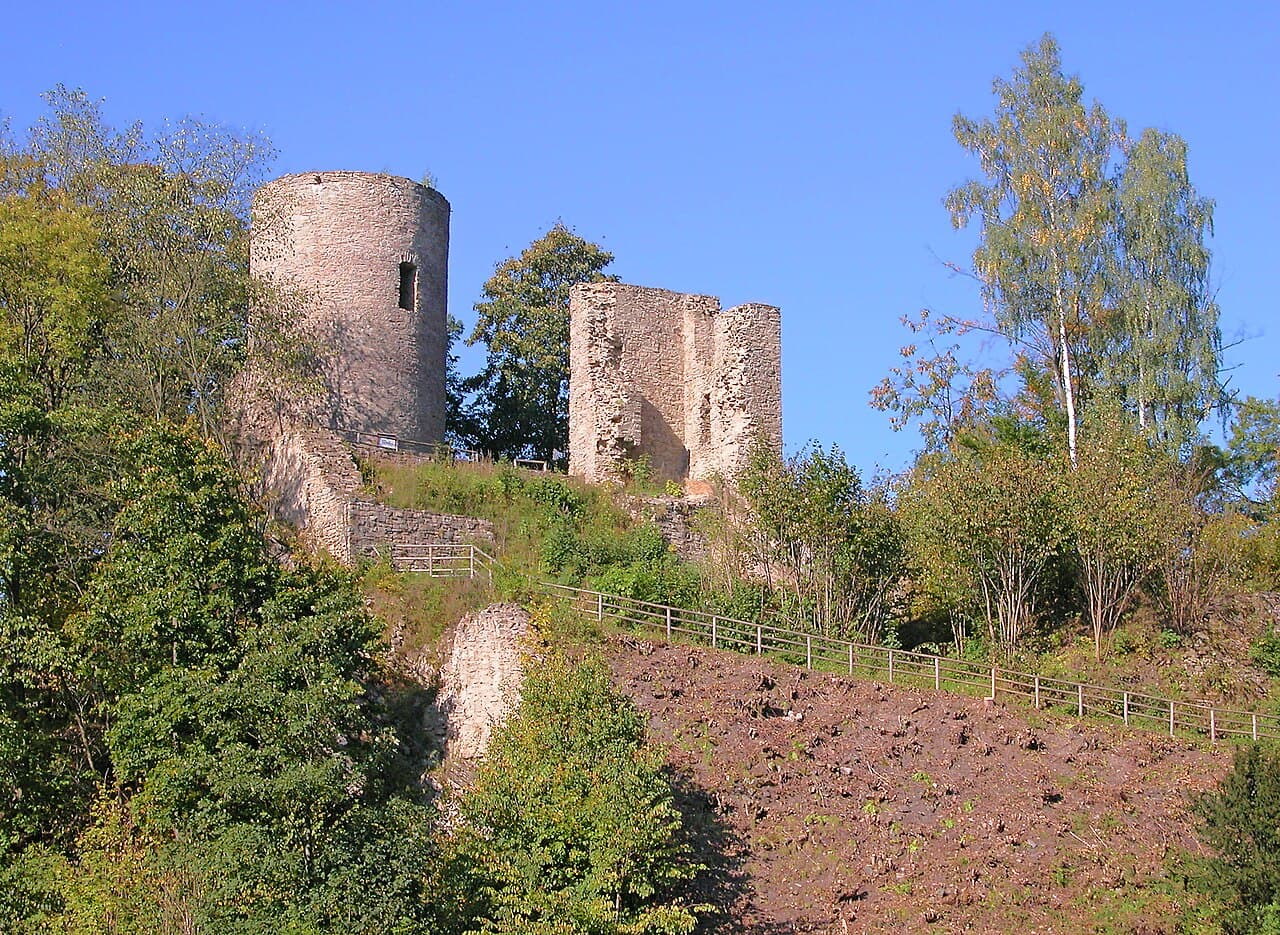
Lauterstein Castle
Lauterstein Castle is a notable example of a high medieval hill castle located in the municipality of Marienberg, in the Ore Mountains region of Germany. Constructed in the second half of the 12th century, this fortress was strategically positioned on a rocky gneiss spur overlooking the village of Niederlauterstein. Its primary function was to protect and oversee an important medieval trade route connecting the cities of Leipzig and Prague, a vital corridor for commerce across the Ore Mountains.
The earliest surviving written record of Lauterstein Castle dates back to 1304, where a document mentions a Johannis in Lutirstein, a member of the ministerial family of Erdmannsdorf, residing within the castle. The castle's ownership transitioned through several noble families, reflecting the turbulent political landscape of the region during the Middle Ages.
Medieval origins and early ownership
During the early 14th century, the castle came under the control of the Schellenberg family. However, their tenure ended in 1323 when they lost a feud with the influential Altzella Abbey. Subsequently, Margrave Frederick the Brave enfeoffed the castle and the adjacent town of Zöblitz to the burgraves Albrecht IV von Altenburg and Otto I von Leisnig, who had supported both the margrave and the abbey in this conflict.
Ownership by the Berbisdorf family and castle division
In 1434, Kaspar von Berbisdorf, a prominent Freiberg nobleman involved in mining and metalworking enterprises in the Ore Mountains, purchased the lordship of Lauterstein Castle for 4,000 guilders. The Berbisdorf family maintained ownership for over a century, during which the castle and its lordship were divided in 1497 between Kaspar's descendants, Bastian and Melchior. This division created two distinct properties known as Oberlauterstein (Upper Lauterstein) and Niederlauterstein (Lower Lauterstein).
The physical manifestation of this division was a separating wall called the Schiedsmauer, which ran through the castle complex. This feature is characteristic of a Ganerbenburg, a type of castle jointly owned and inhabited by multiple families, often resulting in complex internal divisions and shared defenses.
Architectural features and castle layout
The castle occupies a roughly circular area approximately 30 meters in diameter, perched on a steep rocky spur that provides natural defense. The robust stone construction, reflected in the suffix "-stein" in its name, indicates the use of local gneiss stone for foundations and walls.
Among the surviving structures, a prominent round tower approximately nine meters in diameter remains visible, alongside a partially intact square tower measuring around six by six meters. These towers were integral to the castle's defensive system, providing vantage points for surveillance and protection against attackers.
Fragments of surrounding walls outline the former buildings and outer fortifications, including a defensive ditch on the western side. Part of this ditch was later filled to create a courtyard area, reflecting adaptations as the castle transitioned from a purely military fortress to a more residential role.
Castle as a ganerbenburg
The division into Oberlauterstein and Niederlauterstein, marked by the Schiedsmauer, illustrates the castle's function as a Ganerbenburg. This arrangement allowed multiple noble families to co-inhabit and share the castle's defenses and resources, a common practice in medieval Germany to manage inheritance and property rights.
Damage, restoration, and decline
In 1530, Lauterstein Castle suffered significant damage due to a fire. However, it was restored within a few years, indicating its continued importance as a regional stronghold.
By 1559, the castle and its lordship were forcibly sold to Prince-elector Augustus for 107,784 guilders. Following this acquisition, Lauterstein was repurposed as the administrative seat of a Saxon Amt, reflecting a shift from military to administrative functions.
During the Thirty Years' War, local tradition holds that on 14 March 1639, three Swedish cavalrymen set fire to the castle, causing severe destruction. This event marked the end of Lauterstein as a functional fortress; it was never rebuilt and has remained a ruin since.
Archaeological significance and preservation
The site was officially protected as an archaeological monument on 25 November 1968. Excavations in the 1970s uncovered artifacts spanning from the 12th through the 17th centuries, providing valuable insights into the castle's long history and the daily lives of its inhabitants.
A 1629 drawing by the artist Dillich offers a rare visual record of Lauterstein Castle before its destruction, serving as a basis for a modern scale model created by a local manufacturer in Marienberg. This model helps visitors and historians visualize the castle's original layout and grandeur.
Historical and cultural importance
Lauterstein Castle stands as a testament to the complex feudal and political dynamics of medieval Saxony and the Ore Mountains region. Its role in protecting a major trade route, its transformation into a Ganerbenburg, and its eventual decline during the Thirty Years' War encapsulate key aspects of German medieval and early modern history.
Today, the ruins of Lauterstein Castle offer a tangible connection to this past, attracting historians, archaeologists, and visitors interested in medieval architecture, feudal society, and regional heritage.
Frequently asked questions (FAQ)
- How do I get to Lauterstein Castle in Marienberg?
- Lauterstein Castle is located near the village of Niederlauterstein, close to Marienberg in Saxony, Germany. It is accessible by local roads and hiking trails from Marienberg, with parking available nearby for visitors.
- What is the historical significance of Lauterstein Castle?
- Lauterstein Castle was built in the 12th century to protect a vital medieval trade route between Leipzig and Prague. It played a key role in regional defense and administration until its destruction in the 17th century.
- Can I visit the ruins of Lauterstein Castle?
- Yes, the ruins of Lauterstein Castle are open to the public. Visitors can explore the remains of the towers, walls, and courtyard, and learn about the castle's history through onsite information boards and nearby museums.
- When was Lauterstein Castle destroyed?
- Local tradition states that Lauterstein Castle was set on fire by Swedish cavalrymen on 14 March 1639 during the Thirty Years' War, after which it was never rebuilt.
- What architectural features are notable at Lauterstein Castle?
- Notable features include a large round tower, a square tower, the Schiedsmauer dividing wall, and remnants of defensive walls and a ditch, reflecting its function as a Ganerbenburg and medieval fortress.
Photo gallery

Information
Current owner
Municipality
Loading map...
Visitor reviews
No reviews yet. Been here? Write the first review and help other travelers!
Write the first reviewVisited this castle? Share your experience
Your review helps other travelers and adds first-hand knowledge to our encyclopedia.



