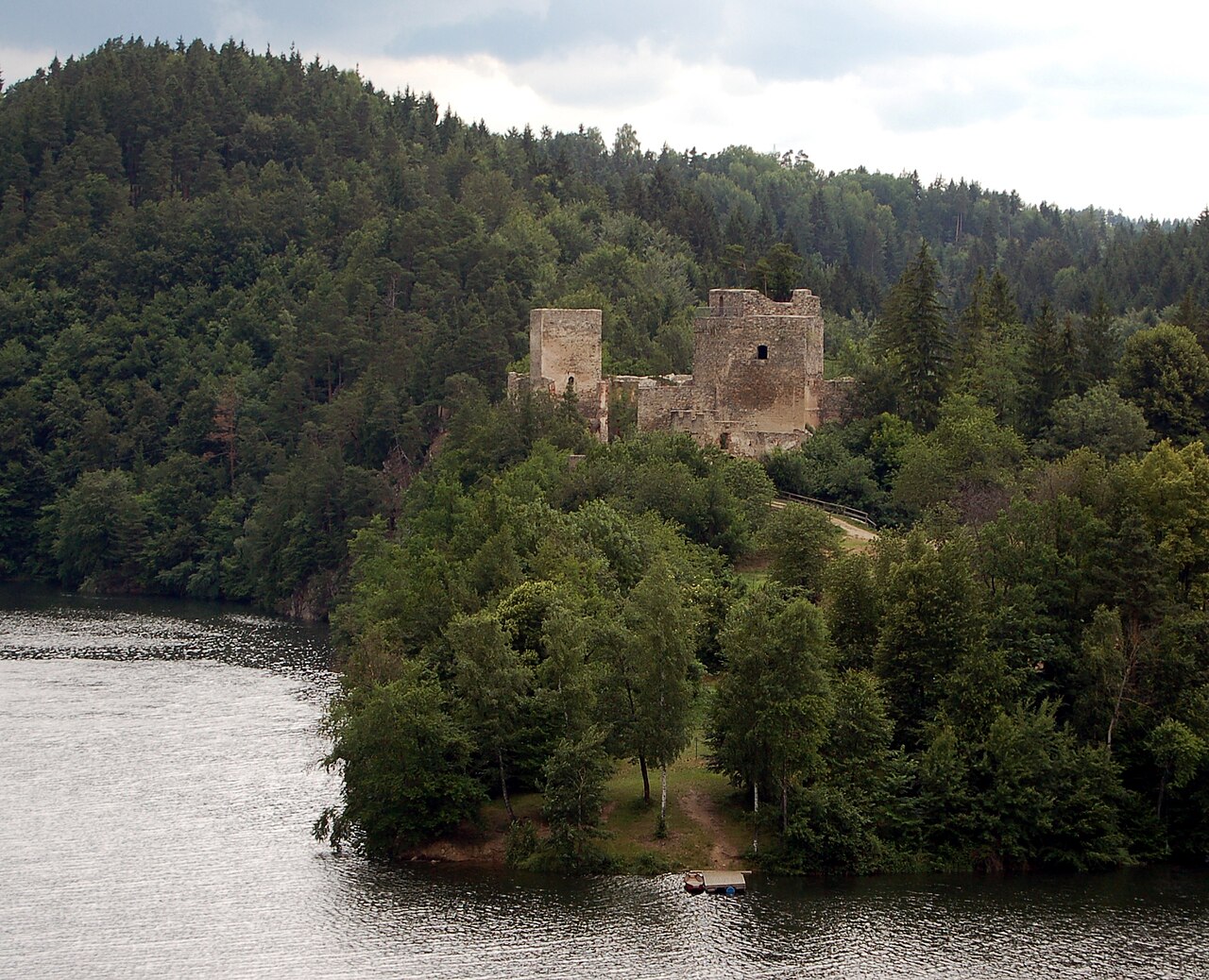
Rastenberg Castle
Rastenberg Castle is a remarkable example of a Romanesque hill castle located in the municipality of Rastenfeld, Lower Austria. Constructed around 1200 by the Rauheneck family, it stands as a testament to medieval military architecture and regional history. The castle's strategic position on a rocky granite spur overlooking the Purzelkamp valley exemplifies the typical defensive siting of high medieval fortifications, combining natural terrain advantages with robust man-made defenses.
Historical context and ownership lineage
The origins of Burg Rastenberg trace back to the late 12th and early 13th centuries, with dendrochronological evidence placing its initial construction between 1193 and 1205. It was established by the Rastenberg family, a branch of the Rauhenecker lineage, who used it as a fortified residence and a control point along the Kamps River. The family maintained possession until the death of Otto, the last known member, at the end of the 13th century.
Subsequently, the castle entered the holdings of Duke Rudolf IV of Austria in 1363. During this period, it was managed by appointed stewards and occasionally used as collateral in pledges. The early 15th century brought significant turmoil during the Hussite Wars, when the castle suffered serious damage. By 1432, the Neideck family took control and undertook substantial renovations to strengthen its defenses.
Later, the castle passed to Michael Zeller, a Protestant nobleman who used it as a refuge during religious conflicts. The Thirty Years' War further impacted the castle, with plundering by imperial forces in 1620 and Swedish troops in 1645. Ownership changed hands several times afterward, including the Lamberg family (from 1663), the Bartenstein family (from 1754), and the Thurn-Valsassina family (from 1879), who maintained it into the 21st century.
Architectural features and layout
Rastenberg Castle occupies a narrow, elongated site approximately 19 meters wide and 54 meters long, oriented east-west along a granite spur. Its layout includes a forecourt followed by two smaller inner courtyards, reflecting a thoughtful organization of defensive and residential spaces typical of high medieval castles.
The castle's most striking feature is its pentagonal bergfried, a tall, robust keep standing 27 meters high. Constructed in the Romanesque style from locally quarried granite, the bergfried has survived with minimal alteration, offering valuable insights into medieval construction techniques and military architecture. Its pentagonal shape is relatively rare and provided enhanced defensive capabilities, allowing defenders to cover multiple angles effectively.
The surrounding walls, also built from granite, blend seamlessly with the rocky terrain, emphasizing the castle's integration into its natural environment. Despite various restorations, the castle has retained its medieval character, with little to no major architectural modifications that would detract from its original appearance.
Military significance and sieges
Throughout its history, Rastenberg Castle played a significant role in regional defense and political conflicts. Its position along the Kamps River made it a strategic asset during the Hussite Wars in the 15th century, when it endured substantial damage from military action. The castle's fortifications were strengthened thereafter to withstand future threats.
During the turbulent Thirty Years' War, the castle was twice plundered, first in 1620 by imperial forces under General Bucquoy and again in 1645 by Swedish troops. These events reflected the broader struggles of Central Europe during this period and left marks on the castle's fabric, though the core structure, especially the bergfried, remained intact.
Preservation and cultural importance
Today, Rastenberg Castle is recognized as a protected historic monument, valued for its well-preserved Romanesque architecture and its embodiment of medieval defensive design in Lower Austria. The castle offers visitors a rare glimpse into the construction methods and strategic considerations of the high medieval period.
The castle's enduring medieval appearance, combined with its dramatic location, makes it a significant cultural landmark. Its preservation allows historians, architects, and tourists alike to appreciate the complexity and resilience of medieval fortifications. The castle's granite walls, pentagonal bergfried, and courtyard arrangement collectively demonstrate the practical and aesthetic considerations of medieval castle builders.
Visitor experience and accessibility
While the castle is privately owned, it is occasionally accessible to visitors during special events or by arrangement. Its rugged terrain and historic structures offer a compelling experience for those interested in medieval architecture and history. Visitors can explore the forecourt, inner courtyards, and admire the imposing bergfried, gaining insight into the castle's defensive mechanisms and residential functions.
Efforts to maintain and restore the castle have focused on preserving its original character, ensuring that future generations can continue to study and enjoy this remarkable example of medieval fortification.
Frequently asked questions (FAQ)
- When was Rastenberg Castle built?
- Rastenberg Castle was constructed around 1200, during the high medieval period, by the Rauheneck family.
- What architectural style characterizes Rastenberg Castle?
- The castle is primarily Romanesque in style, notable for its pentagonal bergfried and granite construction.
- What significant historical events affected Rastenberg Castle?
- The castle was damaged during the Hussite Wars in the 15th century and plundered twice during the Thirty Years' War in 1620 and 1645.
- Is Rastenberg Castle open to the public?
- Rastenberg Castle is privately owned and is occasionally accessible to visitors during special events or by prior arrangement.
- Where is Rastenberg Castle located?
- Rastenberg Castle is located on a rocky granite spur overlooking the Purzelkamp valley in Rastenfeld, Lower Austria.
Information
Loading map...
Visitor reviews
No reviews yet. Been here? Write the first review and help other travelers!
Write the first reviewVisited this castle? Share your experience
Your review helps other travelers and adds first-hand knowledge to our encyclopedia.