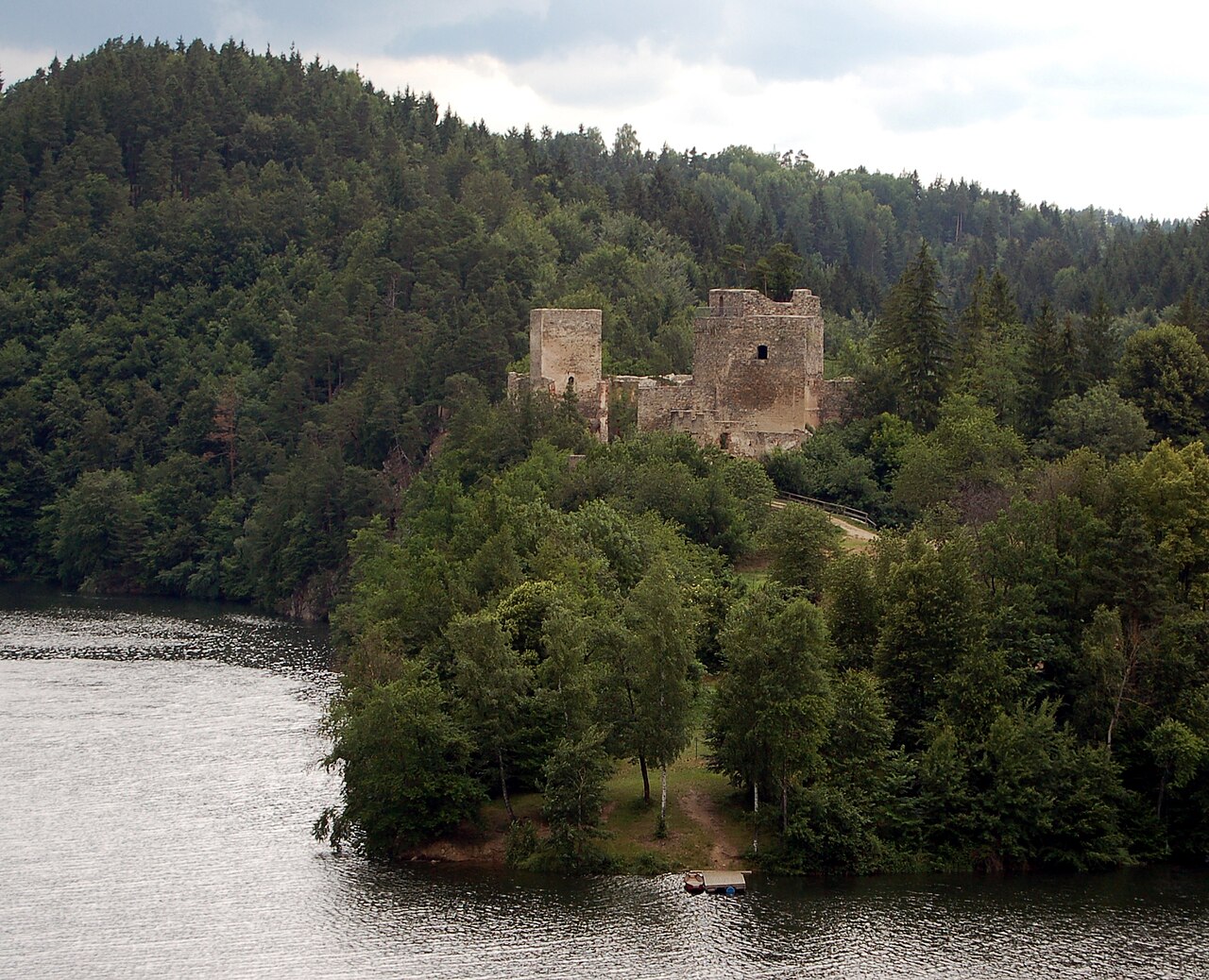
Lichtenfels Castle
Lichtenfels Castle stands as a significant medieval fortress ruin located in the municipality of Friedersbach near Rastenfeld in Austria's Waldviertel region. Originally constructed in the mid-12th century, this hill castle was founded by Hartung von Rauheneck following a fief grant from Duke Heinrich Jasomirgott in a period when the territory was transitioning from direct German royal control to becoming part of the Duchy of Austria in 1156. The castle's strategic location on a rocky outcrop overlooking the surrounding landscape underscored its role in territorial defense and noble residence during the high medieval period.
Early history and ownership
The Rauheneck family, also known as "die Tursen" or "the Giants," maintained possession of Lichtenfels Castle for nearly two centuries, from its foundation until 1335. Among them, Hugo der Turs von Rauheneck is notably documented in a 1248 Austrian record, highlighting the family's prominence in the region during the 13th century. The castle's proximity to the lands of the powerful Kuenring family placed it within a dynamic political frontier, reflecting the complex feudal allegiances and territorial disputes typical of the era.
Transition of ownership and significance
Following the Rauheneck tenure, Lichtenfels Castle changed hands multiple times, passing through the ownership of various noble families such as the lords of Kapell, Georg von Dachsberg, and Jörg von Rappach by the early 15th century. The castle gained particular historical importance during the Hussite wars of 1427 and 1428, serving as a secure refuge for the treasures and library of the nearby Zwettl Abbey. This protective role underscored the castle's strategic and cultural value amid the regional conflicts of the time.
Later ownership and decline
In 1623, Hans Unterholzer von Kranichberg acquired Lichtenfels Castle as a freehold estate from the emperor, subsequently consolidating it with his holdings in Rastenberg in 1628. The castle remained under noble ownership through the 18th century, including possession by the Freiherr von Bartenstein family from 1774. However, by this time, the castle's military and residential functions had diminished significantly.
Economic pressures such as the imposition of a roof tax led to the partial dismantling of the castle's roof in 1790, with materials sold to the Zwettl Abbey. The last resident vacated the castle in 1804, after which the structure fell into increasing disrepair and ruin. Since 1872, the castle and its former lordship have been owned by the comital family Thurn-Valsassina, who hold the site today.
Architectural features and remains
Lichtenfels Castle originally featured a compact layout typical of high medieval hill castles, with thick defensive walls enclosing an inner courtyard. The construction utilized local stone masonry, reflecting the robust building techniques of the 12th century. The castle's elevated position on a rocky promontory provided natural defensive advantages and commanding views of the surrounding terrain.
Castle chapel
The most prominent surviving structure is the castle chapel dedicated to Saint Paul. This chapel remains remarkably well-preserved compared to the rest of the ruins and served as a pilgrimage site well beyond the castle's active use as a noble residence. Its endurance highlights the spiritual and cultural significance of the site within the region.
Ruins and site condition
Today, the castle ruins occupy a peninsula formed by the Ottenstein reservoir, which has altered the original wooded slope setting. The visible remains include fragmented walls and foundational outlines, offering insights into the castle's original defensive design and spatial organization. While no significant archaeological artifacts or inscriptions have been discovered, the ruins stand as a testament to the castle's layered history and the fluctuating fortunes of its various owners.
Historical context and regional importance
Lichtenfels Castle's history reflects the broader dynamics of medieval Austria, including feudal territorial disputes, noble family rivalries, and the impact of regional conflicts such as the Hussite wars. Its role as a refuge for religious treasures during times of unrest underscores its strategic and cultural importance. The castle's decline and eventual ruin mirror the shifting political and economic landscape of the region through the early modern period.
Legacy and cultural heritage
Though now in ruins, Lichtenfels Castle remains an important cultural landmark within the Waldviertel region. The site attracts interest for its historical associations, architectural remnants, and its evocative setting amidst the natural landscape shaped by the Ottenstein reservoir. Preservation efforts focus primarily on maintaining the chapel and stabilizing the remaining structures to allow continued public appreciation of this medieval heritage site.
Frequently asked questions (FAQ)
- How do I visit Lichtenfels Castle and what are the opening hours?
- Lichtenfels Castle is accessible to the public as a ruin without formal opening hours, allowing visitors to explore the site freely at any time. However, it is recommended to visit during daylight hours for safety and better visibility of the ruins.
- What is the historical significance of Lichtenfels Castle?
- Lichtenfels Castle played a crucial role in regional defense and noble residence during the high medieval period. It was notably used as a refuge for the treasures and library of Zwettl Abbey during the Hussite wars, highlighting its strategic importance.
- Can I see the castle chapel dedicated to Saint Paul?
- Yes, the castle chapel dedicated to Saint Paul is the most well-preserved part of Lichtenfels Castle and can be viewed by visitors. It served as a pilgrimage site and remains a significant cultural and spiritual feature of the ruins.
- Is Lichtenfels Castle suitable for families and children?
- The ruins of Lichtenfels Castle can be visited by families, but caution is advised due to uneven terrain and unstable structures. Supervision of children is recommended to ensure safety while exploring the site.
- What nearby attractions can I visit along with Lichtenfels Castle?
- Visitors to Lichtenfels Castle can also explore the nearby town of Rastenfeld and the scenic Waldviertel region, including the Ottenstein reservoir, which offers opportunities for hiking, boating, and enjoying natural landscapes.
Information
Loading map...
Visitor reviews
No reviews yet. Been here? Write the first review and help other travelers!
Write the first reviewVisited this castle? Share your experience
Your review helps other travelers and adds first-hand knowledge to our encyclopedia.