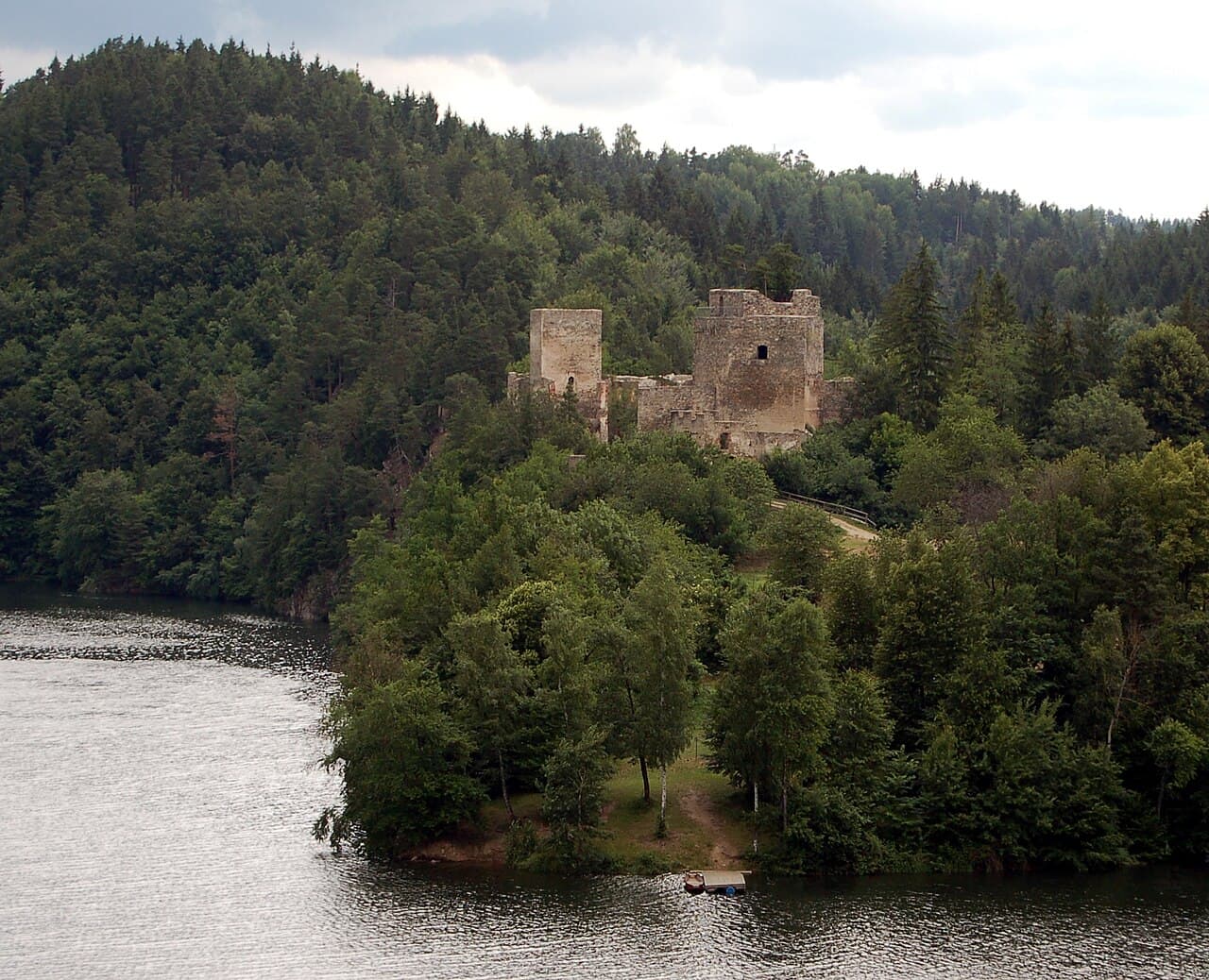
Dobra Castle
Dobra Castle, locally known as Burg Dobra, is a significant historical site located south of the village of Reichhalms and east of Zwettl city in the province of Lower Austria. This castle, now in ruins, offers a glimpse into the region's medieval and Renaissance past, standing on a ridge overlooking the Kamp river valley. The site is notable for its strategic position and its role in regional conflicts during the Middle Ages and early modern period.
Early history and ownership
The origins of Dobra Castle date back to the 12th century, with the earliest documented mention occurring in 1186. The name "Dobra" is derived from a Slavic word meaning "forest," reflecting the castle's setting amid wooded landscapes. The castle first appears in records in 1278 when it was granted to Otto von Dürnstein. Over the following centuries, ownership changed hands multiple times, illustrating the castle's importance in local noble families' power dynamics.
In 1329, Arnold von Dobra sold the castle to his uncle, Simon von Sitzendorf, and by 1342 it was inherited by Johann II von Kuenring. The castle later passed to the influential Liechtenstein family in 1408, who maintained control during a turbulent period marked by military conflicts and sieges.
Sieges and military significance
Dobra Castle endured several sieges, reflecting its strategic importance. In 1448, the castle was besieged during regional conflicts, highlighting its role as a defensive stronghold. Later, in 1645, it faced another siege by Swedish troops amid the broader context of the Thirty Years' War, a devastating conflict that affected much of Central Europe.
These military events underscore the castle's function not only as a noble residence but also as a fortress designed to withstand attacks. Its location on a ridge provided natural defensive advantages, enhanced by its rectangular layout and fortified towers.
Architectural features and layout
The castle's design reflects typical Renaissance military architecture adapted to the local terrain. It has a rectangular layout with fortified gates at each end, providing controlled access points. Several large towers remain standing, offering insight into the castle's defensive capabilities and the living quarters within.
Visitors can explore the surviving cellars and parts of the walls, which convey the scale and complexity of the original structure. The castle was built with durable stone materials, some of which were later repurposed by local residents for building houses and enlarging nearby churches, contributing to the ruinous state observed today.
Today, the castle ruins lie adjacent to an artificial lake formed by a dam downstream on the Kamp river, adding a scenic element to the historic site.
Later history and decline
In 1639, the castle was purchased by Jakob von Kuefstein, marking another chapter in its ownership history. By the early 18th century, the castle belonged to the Von Ehrmanns family. After constructing a new manor in Wetzlas, the family abandoned Dobra Castle in 1725, leading to its gradual decay.
Following abandonment, the castle fell into ruin and was used as a quarry by locals, which accelerated the loss of original structures. Despite this, the ruins remain an important cultural and historical landmark in the region.
Current use and visitor information
Presently, Dobra Castle serves a unique role as a youth camping site during the summer months, known as Camping Ruine Dobra. This use helps maintain the site’s accessibility and engagement with the community. In winter, the castle ruins are freely accessible to visitors, offering an open-air historical experience.
The castle sits at an elevation of approximately 475 metres (1,558 feet) above sea level, providing panoramic views of the surrounding landscape. Its partially preserved ruins attract visitors interested in medieval and Renaissance architecture, as well as those drawn to the natural beauty of Lower Austria.
Cultural and historical significance
Dobra Castle stands as a testament to the region’s feudal history and architectural evolution from the medieval period into the Renaissance. Its multiple sieges reflect the turbulent history of Central Europe, especially during the 15th and 17th centuries. The castle’s ruins offer valuable insights into defensive architecture and noble life over several centuries.
As an archaeological site, it contributes to the understanding of castle construction techniques, regional power struggles, and the transformation of noble estates over time. The adaptive reuse of its stones in local buildings also illustrates historical practices of resource utilization in rural Austria.
Frequently asked questions (FAQ)
- How do I visit Dobra Castle?
- Dobra Castle is freely accessible during the winter months. In summer, it operates as a youth camping site, so visiting hours may vary. Checking the Camping Ruine Dobra website before planning a visit is recommended.
- What is the historical significance of Dobra Castle?
- Dobra Castle played a key role in regional defense during the Middle Ages and Renaissance, enduring multiple sieges and changing ownership among noble families. It reflects the feudal history and military architecture of Lower Austria.
- Can I explore the ruins of Dobra Castle?
- Yes, visitors can explore the castle's rectangular layout, including several large towers and cellars. The ruins provide insight into Renaissance defensive architecture and noble residences.
- When was Dobra Castle built and who owned it?
- The castle was built in the 12th century and first mentioned in 1186. It was owned by various noble families including the von Dürnstein, von Sitzendorf, von Kuenring, Liechtenstein, and Von Ehrmanns families.
- Is there an entrance fee to visit Dobra Castle?
- There is no entrance fee to visit the ruins of Dobra Castle, making it an accessible historical site for all visitors.
Photo gallery

Information
Current owner
Municipality
Loading map...
Visitor reviews
No reviews yet. Been here? Write the first review and help other travelers!
Write the first reviewVisited this castle? Share your experience
Your review helps other travelers and adds first-hand knowledge to our encyclopedia.



