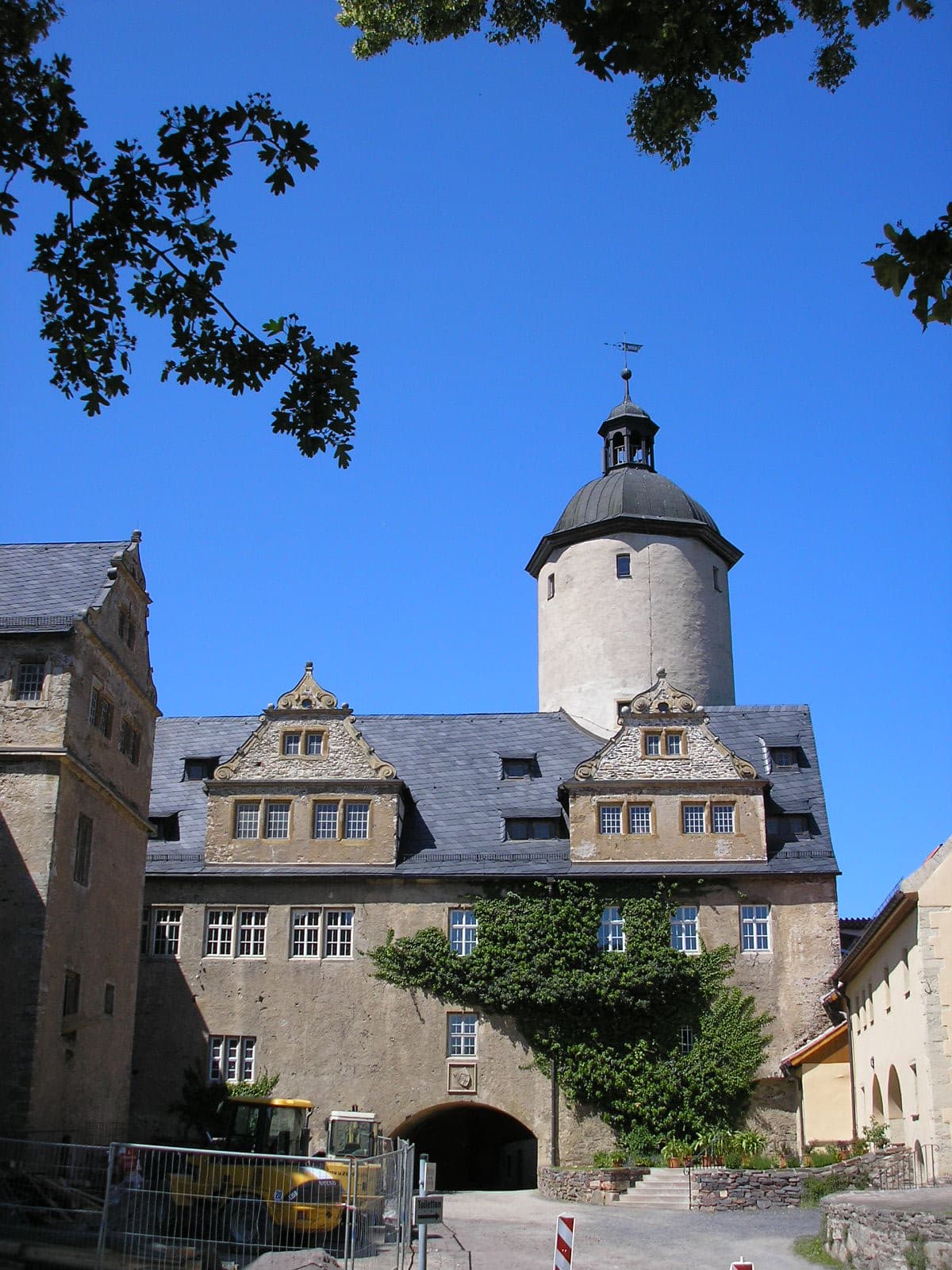
Ranis Castle
Ranis Castle stands as a remarkable example of a hilltop fortress (Höhenburg) in the municipality of Ranis, located in the German state of Thuringia. Perched on a distinctive Zechstein reef rock formation at an elevation of 405 meters above sea level, the castle's strategic position underscores its historical role as a defensive stronghold on the eastern frontier of the Holy Roman Empire. The castle's earliest documented mention dates back to 1084, when Emperor Henry IV enfeoffed it to the nobleman Wiprecht of Groitzsch, marking the beginning of its long and varied history.
Early history and medieval significance
Ranis Castle was constructed under the auspices of German imperial authorities and nobility during the 11th century. Its primary function was as an imperial estate, or Reichsgut, serving as a bulwark against Slavic groups in the region known as Saalegau. During the 12th and 13th centuries, the castle was inhabited by imperial ministeriales—knightly officials appointed directly by the emperor—who managed the estate and oversaw its defenses. The castle's location and fortifications played a critical role in securing the eastern borders of the empire.
Throughout the late medieval period, ownership of Ranis Castle shifted among several noble families. Emperor Otto IV pledged the castle to the counts of Schwarzburg, who were formally enfeoffed with it by Emperor Frederick II in 1220. Subsequently, the castle passed between the counts of Kevernburg and Schwarzburg, reflecting the complex feudal dynamics of the region. By 1389, the castle was sold by the Schwarzburg family to the influential House of Wettin, a dynasty that played a significant role in Saxon and Thuringian history.
Renaissance transformation and later ownership
In the mid-15th century, specifically in 1463, Ranis Castle was willed by Wilhelm III to his brother-in-law Heinrich von Brandenstein, linking the estate to the Brandenstein family through marriage. Financial difficulties led the Brandenstein family to sell the castle in 1571 to the lords of Breitenbauch, who later adopted the name Breitenbuch. This transition marked a shift in the castle’s function from a purely military fortress to a more residential and representative estate.
The early 17th century brought significant architectural changes, including the construction of a south wing in the late Saxon Renaissance style. This addition featured characteristic gabled dormers and reflected contemporary tastes that favored more comfortable living spaces and aesthetic refinement over strict fortification.
Architectural features and defensive structures
The core of Ranis Castle is its compact main castle (Hauptburg), located on the western side of the site. Central to this is a tall, round bergfried—a fortified tower or keep—rising approximately 38 meters high. This tower is a defining landmark and a testament to the castle's medieval defensive capabilities.
East of the main castle lie two extensive outer baileys (Vorburgen), which historically housed ancillary buildings and supported the castle’s economic functions. A preserved building between the larger eastern courtyard and the outer bailey served as a dividing structure within the complex. Notably, a vaulted tunnel runs beneath the outer bailey, connecting the castle grounds to the old town below, demonstrating sophisticated medieval engineering.
The castle's defensive design includes a zwinger—an enclosed killing ground—on the eastern side, protected by an outer moat and accessible via a drawbridge. These fortifications highlight the castle’s role in active defense during medieval warfare and its strategic importance in regional conflicts.
Natural features and unique elements
Beneath the castle’s outer bailey lies the Ilsen cave, a natural chamber formed within the Zechstein reef rock. This cave has been incorporated into the castle’s cultural narrative and is featured in museum exhibitions focusing on regional geology and prehistory.
Historical records also mention a bear enclosure (Bärenzwinger) on the castle grounds around 1940. Such enclosures were sometimes maintained at medieval sites for symbolic or entertainment purposes, adding a unique dimension to the castle’s history.
Modern history, preservation, and cultural significance
In the 19th and 20th centuries, Ranis Castle’s surrounding town and district became part of Prussia in 1815. Despite political changes, the castle remained in the possession of the Breitenbuch family until 1942, when ownership transferred to the German Red Cross. Since 1994, the castle has been managed by the Stiftung Thüringer Schlösser und Gärten (Thuringian Castles and Gardens Foundation), which has overseen extensive preservation and restoration efforts to maintain the site’s historical integrity.
The castle also serves as a cultural hub. A museum established in 1926 by Dietrich von Breitenbuch originally focused on the castle’s heritage and the region’s geology, prehistory, and seismology. Reopened in 1956 as a local history museum, it has since benefited from state support to modernize its exhibitions and improve visitor experience. The castle grounds have hosted an annual literary festival since 1997 and were used as a filming location for a family movie in 2010, enhancing its cultural profile.
Today, Ranis Castle stands as a well-preserved monument to medieval and Renaissance architecture, offering visitors insights into the region’s history, architecture, and natural environment. Its combination of military, residential, and cultural functions across centuries makes it a significant heritage site in Thuringia and Germany at large.
Frequently asked questions (FAQ)
- When was Ranis Castle originally built?
- Ranis Castle was originally constructed in the 11th century, with its first recorded mention in 1084.
- What architectural styles are present at Ranis Castle?
- The castle features a mix of medieval defensive architecture and late Saxon Renaissance style, especially evident in the 17th-century south wing addition.
- Is Ranis Castle open to the public for visits?
- Yes, Ranis Castle is open to visitors and includes museum exhibitions on its history, regional geology, and prehistory.
- What are the main defensive features of Ranis Castle?
- Key defensive features include a tall round bergfried, outer baileys with a zwinger, an outer moat, and a drawbridge.
- Who currently manages Ranis Castle?
- The castle is currently managed by the Stiftung Thüringer Schlösser und Gärten, the Thuringian Castles and Gardens Foundation.
Photo gallery

Information
Sources & official resources
Verify the information above using these authoritative references.
Loading map...
Visitor reviews
No reviews yet. Been here? Write the first review and help other travelers!
Write the first reviewVisited this castle? Share your experience
Your review helps other travelers and adds first-hand knowledge to our encyclopedia.



