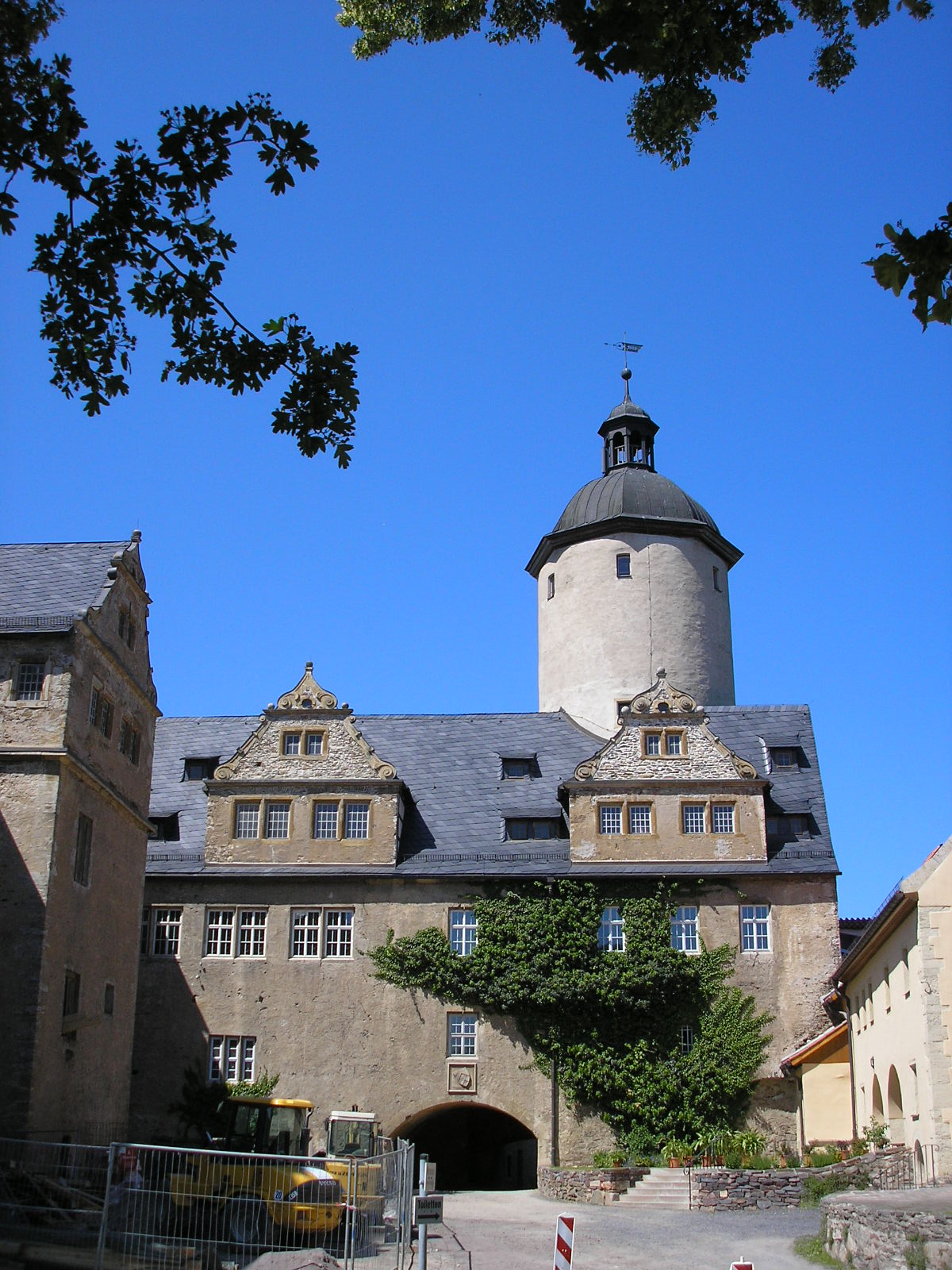
Burg Weißenburg
Burg Weißenburg stands as a remarkable example of a hill castle with a rich history dating back to the 13th century. Located in the municipality of Uhlstädt-Kirchhasel in Thuringia, Germany, this castle was originally established by a medieval German noble family as a fortified residence and dynastic seat. Its strategic placement on a rock plateau overlooking the Saale valley provided a natural defensive advantage, complemented by man-made fortifications that evolved over centuries.
The earliest known reference to the castle, originally called "Wizzenburgk," dates to around 1248, coinciding with the partition of the Weimar-Orlamünde comital house. This period marked the castle's initial role as a stronghold for local nobility, designed to assert control over the surrounding region. In 1344, ownership transferred to Margrave Frederick II of Meissen, though the previous owners retained rights of residence, reflecting the complex feudal relationships of the time.
Medieval origins and architectural features
The castle's medieval architecture was shaped by its dual function as a defensive fortress and noble residence. Positioned on a rock cliff with steep natural slopes on the northern side, the site was fortified with a series of five towers concentrated on the highest ground. These towers, along with a rampart, a protective ditch, and a robust outer wall featuring a main gate, formed a formidable barrier against invaders.
Beneath the southwestern section, a network of sandstone cellars known as the "Schleiflöcher" was carved directly into the rock. These underground chambers likely served as storage or shelter and are believed to date back to the original Orlamünde family era, highlighting the castle's long-standing strategic utility.
Fortifications and defensive design
The castle's octagonal northern tower and the vaulted ground floor of the gatehouse are among the surviving medieval elements that illustrate the defensive architecture of the period. The steep northern escarpment acted as a natural moat, while the man-made defenses on other sides ensured comprehensive protection.
Historical ownership and noble residence
Throughout the 15th century, Burg Weißenburg experienced several changes in ownership. It was managed by ducal officials known as vogts before passing to the lords of Entzenberg and subsequently to the von Kochberg family as feudal tenants. By the late 15th and early 16th centuries, the castle became associated with Friedrich von Thun, a nobleman connected to the Saxon electors and dukes. Notably, Friedrich von Thun accompanied Martin Luther to the Diet of Worms in 1521 and played a role in Luther's protection at Wartburg Castle.
During the 1525 Peasants' War, the castle served as a refuge for Georgius von Thüna, the last abbot of the Benedictine monastery of Saalfeld, who reportedly died in the castle's deepest cellar. This episode underscores the castle's function as a sanctuary during times of conflict.
In 1529, Friedrich von Thüna undertook significant modernization efforts, transforming the fortress into a more comfortable noble residence. His coat of arms, prominently displayed above the main gate, symbolizes this period of architectural and functional transition. The estate remained under the Thüna family for over 150 years, later jointly held with the von Lengefeld family, vassals to the Schwarzburg counts in nearby territories.
Early modern transformations and cultural connections
From 1707 to 1761, the von Lengefeld family maintained sole ownership but eventually sold the property due to financial difficulties. Among the notable figures linked to the castle is Charlotte von Lengefeld, who spent part of her youth here before marrying the celebrated poet Friedrich Schiller.
In 1777, the renowned writer Johann Wolfgang von Goethe visited Burg Weißenburg multiple times. During his stay, he cared for the von Lengefeld children and created drawings of the estate, highlighting the castle's continued significance as a noble residence and cultural site in the late 18th century.
A devastating fire in 1792 destroyed large portions of the original fortress and the Thüna residential quarters. Reconstruction began in 1796, resulting in a two-story residential building on the southwestern plateau and a larger main structure along the cliff edge. This rebuilding preserved key medieval elements, including parts of the vaulted gatehouse and the northern tower's lower sections.
19th and 20th century uses and adaptations
During the late 19th century, the castle changed hands several times. Around 1881, merchant Krüger acquired part of the estate and expanded the northeastern villa by adding an additional floor. The southwestern wing served as the administrative center for the Meiningian forestry office, later known as the Thüringisches Forstamt Weißenburg, reflecting the castle's evolving role in regional governance.
In 1893, Baron Eduard von Derenthall, a Prussian diplomat, purchased the castle. After his widow's tenure, the property underwent social transformations beginning in 1927, when it was leased to welfare organizations. It functioned as a children's home until 1932 and later as a training center for unemployed girls in 1936.
During World War II, the castle was the residence of Johann von Leers, a Nazi propagandist. After the war, the castle and adjacent Weißeneck estate became public property, serving as shelters for displaced persons and refugees. By 1946, it was converted into a sanatorium specializing in lung diseases by the local district administration.
Modern restoration and current use
Following German reunification, Burg Weißenburg returned to private ownership and was adapted into a rehabilitation clinic focusing on cancer and rheumatic illnesses. A specialized therapy center was established, accompanied by restoration work on the historic structures. The former servants' house now hosts the Thuringian branch of the German Rheumatism League, integrating the castle into contemporary healthcare and community services.
Architectural legacy and surviving features
Today, visitors to Burg Weißenburg can observe remnants of its medieval defensive structures, including parts of the outer wall, the defensive ditch, and the foundations of several towers. The castle's dramatic position atop a rock cliff continues to offer panoramic views over the Saale valley, reminiscent of its strategic importance.
The blend of medieval fortifications with later residential modifications illustrates the castle's evolution from a military stronghold to a noble residence and administrative center. The preserved vaulted gatehouse and the lower portion of the octagonal northern tower provide tangible links to its medieval origins.
Subsequent additions, such as the 19th-century villa expansion and the administrative buildings, reflect the castle's adaptation to changing social and functional demands over centuries. Burg Weißenburg's layered history encapsulates the broader narrative of German noble estates transitioning through feudal, cultural, and modern periods.
Overall, Burg Weißenburg remains a significant cultural landmark in Thuringia, embodying centuries of architectural development, noble heritage, and adaptive reuse that continues into the present day.
Frequently asked questions (FAQ)
- What is the historical significance of Burg Weißenburg?
- Burg Weißenburg, located in Uhlstädt-Kirchhasel, is a key historical site that dates back to the Middle Ages. It served as a strategic fortification and residence for local nobility, showcasing the architectural and cultural developments of that era. The castle is a testament to the region's rich history and medieval heritage.
- When was Burg Weißenburg built?
- Burg Weißenburg was constructed in the 12th century, making it one of the oldest castles in the area. Its original purpose was to serve as a defensive stronghold, and over the centuries, it has undergone several renovations and restorations to preserve its historical integrity.
- Can I visit Burg Weißenburg?
- Yes, Burg Weißenburg is open to visitors throughout the year. Guests can explore the castle grounds, enjoy guided tours, and learn about its history and architecture. It is advisable to check the official website for any specific visitor guidelines or restrictions.
- What are the opening hours for Burg Weißenburg?
- Burg Weißenburg typically opens from 10 AM to 6 PM during the summer months and has reduced hours in the winter. It is best to verify the current opening hours on the castle's official website as they may vary seasonally or due to special events.
- Is it possible to access Burg Weißenburg with limited mobility?
- While Burg Weißenburg is a historical site, efforts have been made to improve accessibility. However, due to its age and structure, some areas may be challenging for visitors with limited mobility. It is recommended to contact the castle administration for specific information regarding accessibility options.
- What are the ticket prices for visiting Burg Weißenburg?
- Ticket prices for Burg Weißenburg are generally affordable, with discounts available for children, students, and seniors. Family packages may also be offered, making it a great option for group visits. Check the official website for the most current pricing and any promotional offers.
- When is the best time to visit Burg Weißenburg?
- The best time to visit Burg Weißenburg is during the late spring and early autumn when the weather is pleasant, and the surrounding landscape is in full bloom. Additionally, visiting during these seasons often means fewer crowds, allowing for a more enjoyable experience while exploring the castle.
- What nearby attractions can I explore while visiting Burg Weißenburg?
- While visiting Burg Weißenburg, you can also explore the charming village of Uhlstädt-Kirchhasel and other nearby historical sites. The region boasts beautiful hiking trails and scenic views, making it perfect for outdoor enthusiasts. There are also local eateries and shops to enhance your visit.
Information
Website
Visit websiteSources & official resources
Verify the information above using these authoritative references.
Loading map...
Visitor reviews
No reviews yet. Been here? Write the first review and help other travelers!
Write the first reviewVisited this castle? Share your experience
Your review helps other travelers and adds first-hand knowledge to our encyclopedia.