
Rambures Castle
Rambures Castle, also known as Château Fort de Rambures, is a remarkable example of a 15th-century military fortress located in the village of Rambures in the Somme department of the Hauts-de-France region in northern France. Constructed primarily of brick, it stands as one of the earliest European castles built almost exclusively using this material, a strategic choice to resist the evolving artillery technology of the late medieval period. The castle's robust design and well-preserved state make it an exceptional monument of late medieval military architecture.
The castle's origins date back to around 1412, when construction was initiated by David de Rambures, a nobleman and royal grand master of crossbowmen. Situated near the volatile frontier between French and English territories during the Hundred Years' War, the fortress was intended as a defensive stronghold. However, David de Rambures died at the Battle of Agincourt in 1415 before seeing its completion. The castle's construction was interrupted by the war and political turmoil but resumed after the conflict's conclusion, with major works completed by his descendants around 1470.
Architectural design and construction
The Château de Rambures is laid out in a nearly perfect square, fortified by eight large round towers at each corner, interconnected by smaller half-towers on the courtyard side. This configuration provided comprehensive defensive coverage and internal communication. Each tower contains a single room on each floor from the basement to the second floor, connected by four spiral staircases located within the inner angles of the corner towers. This design facilitated efficient movement throughout the fortress while maintaining strong defensive capabilities.
The castle is surrounded by a dry moat, enhancing its defensive perimeter. Its walls and towers are constructed predominantly of specially fired brick with some limestone elements, chosen for their superior resilience against artillery bombardment compared to traditional stone masonry. This innovative use of brick distinguishes Rambures as a pioneer in adapting castle construction to the changing demands of warfare in the 15th century.
Defensive features
The fortress's sole entrance is located on the south side, accessible via a historic drawbridge spanning the deep moat. The defensive walls and towers have withstood multiple sieges without being breached, underscoring the effectiveness of its military architecture. The robust circular towers allowed defenders to cover all angles of approach, while the height and thickness of the walls provided formidable protection.
Historical significance and lineage
The castle's history is deeply intertwined with the Hundred Years' War and the political struggles of medieval France. After David de Rambures' death, his son André was captured by the English and held prisoner for a decade. During this period, French forces recaptured and reinforced the castle to serve as a base for operations against English positions. Upon André's release in 1440, construction efforts resumed, culminating in the castle's completion under his son Jacques de Rambures around 1470. Jacques was a prominent counselor to King Louis XI and played a diplomatic role in negotiations with Charles the Bold, Duke of Burgundy.
The Rambures family maintained ownership until the late 17th century, when the estate passed through marriage to the La Roche-Fontenille family, who remain the current owners. The castle survived subsequent conflicts, including both World Wars, without significant damage, preserving much of its original medieval character.
Notable figures
- David de Rambures (1364–1415): founder and original builder, died at Agincourt.
- André de Rambures: son of David, prisoner of the English, resumed construction post-release.
- Jacques de Rambures: completed construction, royal counselor, diplomat.
- Charles de Rambures (1572–1633): known as 'Brave Rambures', saved King Henry IV's life in 1590.
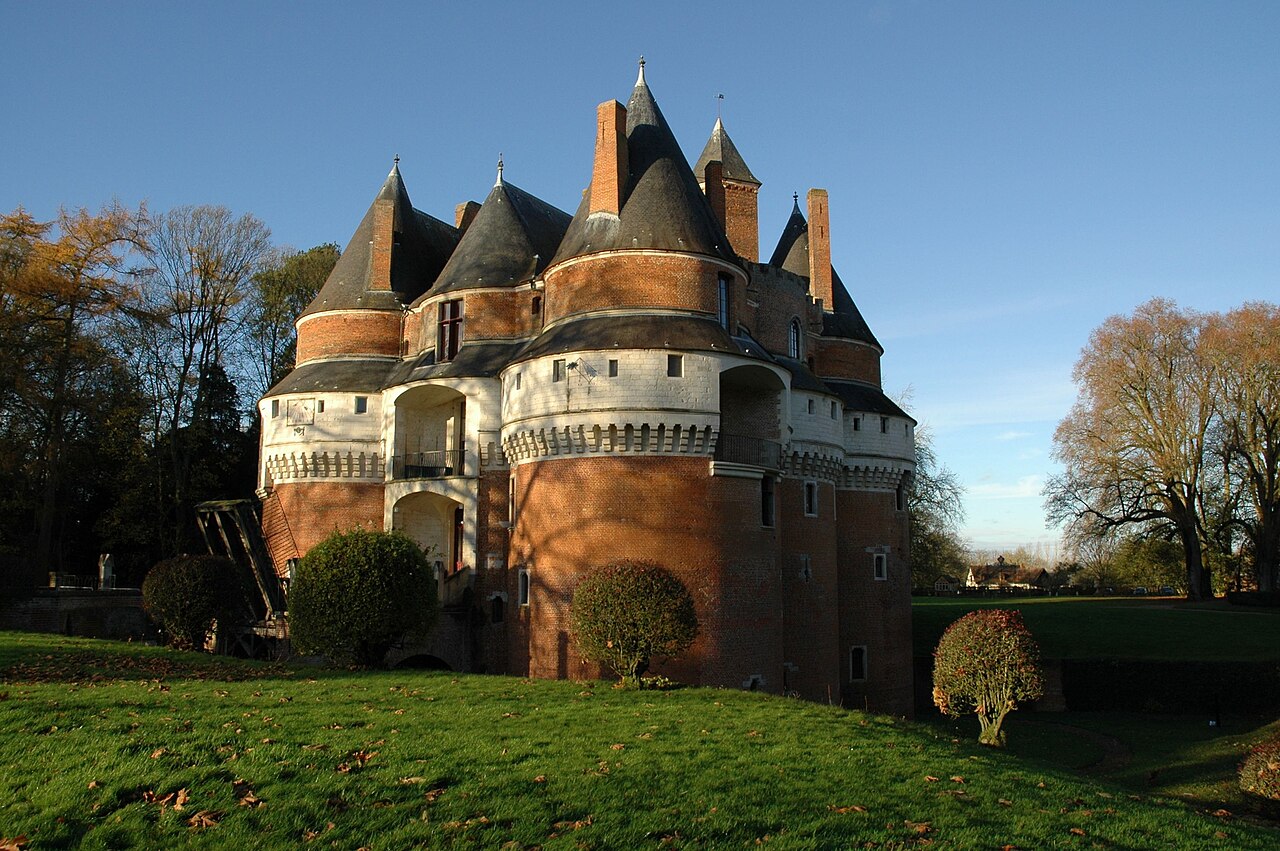
Photo by W.Mechelke/W.Mechelke • CC BY-SA 3.0
Later modifications and preservation
During the 17th century, the castle underwent modifications to improve residential comfort, reflecting a transition from purely military use to noble habitation. The original defensive features were partially dismantled or adapted to suit these new purposes. By the early 20th century, the castle had fallen into disrepair and was largely uninhabitable.
Starting in the 1960s, extensive restoration efforts began to preserve both the interior and exterior of the castle. These restorations have been largely successful, allowing visitors today to appreciate the castle's historical and architectural significance. The castle houses an impressive collection of Picardy furniture from the 15th to 17th centuries, offering insights into the lifestyle and artistry of the period.
Chapel and outbuildings
The estate includes a neo-Gothic chapel built in 1826, containing the tombs of the La Roche-Fontenille family. The castle grounds also feature historic outbuildings dating back to the 18th century, including a rare 19th-century wood shed with decorative openwork and lambrequin motifs, recognized as a historic monument for its uniqueness in France.
Park and gardens
Surrounding the castle is the Parc et Roseraie du Château de Rambures, a classified remarkable garden that enhances the site's cultural value. The park includes a botanical garden and a rose garden established on the site of the former kitchen garden. It is home to ancient trees, including a sequoia over 200 years old, introduced to France in 1787 during the American War of Independence. This rich natural environment complements the castle's historical ambiance.
Visitor experience and significance
Today, Rambures Castle is open to the public for guided tours, allowing visitors to explore its well-preserved medieval architecture, historic interiors, and extensive gardens. The castle's unique brick construction, combined with its historical importance and continuous family ownership, make it a significant cultural and heritage site in northern France.
The castle's endurance through centuries of warfare, political change, and modernization reflects the adaptability and resilience of medieval fortifications. Its preservation offers valuable insights into the architectural innovations of the 15th century and the social history of French nobility.
Frequently asked questions (FAQ)
- When was Rambures Castle built and by whom?
- Rambures Castle was built starting around 1412 by David de Rambures, a nobleman and royal grand master of crossbowmen. Construction was completed around 1470 by his descendants after interruptions caused by the Hundred Years' War.
- What is unique about the construction materials of Rambures Castle?
- The castle is one of the first in Europe to be constructed almost entirely of brick, chosen for its superior resistance to artillery compared to stone, reflecting late medieval military architectural innovations.
- Can visitors tour the interior of Rambures Castle?
- Yes, Rambures Castle is open to the public for guided tours, allowing exploration of its medieval architecture, historic interiors, and gardens. Visitors should check opening hours and ticket prices in advance.
- What notable historical events are associated with Rambures Castle?
- The castle played a strategic role during the Hundred Years' War, was captured and recaptured between French and English forces, and was linked to notable figures such as David de Rambures who died at Agincourt and Charles de Rambures who saved King Henry IV.
- What features does the park surrounding Rambures Castle include?
- The Parc et Roseraie du Château de Rambures includes a rose garden, botanical garden, and ancient trees such as a 200-year-old sequoia introduced in 1787. The park is classified as a remarkable garden enhancing the castle's cultural setting.
Photo gallery

Information
Current owner
La Roche-Fontenille family
Website
Visit websiteAddress
8 Rue du Château, France
Sources & official resources
Verify the information above using these authoritative references.
Loading map...
Visitor reviews
No reviews yet. Been here? Write the first review and help other travelers!
Write the first reviewVisited this castle? Share your experience
Your review helps other travelers and adds first-hand knowledge to our encyclopedia.