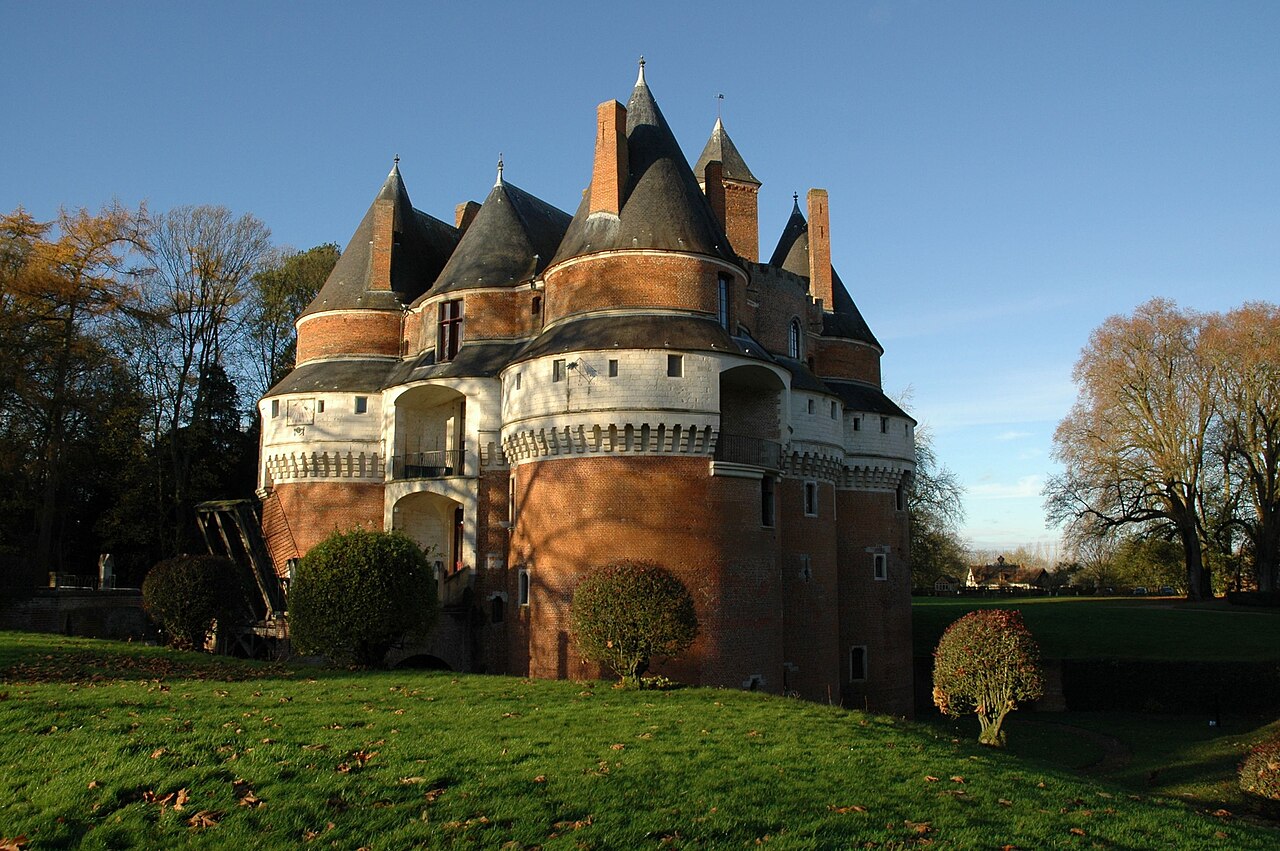
Airaines Castle
Airaines Castle, also known locally as Tours de Luynes, is a medieval fortress ruin located on a prominent hill in the village of Airaines, in the Somme department of northern France. The castle's strategic position offers commanding views over the surrounding countryside, reflecting its historical importance as a defensive stronghold.
Early history and origins of Airaines
The village of Airaines has ancient roots, with archaeological excavations revealing evidence of Gallo-Roman habitation in the area. This early settlement highlights the long-standing human presence at this site. In the mid-5th century, around 450 AD, the village suffered devastation when it was ransacked by the forces of Attila the Hun, marking a turbulent period in its early history.
Construction of the first castle in 1159
The original Airaines Castle was constructed in 1159 by Renaud, Lord of Saint Valery, following his return from the Crusades. This first fortress was built primarily from white stone, a material choice that likely gave the castle a distinctive appearance. The castle served as a fortified residence and a defensive structure during the High Medieval period.
Unfortunately, this initial castle did not survive intact through the centuries. It was demolished in 1422 by Jean of Luxembourg, reflecting the ongoing conflicts and power struggles in the region during the Late Medieval period.
The 15th-century reconstruction and architectural features
In 1444, a new castle was erected on the site, replacing the earlier structure. This second castle featured a keep, a central fortified tower that served as the last line of defense and the lord's residence. Surrounding the keep was a courtyard enclosed by defensive walls.
The castle was further protected by ditches and included several underground chambers, which may have served as storage or escape routes. Additionally, the castle boasted multiple towers with dungeons, emphasizing its role as a military fortress and a place of imprisonment.
Ownership and conflicts in the 16th and 17th centuries
By 1589, the castle was owned by Duke Henri d'Orleans Longueville, who was both the Governor of Picardy and the Lord of Airaines. During a period of religious and political turmoil in France, he successfully defeated the League troops that controlled northern France against the French crown.
Despite his victory, the castle suffered damage when these opposing forces demolished it and took its occupants prisoner until 1592. After their release, the castle and lands were restored to Longueville. Upon his accidental death in 1595, the castle was inherited by his young son, Henri II d'Orleans Longueville.
In 1620, the then Lord of Airaines armed his province against King Louis XIII of France but was defeated, resulting in the confiscation of his possessions. The castle was granted to Duke Charles d'Albert de Luynes, who initiated rebuilding efforts.
Eventually, the Longueville family regained favor, and the castle was returned to them. After the death of Henri II in 1663, the castle passed to his daughter, Marie d'Orleans Longueville. Through marriages and alliances, by 1711, the castle came back under the control of the Duke of Luynes, Charles Philippe d'Albert.
Decline and present condition
The exact circumstances and timing of the castle's decline into ruin are not well documented. Today, only the two gate towers and some adjoining walls remain. These remnants are situated on a circular mound surrounded by a dry moat, typical of medieval fortifications designed to impede attackers.
The site has been transformed into a small park, providing visitors with scenic views of the surrounding landscape. The surviving towers have become a habitat for large numbers of pigeons, adding to the site's character.
Architectural significance and legacy
Although now in ruins, Airaines Castle exemplifies the evolution of medieval military architecture in northern France. Its successive phases of construction and reconstruction reflect the region's turbulent history from the High Medieval through the Early Modern period.
The castle's features, such as the keep, ditches, gate towers, and dungeons, illustrate typical defensive strategies of the time. The use of white stone in the original construction and the later additions by prominent noble families highlight the castle's status and importance.
Visiting Airaines Castle today
Visitors to Airaines can explore the ruins and enjoy the peaceful park setting. The site offers a tangible connection to the medieval past and the complex history of the Picardy region. While the castle no longer stands in its full glory, the remaining structures provide insight into the architectural and historical significance of this once formidable fortress.
Frequently asked questions (FAQ)
- How do I get to Airaines Castle?
- Airaines Castle is located in the village of Airaines, Somme, France, on Rue de Luynes. It is accessible by local roads and is best reached by car or regional transport services.
- What remains of Airaines Castle can I see today?
- Today, visitors can see the two surviving gate towers, adjoining walls, and the circular mound with a dry moat. These ruins offer a glimpse into the castle's medieval defensive structures.
- When was Airaines Castle originally built?
- The first castle at Airaines was built in 1159 by Renaud, Lord of Saint Valery, following his return from the Crusades.
- Who were some notable owners of Airaines Castle?
- Notable owners include Duke Henri d'Orleans Longueville, Duke Charles d'Albert de Luynes, and members of the Longueville family, who played significant roles in the castle's history.
- Is Airaines Castle open to the public?
- The castle ruins are part of a small park open to visitors. There are no formal opening hours or entrance fees, making it accessible for casual exploration.
Information
Address
Rue de Luynes, Airaines, France
Loading map...
Visitor reviews
No reviews yet. Been here? Write the first review and help other travelers!
Write the first reviewVisited this castle? Share your experience
Your review helps other travelers and adds first-hand knowledge to our encyclopedia.