Radyne Castle
Radyně Castle, located near the town of Starý Plzenec in the Czech Republic, is a remarkable example of a 14th-century hill castle that played a pivotal role in the medieval administration and defense of the Plzeň region. Constructed between 1353 and 1361 during the reign of King Charles IV, the castle was originally named Karlskrone (Charles' Crown) but gradually became known by the name of the sandstone hill on which it stands. This castle represents the height of the Late Medieval architectural trend toward merging residential and defensive structures into a cohesive complex.
Historical context and royal significance
The castle was built to replace the earlier stronghold at Starý Plzenec, which had fallen into disrepair by the first half of the 13th century. Radyně Castle was established as a new center of royal power, serving as the residence of royal burgraves who administered the region and maintained security along vital trade routes linking Bohemia with important cities like Nuremberg and Regensburg. This strategic role underscored the castle's importance in both governance and military defense during the reign of Charles IV.
Throughout the 14th and 15th centuries, Radyně remained a royal possession, though its status fluctuated, notably being pawned by King Wenceslaus IV in 1400. During the tumultuous Hussite Wars in the early 15th century, the castle served as a refuge for Catholic nobility. It was also a site of scholarly activity, as the priest Šimon Burda composed commentaries on canon law while residing there.
Ownership changed hands several times among lower nobility during the 15th century, reflecting the castle's role in regional power struggles. By the late 15th century, the Šternberk family acquired Radyně and shifted its use toward a hunting residence, marking a decline in its military importance. The castle's difficult accessibility contributed to its gradual abandonment, especially after a devastating fire in the early 16th century damaged key structures.
Architectural features and layout
Principal structures and defensive elements
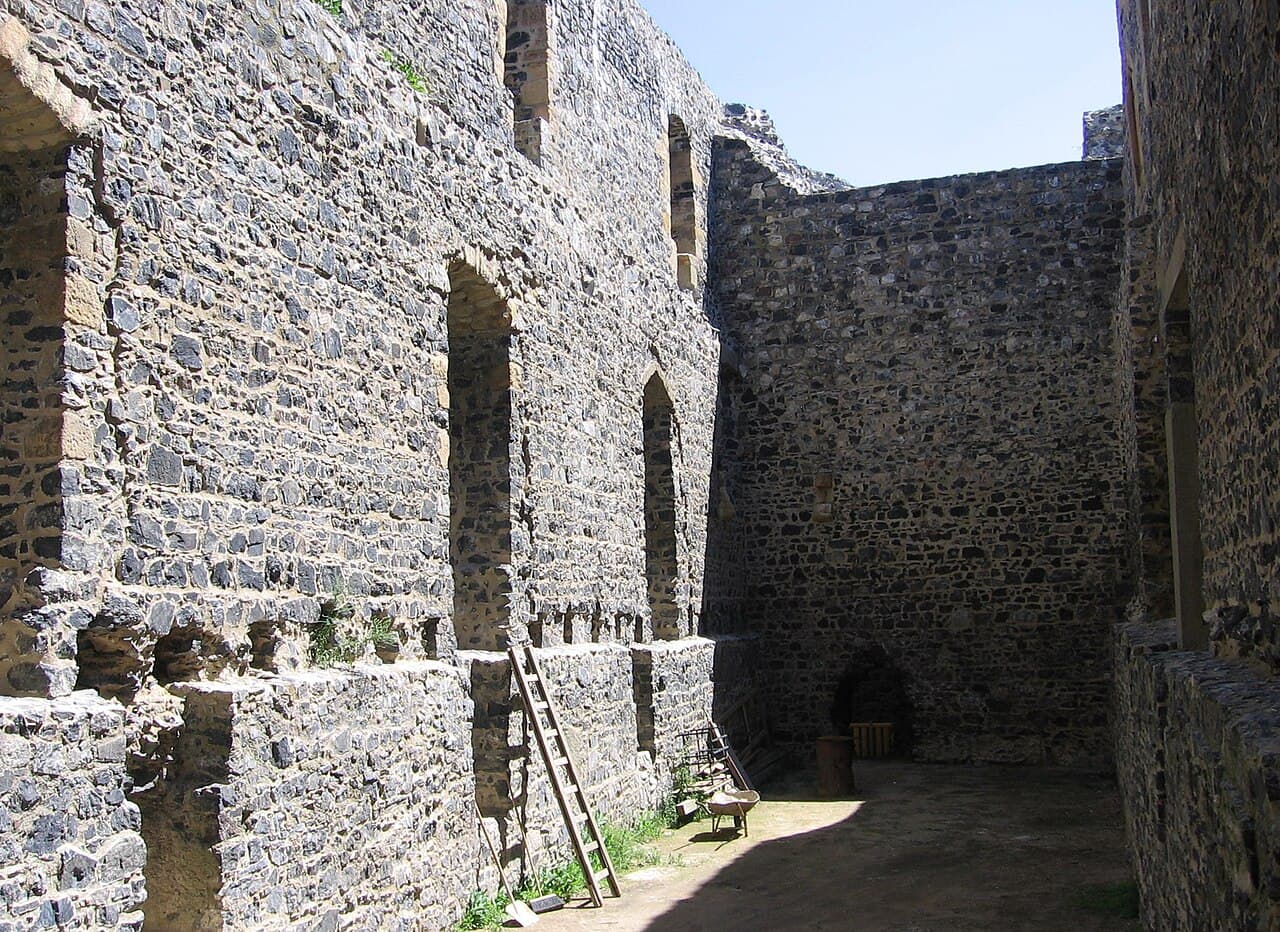
Radyně Castle is perched atop a sandstone hill rising to 567 meters above sea level, commanding extensive views of the surrounding landscape. Its core is a rectangular palace approximately 49 meters long and 11 meters wide, with walls about 2.6 meters thick, emphasizing its fortified nature. At each end of the palace stand two distinctive towers: a square residential tower and a semi-circular tower believed to have functioned as a prison, evidenced by the discovery of human skeletons during archaeological clearing.
The square tower housed comfortable living quarters with features such as large windows with seats, a substantial fireplace, and a private latrine. Above these rooms were additional chambers connected by a corridor running through the palace roof to the opposite tower. The semi-circular tower's undivided interior up to the second floor suggests its use for detention or confinement.
Internal spaces and circulation
Below the palace lies a basement divided into three rooms with narrow slit windows for light and ventilation. These were originally connected to the square tower by an internal passage. The castle's main entrance remains uncertain, with hypotheses including a bridge supported by pillars on the northern wall or an opening above the current blocked entrance.
Inside, the rooms featured timber ceilings and were heated by tiled stoves, with remnants of a large fireplace still visible. The second floor contained a large hall approximately 20 by 7.5 meters, serving as a principal gathering space. The castle's design reflects adaptation to the narrow, rocky ridge, limiting the construction of a continuous defensive wall.
Outer defenses and ancillary buildings
The castle's defenses included a first gatehouse protected by a short moat, a bridge leading to a second gate tower, and curtain walls about 1.2 meters thick extending from this tower. The southern approach was fortified by a barbican and a horseshoe-shaped bastion dating from the 15th century, equipped with loopholes for defenders to cover the moat below.
On the northern side, a curtain wall connected to a rectangular stable building, with a thinner wall descending the hillside toward the semi-circular tower, forming a defensive boundary. Evidence suggests a possible third gatehouse narrowing access between the outer wall and natural rock formations. West of the square tower, a courtyard housed economic buildings and a cistern carved 10 meters deep into the sandstone, enclosed by a now mostly vanished wall.
Decline, restoration, and modern use
Following the fire in the early 16th century, which severely damaged the palace and square tower, Radyně Castle was abandoned by 1558. The noble Černín family owned the ruins in the 18th century but did not invest in restoration. Interest revived in the 19th century during the Romantic movement, leading to a restoration of the square tower into a habitable lookout chamber furnished with a fireplace, stained glass windows, and a large iron chandelier, reflecting contemporary tastes.
In the 20th century, local authorities and preservation societies undertook repairs, and the castle was equipped with a television transmitter in the square tower during the 1950s. Quarrying activities nearby caused structural damage, necessitating further repairs in the 1970s. Since 1981, Radyně Castle has been open to the public, with ownership returned to Starý Plzenec in the early 1990s.
Today, Radyně stands as a well-preserved ruin that offers visitors a glimpse into medieval castle architecture and regional history. The restored square tower serves as an observation point with panoramic views, while exhibitions within the castle provide insights into its historical significance and architectural evolution.
Cultural significance and heritage
Radyně Castle holds an esteemed place in local cultural heritage. It is famously depicted on the stage curtain of the Pilsener Theater, painted by Augustin Němejc between 1899 and 1902, underscoring its iconic status in the region around Plzeň. The castle's enduring presence on the sandstone hill continues to inspire interest in Bohemian medieval history and architecture.
Visitors today can explore the layered history of Radyně Castle, appreciating its combination of Gothic architectural features, defensive ingenuity, and the romantic restoration that has preserved its legacy for future generations.
Frequently asked questions (FAQ)
- How do I get to Radyne Castle?
- Radyne Castle is located in Starý Plzenec, Czechia, and can be accessed by car or public transport. The nearest train station is in Plzeň, from where you can take a bus or taxi to reach the castle.
- What is the historical significance of Radyne Castle?
- Radyne Castle dates back to the 13th century and played a crucial role in the region's defense. It is known for its strategic location and has witnessed many historical events throughout the centuries.
- When was Radyne Castle built?
- Radyne Castle was constructed in the early 13th century, making it one of the oldest castles in the area. Its architecture reflects the medieval style, showcasing the historical craftsmanship of that era.
- Can I visit Radyne Castle year-round?
- Yes, Radyne Castle is open to visitors throughout the year, although certain areas may be restricted during the winter months. It's best to check their official website for any seasonal updates or maintenance closures.
- Why is Radyne Castle a popular tourist attraction?
- Radyne Castle attracts visitors due to its rich history, stunning architecture, and panoramic views of the surrounding landscape. Additionally, the castle offers guided tours that enrich the visitor experience with fascinating stories and insights.
- Is it possible to explore the castle grounds on my own?
- While guided tours are available, visitors are also allowed to explore certain areas of the castle grounds independently. This allows for a more personalized experience, but be sure to respect any marked boundaries and rules.
- What are the ticket prices for Radyne Castle?
- Ticket prices for Radyne Castle vary depending on the type of tour and visitor age. Generally, adult tickets are affordable, and discounts may be available for children, students, and seniors.
- What are the opening hours of Radyne Castle?
- Radyne Castle typically opens from 9 AM to 5 PM during the tourist season, with extended hours in the summer months. It is advisable to check the official website for the most current opening hours before your visit.
- What are some nearby attractions to Radyne Castle?
- In addition to Radyne Castle, visitors can explore the charming town of Starý Plzenec, which features historical architecture and local shops. Nearby, Plzeň offers the famous Pilsner Urquell Brewery and various museums for a fulfilling day trip.
Photo gallery

Information
Website
Visit websiteSources & official resources
Verify the information above using these authoritative references.
Loading map...
Visitor reviews
No reviews yet. Been here? Write the first review and help other travelers!
Write the first reviewVisited this castle? Share your experience
Your review helps other travelers and adds first-hand knowledge to our encyclopedia.