Castle Lopata
Castle Lopata stands as a significant medieval fortress ruin near the village of Milínov in the modern Czech Republic. This hill castle occupies a strategic elevated position at 452 meters above sea level, reflecting its defensive purpose. The site boasts a history of occupation dating back to the Eneolithic period when the Cham culture established an early settlement here. Its continuous use through the Late Hallstatt era saw the emergence of a fortified settlement on the hilltop, which was later dismantled to make way for the medieval castle we recognize today.
The castle itself was constructed in the late 14th century, most likely between 1367 and 1377, under the direction of Heřman of Litice. It is first documented in written records in 1377. The fortress played a notable role in the turbulent political and military conflicts of the period. In 1397, it was besieged and captured by royal forces led by Prokop, after which it became royal property. Subsequently, King Wenceslaus IV granted the estate to Maršík of Hrádek. His son, Jan of Lopata and Hrádek, was a loyal supporter of King Sigismund during the Hussite Wars, a series of religious and political conflicts that shaped Bohemian history in the early 15th century.
The siege and downfall of castle lopata
Before 1427, Jan donated the castle to his brother Habart of Lopata, who became infamous as a robber baron, conducting raids on neighboring estates, notably targeting the Vlčtejn estate. This aggressive behavior provoked a coalition of local nobles and town representatives to lay siege to Castle Lopata on October 27, 1432. The defenders endured a prolonged siege lasting four months. Ultimately, facing starvation and despair, the garrison set fire to the fortress and attempted a desperate escape in February 1433. While forty defenders were captured, Habart himself escaped to Hus Castle, from where he continued his raiding activities. After this dramatic siege, Castle Lopata was left in ruins and was never restored, with official records from 1457 and 1539 marking it as deserted.
Architectural features and defensive structures
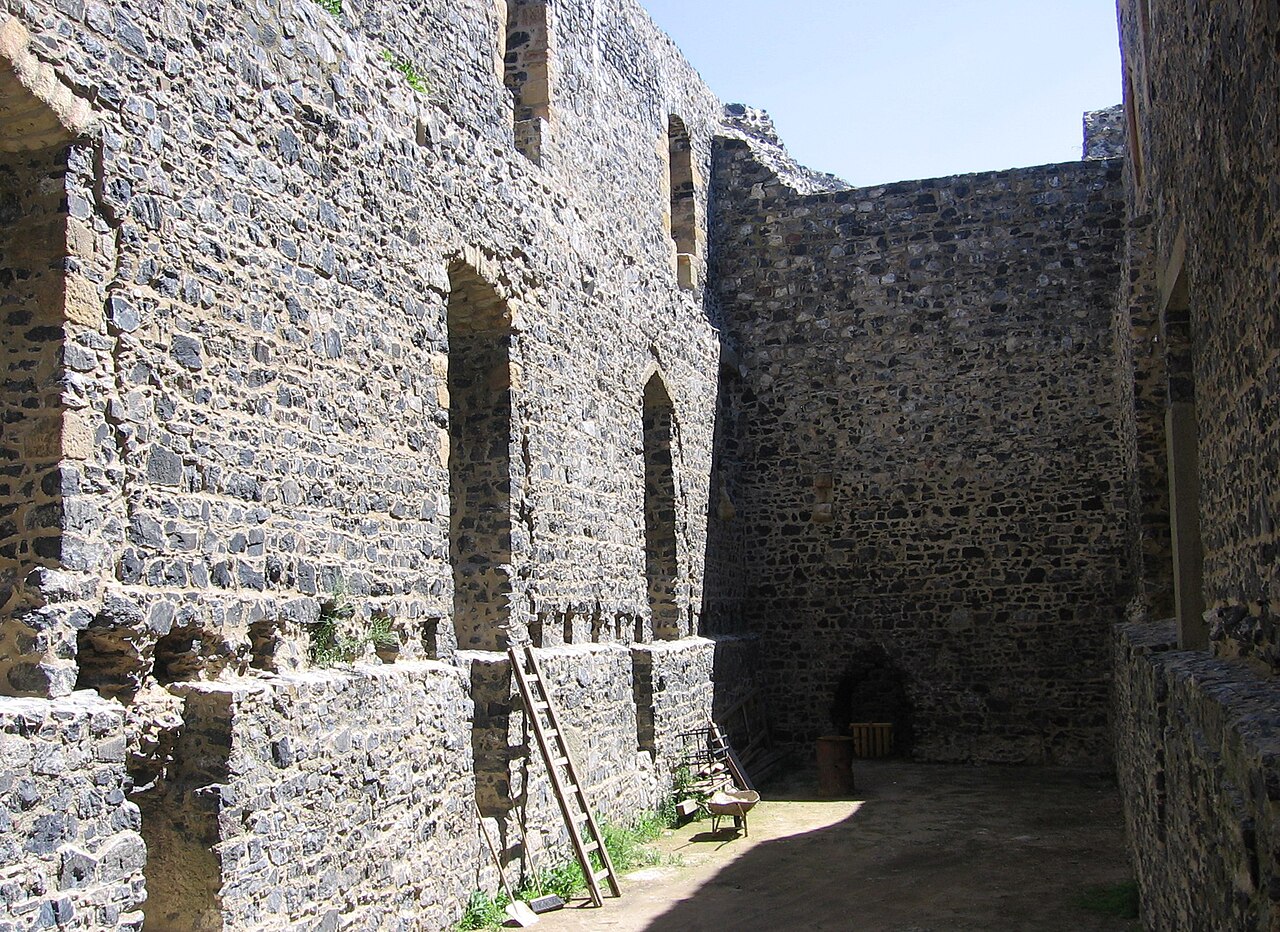
Castle Lopata was designed as a two-part bergfried fortress, a common medieval castle type centered around a strong keep or bergfried. Unusually, its bergfried tower was positioned in the northern corner of the castle's core, occupying the most defensible location. This tower features walls nearly three meters thick and a diameter of approximately ten meters, emphasizing its role as the primary defensive stronghold.
Adjacent to the bergfried on the southwest side was a palace building equipped with tiled stoves, indicating residential use with provisions for heating. The outer bailey contained various buildings and fortifications primarily made of wood, which have mostly disappeared over time. However, stone foundations of a square tower remain on a prominent rock outcrop on the eastern side, and traces of another square structure survive as a ground depression in the southern corner.
Access to the castle core was via a footbridge crossing a moat, leading to a now-lost bridge tower. This bridge connected to the first floor of the tower and led into a barbican wall featuring a cradle-type drawbridge, a defensive mechanism designed to protect the main gate. Beyond this gate, a short flight of stairs led to a secondary gate approximately 1.5 meters wide and 4 meters tall. Although this gate was demolished after the castle's fall, surviving fragments allowed 19th-century historians to reconstruct its appearance. By the 20th century, most of this gate had disappeared except for a small remnant.
Next to the gate stood a square residential tower, illustrating the blend of defensive and domestic functions within the castle core. Between this tower and the bergfried was another building of uncertain purpose, suggesting a complex internal layout. The castle's water supply was secured by a cistern approximately four meters deep within the core, essential for sustaining the garrison during sieges.
Archaeological discoveries and siege remains
Archaeological excavations since the 19th century have uncovered a wealth of artifacts at Castle Lopata, including a face cup, various ceramic vessels, and glass beads. These finds reflect the site's long-term occupation and its cultural layers predating the medieval fortress.
Significant remains of the siege works from 1432–1433 surround the castle ruins. On the highest plateau, the location of the besieging forces' camp has been identified. To the east of the watchtower in the outer bailey, archaeologists found the remains of a bombard firing position, an early artillery emplacement with a bore diameter of about 50 centimeters. This position was protected by a ditch and rampart, highlighting the military technology used during the siege.
Projectile discoveries include crossbow bolts, hand-gun balls (early firearm projectiles), and tarasnice stones (sling stones or small cannonballs). These artifacts provide valuable evidence of the diverse siege weapons and early firearms employed during the castle's final assault, offering insight into medieval warfare techniques and the evolution of military technology in the early 15th century.
Historical significance and cultural heritage
Castle Lopata is an important monument illustrating the transition from prehistoric fortified settlements to medieval castle architecture in the Czech lands. Its history encapsulates the complex feudal and military struggles of the Late Middle Ages, including the Hussite Wars and the phenomenon of robber barons. The castle's ruins and archaeological remains offer a tangible connection to this turbulent period and contribute to understanding the development of fortifications and siege warfare.
Today, the site is protected as an archaeological ruin and continues to attract historians, archaeologists, and visitors interested in medieval history and castle architecture. Its preserved bergfried tower foundations and siege works remain a compelling testament to the castle's strategic importance and dramatic downfall.
Frequently asked questions (FAQ)
- How do I get to Castle Lopata?
- Castle Lopata is located near the village of Milínov in Central Bohemia, Czechia. Visitors typically reach the site by car or on foot via local hiking trails. It is advisable to check local maps and guides for the best route, as the castle is situated on a hilltop.
- What is the historical significance of Castle Lopata?
- Castle Lopata is significant for its late 14th-century origin and its role during the Hussite Wars. It illustrates medieval fortification techniques and the turbulent feudal conflicts of the period, including its dramatic siege in 1432-1433.
- Can I visit the ruins of Castle Lopata?
- Yes, the ruins of Castle Lopata are accessible to the public as an archaeological site. Visitors can explore the remains of the bergfried tower, outer bailey, and siege works, though facilities are limited due to the site's ruinous condition.
- What architectural features are notable at Castle Lopata?
- Notable features include the thick-walled bergfried tower, the palace with tiled stoves, the barbican with cradle-type drawbridge, and the remains of wooden and stone fortifications. The cistern within the castle core is also a key feature.
- When was Castle Lopata built?
- Castle Lopata was most likely built between 1367 and 1377, during the late medieval period, by Heřman of Litice.
Information
Loading map...
Visitor reviews
No reviews yet. Been here? Write the first review and help other travelers!
Write the first reviewVisited this castle? Share your experience
Your review helps other travelers and adds first-hand knowledge to our encyclopedia.