Radboud Castle
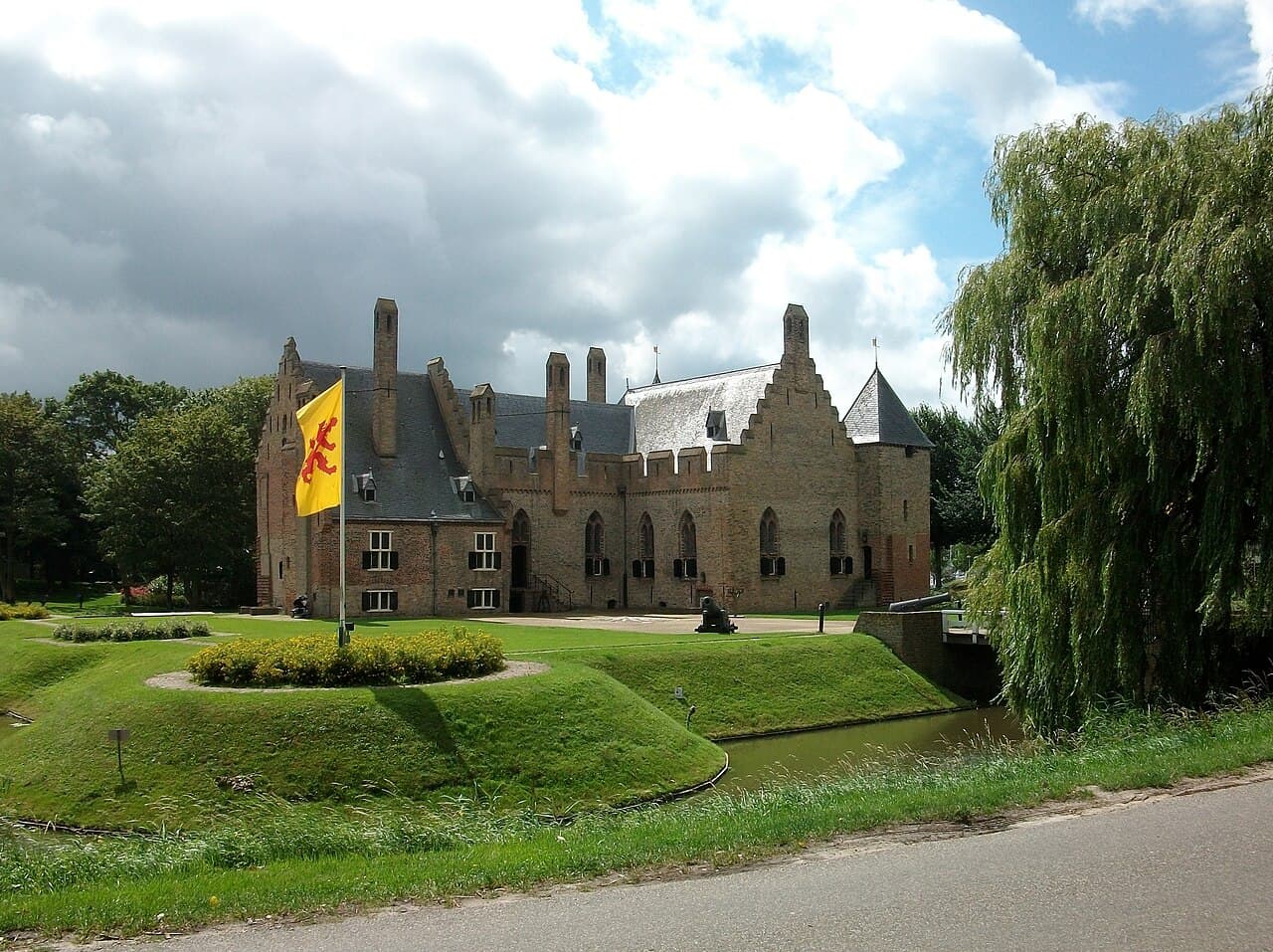
Radboud Castle, also known locally as Kasteel Radboud or Kasteel Medemblik, is a significant high medieval fortress situated in the town of Medemblik within the province of North Holland, Netherlands. Commissioned in the late 13th century by Floris V, Count of Holland (1256-1296), the castle was part of a strategic effort to establish control over the West Frisian population through a network of coercion castles. It stands today as the only surviving example of these fortifications, with others like Nuwendoorn Castle reduced to mere foundations.
Historical context and construction
The castle's construction was ordered by Floris V during a turbulent period when the Counts of Holland sought to consolidate their power in the region. Completed prior to the devastating St. Lucia's Flood of 1287, which reshaped much of the Dutch landscape, Radboud Castle was designed as a formidable defensive structure. Its architecture shares similarities with Muiden Castle, another square castle commissioned by Floris V, reflecting the military architectural style of the era.
The name "Radboud" is traditionally linked to the legendary Frisian king Radboud from the 8th century, based on the belief that the castle was built on the site of his original stronghold, though this connection remains speculative.
Architectural features and layout
Originally, Radboud Castle was a robust fortress featuring multiple defensive elements. Today, remnants include two residential wings, two square towers, and one round tower. Archaeological research and historical images indicate the castle was well-fortified, with thick walls, battlements, and a moat enhancing its defensive capabilities. The round south tower was reconstructed during restoration efforts in the late 19th century, preserving the castle’s silhouette.
The castle’s design reflects typical high medieval military architecture, with a focus on strongholds that could serve as both administrative centers and prisons. Unlike many noble residences, Radboud Castle was primarily used as a prison and administrative stronghold rather than a noble seat.
Role and usage through the centuries
Throughout the 14th and 15th centuries, the castle served as a custodial facility where the Counts of Holland appointed guardians to oversee its operation. It was never a noble residence but functioned mainly to imprison and control local populations. The citizens of Medemblik also used the castle as a refuge during times of unrest.
In the late 16th century, the strategic importance of Radboud Castle diminished significantly with the construction of city walls around Medemblik between 1573 and 1578. This new fortification system made the castle redundant as a defensive structure, leading to its gradual decline.
The castle’s great hall was repurposed as a Reformed church from 1661 to 1734, and the western square tower was converted into a bell tower, demonstrating adaptive reuse of the structure during periods of diminished military need.
Decline, restoration, and modern usage
The 19th century saw significant demolition of Radboud Castle’s structures. In 1850, the gatehouse and three towers were dismantled, followed by the removal of two more towers in 1870. By 1889, the castle ruins were transferred to the Dutch State, which initiated extensive restoration projects to preserve the remaining structures.
Notably, the round south tower was reconstructed during this period, saving the castle from further decay. From 1897 to 1934, Radboud Castle served as a courthouse, reflecting its continued civic importance.
In 1936, the castle’s moat was cleared, revealing the original ground plan more clearly and enhancing archaeological understanding of the site. Further restoration in the 1960s focused on removing earlier restoration inaccuracies and emphasizing historical and architectural authenticity.
During World War II, Radboud Castle played a unique role in cultural preservation, temporarily housing Rembrandt's masterpiece Nachtwacht (The Night Watch) in 1939 before it was moved to a secure bunker to protect it from wartime damage.
Significant historical events
Radboud Castle witnessed several notable events, including its role in protecting Medemblik townsfolk during the 1517 raids by Grutte Pier and his Arumer Zwarte Hoop, a band of marauding pirates. The castle also surrendered to Diederik Sonoy and the Geuzen in 1588 during the Dutch Revolt, marking its involvement in the region's turbulent political history.
Architectural and cultural significance
Radboud Castle is an important example of a high medieval square castle in the Netherlands, showcasing the military architectural principles of the late 13th century. Its preservation offers insight into the methods of control and defense employed by the Counts of Holland in their efforts to dominate the West Frisian territories.
The castle's transformation over the centuries—from fortress to prison, refuge, church, courthouse, and cultural repository—reflects the adaptive reuse of medieval structures in response to changing political and social needs.
Visiting Radboud Castle today
Today, Radboud Castle stands as a well-preserved monument of Dutch medieval history and architecture. Visitors can explore the remaining towers, residential wings, and the moat, gaining a tangible sense of the castle's original defensive strength and historical context. The castle's location in Medemblik makes it accessible for those interested in Dutch heritage and medieval military architecture.
Frequently asked questions (FAQ)
- What is the historical significance of Radboud Castle?
- Radboud Castle, built in the 13th century, is one of the oldest brick castles in the Netherlands. It played a crucial role in the defense of the region and served as a residence for various noble families, reflecting the medieval architecture and feudal history of the area.
- When was Radboud Castle built?
- Radboud Castle was constructed around 1285, making it a significant example of medieval fortifications in the Netherlands. The castle has undergone various renovations over the centuries, preserving its historical essence while accommodating modern visitors.
- Can I visit Radboud Castle?
- Yes, Radboud Castle is open to visitors throughout the year. Guests can explore its historical rooms, towers, and exhibits that showcase its rich heritage and architectural grandeur.
- What are the opening hours for Radboud Castle?
- Radboud Castle typically opens from 10 AM to 5 PM, with extended hours during the summer months. It’s advisable to check the official website for any seasonal changes or special events that may affect visiting hours.
- Is it possible to access Radboud Castle with a wheelchair?
- Radboud Castle strives to be accessible to all visitors; however, due to its historical structure, some areas may present challenges for wheelchair users. It is recommended to contact the castle in advance to confirm accessibility options and available accommodations.
- When is the best time to visit Radboud Castle?
- The best time to visit Radboud Castle is during the spring and early autumn when the weather is pleasant and the gardens are in full bloom. Additionally, visiting during weekdays can help avoid larger crowds.
- What are the ticket prices for Radboud Castle?
- Ticket prices for Radboud Castle vary, with discounts available for children, seniors, and groups. It’s best to check the official website for the most up-to-date pricing and any special offers.
- What nearby attractions can I explore after visiting Radboud Castle?
- After visiting Radboud Castle, you can explore the charming town of Medemblik, which features picturesque canals and historic buildings. Nearby, the Zuiderzee Museum offers an insight into the region's maritime history, making it a great complement to your castle experience.
Photo gallery

Information
Sources & official resources
Verify the information above using these authoritative references.
Loading map...
Visitor reviews
No reviews yet. Been here? Write the first review and help other travelers!
Write the first reviewVisited this castle? Share your experience
Your review helps other travelers and adds first-hand knowledge to our encyclopedia.