Rabsztyn
Rabsztyn Castle stands majestically on a rocky limestone hill overlooking the surrounding landscape in the village of Rabsztyn, Poland. This historic site presents an evocative example of medieval military architecture evolving into a Renaissance magnate residence. The castle's origins date back to the late 13th or early 14th century, with early wooden fortifications likely established by the noble Toporczyk family from Morawica. However, the stone castle that dominates the hill was commissioned by King Casimir III the Great in the 14th century as part of a strategic defensive network known as the "Eagle's Nests," designed to protect the Polish kingdom's borders and vital mining centers such as nearby Olkusz.
Medieval origins and gothic architecture
The initial stone construction of Rabsztyn Castle was a typical Gothic fortress built irregularly on a high limestone crag, utilizing local limestone and brick. The castle's most significant feature was a four-story donjon tower, serving as the last line of defense and a residence. This tower's base was rectangular, later heightened with an octagonal brick upper section during the mid-15th century, enhancing its defensive capabilities and visibility.
Throughout the 14th and 15th centuries, Rabsztyn played a crucial role guarding the border against Bohemian incursions and securing the important trade route between Kraków and Wrocław. The castle was owned by the Melsztyński family bearing the Leliwa coat of arms from the late 14th century. Spytek III Melsztyński, a notable figure and leader of Polish Hussites, used the castle as a base during his 1439 rebellion against the oligarchic rule during King Władysław's minority. After Spytek's death in battle and the defeat of his forces, the crown confiscated Rabsztyn, converting it into a royal starosty.
Renaissance transformation and magnate residence
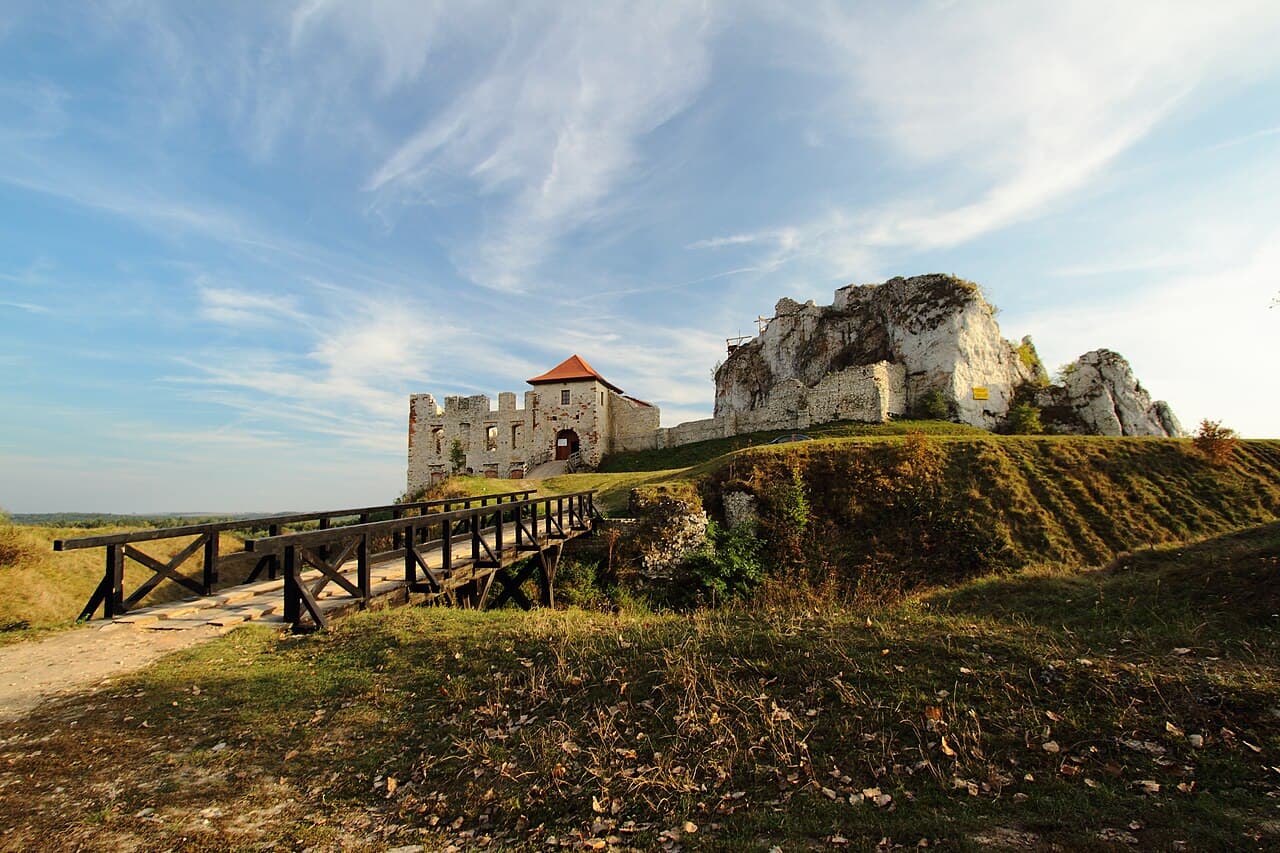
During the late 16th century, the castle underwent significant changes reflecting the shift from military fortress to noble residence. Under the stewardship of starosts such as Mikołaj Wolski and Zygmunt Myszkowski, the lower castle was transformed into a Renaissance palace with a three-winged, two-story layout comprising nearly forty rooms. The construction featured elegant residential spaces replacing earlier defensive structures. The entrance was fortified by a northern gate tower known as the Sławkowska gate, accessed via a drawbridge over a dry moat, underscoring the blend of defense and comfort.
One of the castle's most celebrated historical moments was the 1583 wedding feast hosted by Hetman Jan Zamoyski, who married Gryzelda Batory, niece of King Stefan Batory. This event highlighted Rabsztyn's status as a prestigious noble residence during the Renaissance.
Military conflicts and destruction
Rabsztyn Castle witnessed military action during the late 16th century, notably in 1587-1588 when a small garrison commanded by Colonel Gabriel Hołubek successfully ambushed and defeated a 350-strong force of Silesian soldiers supporting the Habsburg pretender Maximilian during the siege of Kraków. This event underscored the castle's ongoing strategic importance despite its transition to a residence.
However, the castle's fortunes declined sharply during the Swedish Deluge in 1657 when retreating Swedish troops looted and set fire to the fortress, causing extensive damage. Although some repairs were attempted, the castle was never fully restored to its former glory. By the early 18th century, the starost's residence had moved to a nearby manor, and the castle gradually fell into ruin.
In the 19th century, treasure hunters further devastated the site by dynamiting the upper castle's tower and parts of the remaining structures, significantly reducing the visible remains.
Architectural remains and modern restoration
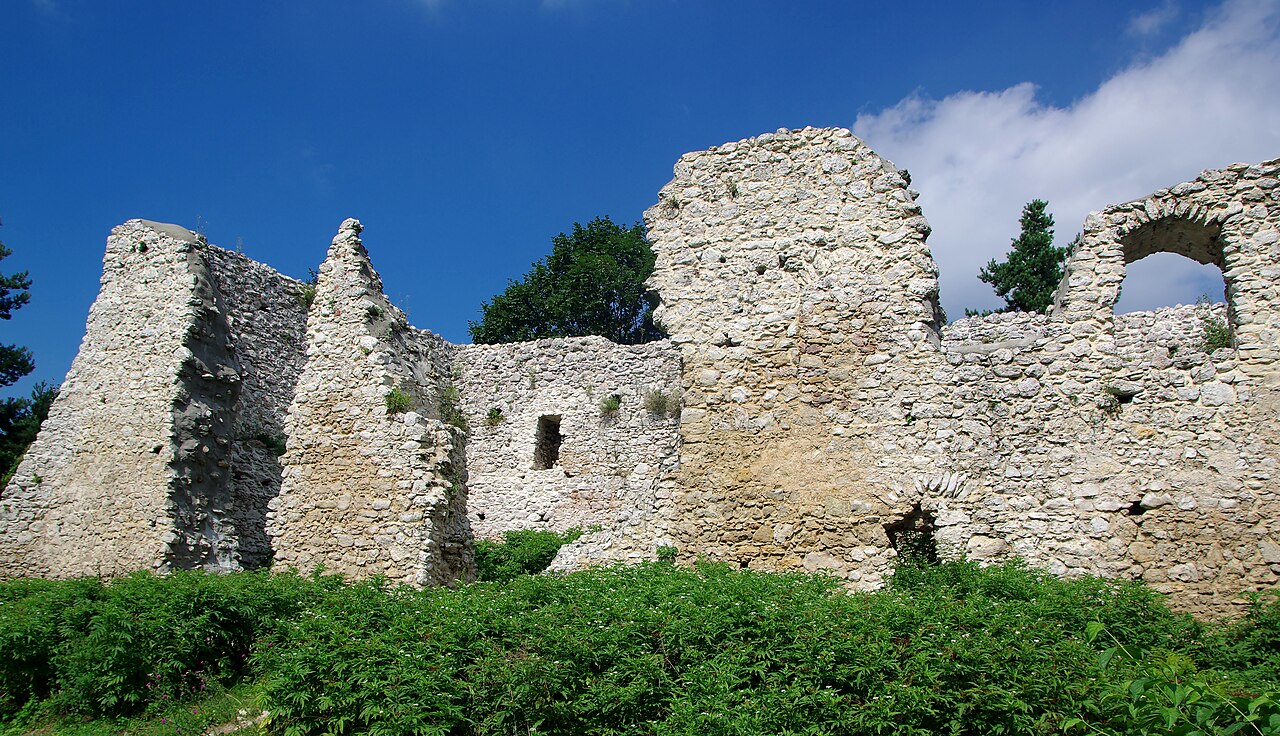
Today, Rabsztyn Castle exists as picturesque ruins that illustrate the site's architectural evolution from a medieval fortress to a Renaissance palace complex. The upper castle ruins include parts of the donjon tower and residential buildings perched on the inaccessible limestone rock. Below lie the remains of the middle castle with its courtyard, gate, and a deep well that once supplied water during sieges.
The lower castle's Renaissance palace survives only as external walls, outlining the grand scale of the former residence. Defensive features such as the dry moat, curtain walls, and the restored Sławkowska gate with its drawbridge remain visible. Recent conservation efforts have focused on stabilizing the ruins and reconstructing key elements, including the gatehouse rebuilt in 2009, which now houses a small historical exhibition about the castle's rich past.
Archaeological excavations have confirmed the sequence of construction phases and revealed details about the castle's adaptation to changing military technologies, including artillery earthworks added in later periods.
Historical significance and cultural heritage
Rabsztyn Castle is an important cultural landmark within the Polish Jura region, embodying centuries of Polish history, from medieval border defense to Renaissance aristocratic life. Its name likely derives from the German "Rabenstein," meaning "raven's rock," reflecting either the natural environment or the identity of early founders.
As part of the "Eagle's Nests" trail, Rabsztyn attracts visitors interested in medieval architecture, military history, and the Renaissance noble lifestyle. The castle's dramatic ruins offer a tangible connection to Poland's turbulent past and the evolution of castle design over several centuries.
Visitors today can explore the partially restored ruins, enjoy panoramic views from the hilltop, and learn about the castle's storied history through exhibitions housed in the gatehouse. The site hosts cultural events and educational programs, contributing to the preservation and appreciation of Poland's architectural heritage.
Frequently asked questions (FAQ)
- How do I get to Rabsztyn Castle?
- Rabsztyn Castle is located in the village of Rabsztyn in Lesser Poland Voivodeship. It is accessible by car and local buses from Kraków and Olkusz, with parking available near the site.
- What is the best time to visit Rabsztyn Castle?
- The castle is best visited during the spring through early autumn months when the weather is favorable, and the surrounding landscape is lush and accessible.
- Is Rabsztyn Castle suitable for children and families?
- Yes, the castle ruins are open to visitors of all ages. The site offers an educational experience with exhibitions and scenic views, but caution is advised on uneven terrain and steep rocky areas.
- Are there guided tours available at Rabsztyn Castle?
- Guided tours are occasionally available, especially during the tourist season and cultural events. Visitors can also explore the site independently using informational panels and brochures.
- What architectural styles are represented at Rabsztyn Castle?
- Rabsztyn Castle showcases primarily Gothic architecture in its medieval upper castle structures, complemented by Renaissance elements in the lower castle palace built in the late 16th century.
Photo gallery

Information
Opening hours
10:00-18:00, daily
Ticket prices
Free
Current owner
Municipality
Website
Visit websiteSources & official resources
Verify the information above using these authoritative references.
Loading map...
Visitor reviews
No reviews yet. Been here? Write the first review and help other travelers!
Write the first reviewVisited this castle? Share your experience
Your review helps other travelers and adds first-hand knowledge to our encyclopedia.