Pyrmont Castle
Pyrmont Castle (German: Burg Pyrmont) is a high medieval hill castle located in the municipality of Roes, in the district of Cochem-Zell, Germany. Perched on a prominent slate rock outcrop above the Elzbach waterfall in the southern Eifel mountains, the castle commands sweeping views of the surrounding landscape. Its strategic position and robust fortifications reflect the military and residential needs of the noble families who controlled it since its construction in the late 12th century.
Early history and noble lineage
Burg Pyrmont was constructed in the late 12th century by Kuno von Schönburg, a nobleman serving under the count palatine of the Holy Roman Empire. The first documentary mention of the castle dates to 1225, marking its establishment as a significant noble residence. The castle's early history is closely tied to the Schönburg family, with Kuno’s son, Cuno II, adopting the title "Lord of Pyrmont," solidifying the castle's status as a seat of regional power.
During the 15th century, the castle's ownership became fragmented when Cuno VI von Pyrmont divided the estate among his three sons, leading to internal disputes. These conflicts escalated to the point where Henry VI, one of the heirs, was placed under the Reichsacht (imperial outlawry). The intervention of Emperor Maximilian I restored Henry VI's status by elevating him to the rank of Freiherr (baron), reaffirming his control over Pyrmont Castle.
The castle later passed to the influential Eltz family through the marriage of Elisabeth, Henry VI’s daughter, to Philip of Eltz. However, inheritance disputes persisted, resulting in the partial sale of the castle to the Waldbott von Bassenheim family in 1652. By 1725, the Waldbott family had consolidated full ownership, including shares previously held by the Electorate of Trier.
Architectural evolution and baroque transformation
Starting in 1712, the Waldbott family undertook extensive renovations that transformed Pyrmont Castle from a medieval fortress into a baroque residence. The main residential building, or palas, was raised to three stories, with the addition of large windows and an open staircase on the southern façade to enhance light and accessibility. These changes reflected the shift from purely defensive architecture to more comfortable noble living quarters.
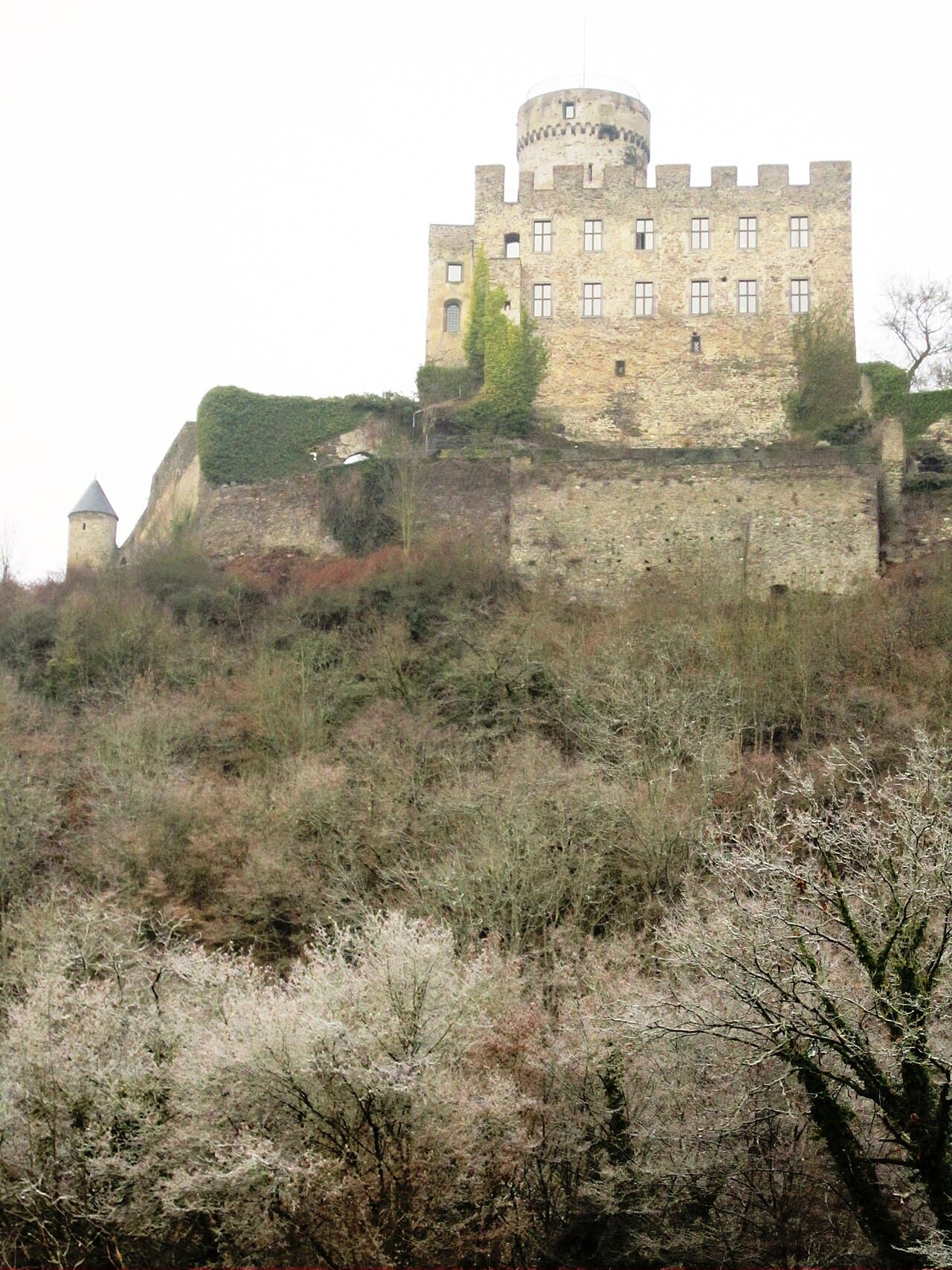
The castle's layout is an irregular rectangular plan characteristic of the Staufer period (12th-13th centuries). Its most prominent feature is the 24.5-meter-high round bergfried, the first of its kind in the Middle Rhine region. This stone tower includes two vaulted ceilings, multiple fireplaces, and a conical roof that now serves as an open viewing platform. Beneath the bergfried lies the Sodbrunnen, a 49-meter-deep well essential for sustaining the castle during sieges.
The 15th-century zwinger surrounds the inner ward, featuring round towers and defensive walls. While most domestic buildings within the zwinger have not survived, the large storage cellar known as the Fuderkeller remains intact. A deep neck ditch separates the zwinger and inner bailey from the outer bailey, enhancing the castle’s defensive capabilities.
The main castle complex includes the palas, an attached cookhouse, and the bergfried. The palas houses an entrance hall, a great hall called the Rittersaal, smaller chambers, and remnants of a chapel. The cookhouse’s ground floor contains a reconstructed kitchen space, providing insight into the domestic life of the castle’s inhabitants.
Decline, restoration, and modern use
The castle’s peaceful existence was disrupted during the upheavals of the French Revolution in the late 18th century. The owners fled, and in 1794 the French state declared the castle national property. It was auctioned in 1810, leading to neglect and partial demolition during the 18th and 19th centuries. Valuable materials were sold off, and the castle fell into ruin.
Count Friedrich Karl Waldbott von Bassenheim repurchased the estate in 1818 but lacked resources for restoration. The castle changed hands multiple times without significant rebuilding until 1912, when architect Franz Krause’s family made parts of the castle habitable again. A major restoration effort began in 1963 under architects Helmut Hentrich and Hubert Petschnigg, culminating in the castle’s public opening in 1990.
Today, Pyrmont Castle features restored interiors that reflect its historical ownership and architectural evolution. The outer bailey includes modern amenities such as a souvenir shop and restaurant integrated into the historic structures. Restoration has also revived the former drawbridge, the forecourt (vorburg), and the deep neck ditch, enhancing visitor experience while preserving the castle’s medieval character.
Castle grounds and surrounding landscape
The castle is surrounded by an 18th-century baroque park with a pond and partial stone wall enclosure. The southern and western slopes bear traces of historic vineyards, indicating the estate’s agricultural past. Below the castle, a garden supported by dry stone walls contains a fish pond, which appears to have been left unfinished.
Its location near a watermill on the Elzbach stream highlights the castle’s integration into the local economy and landscape. The surrounding natural features, including the slate rock outcrop and waterfall, contribute to the castle’s dramatic setting and defensive advantages.
Architectural significance and heritage value
Pyrmont Castle is an important example of a Staufer period hill castle with significant medieval military architecture adapted through centuries into a baroque noble residence. Its round bergfried is a pioneering structure in the Middle Rhine region, and the castle’s layered history reflects the complex feudal and political dynamics of the Holy Roman Empire.
The castle’s preservation and restoration efforts have maintained its historical fabric while adapting it for public access and education. It serves as a cultural landmark in the Eifel region, illustrating the evolution of castle architecture from the high medieval period through the baroque era and into modern times.
Frequently asked questions (FAQ)
- How do I get to Pyrmont Castle?
- Pyrmont Castle is located near the town of Roes in the Cochem-Zell district of Germany. It is accessible by car and public transport, with parking available nearby. Visitors should check local travel guides for the best routes.
- What are the opening hours of Pyrmont Castle?
- The castle is generally open to the public from spring through autumn, with specific opening hours varying seasonally. It is recommended to check the official website or contact the castle management for current visiting hours.
- Is Pyrmont Castle suitable for families with children?
- Yes, Pyrmont Castle offers a family-friendly environment with spacious grounds and engaging historical exhibits. The castle’s viewing platform atop the bergfried provides panoramic views that appeal to visitors of all ages.
- Can I take guided tours at Pyrmont Castle?
- Guided tours are often available, providing detailed insights into the castle’s history, architecture, and restoration. Visitors should inquire in advance to confirm availability and tour times.
- What architectural styles are represented at Pyrmont Castle?
- Pyrmont Castle primarily exhibits <strong>high medieval</strong> architecture with significant <strong>baroque</strong> modifications from the 18th century. Its <strong>Staufer period</strong> origins are evident in its irregular rectangular layout and defensive structures.
Photo gallery

Information
Sources & official resources
Verify the information above using these authoritative references.
Loading map...
Visitor reviews
No reviews yet. Been here? Write the first review and help other travelers!
Write the first reviewVisited this castle? Share your experience
Your review helps other travelers and adds first-hand knowledge to our encyclopedia.