Eltz Castle
Eltz Castle is a remarkable example of a medieval hill castle nestled in the scenic hills above the Moselle River, between the historic cities of Koblenz and Trier in Germany. This castle is uniquely significant as it remains under the ownership of the same noble family, the Eltz family, who first established residence here in the 12th century. Over 33 generations have lived within its walls, making it one of the few castles in Europe continuously inhabited by the original family lineage. Notably, the castle has never been destroyed, preserving its medieval character and architectural integrity through centuries of European history.
Positioned strategically on a 70-meter-high rock spur surrounded on three sides by the Elzbach River—a tributary of the Moselle—Eltz Castle enjoys a naturally defensible location. This geographical advantage was crucial in the Middle Ages, not only for protection but also for controlling and taxing trade along the important Rhine-Moselle trade route. The castle's location in a small wooded valley with the river looping around it created a formidable natural fortress, which was enhanced by the castle's construction.
The origins and historical development of Eltz Castle
The castle's foundation dates back to approximately 1157, with the first documented mention in a donation deed by Emperor Frederick Barbarossa that named Rudolfus de Elze as the lord of the castle. Initially built to oversee and protect the trade route connecting the Moselle River and the Maifeld region, Eltz Castle quickly became a significant stronghold in the region.
Before 1268, the castle and its lands were divided among three brothers—Elias, Wilhelm, and Theoderich—who established three branches of the Eltz family. This division resulted in the castle becoming a Ganerbenburg, a jointly owned fortress where each branch built and maintained separate living quarters within the complex. These branches were known as Eltz-Kempenich, Eltz-Rübenach, and Eltz-Rodendorf, each named after their heraldic symbols and estates. This unique arrangement allowed the castle to function as three castles in one, sharing common areas such as the courtyard and the well.
The Eltz feud and later ownership changes
Between 1331 and 1336, Eltz Castle was involved in the Eltz Feud, resisting the territorial expansion of Archbishop Baldwin of Trier. Baldwin constructed the siege castle Trutzeltz nearby and bombarded Eltz Castle with catapults during a two-year siege. Ultimately, the defenders surrendered, and the Eltz family lost their imperial immediacy, becoming vassals to the Archbishopric of Trier.
Despite this setback, the castle remained in the family’s hands and underwent significant expansions from the late 15th to the 17th centuries. The Rodendorf houses were built between 1490 and 1540, the Rübenach house was completed in 1472 and expanded around 1520, and the Kempenich houses were constructed from 1604 to 1661. These expansions reflect the evolving architectural styles and functional needs of the three family branches.
Architectural features and layout
Eltz Castle is characterized by its elliptical layout on a rock spur, surrounded on three sides by the Elzbach river, which enhances its defensive capabilities. The castle complex consists of multiple independent residential towers grouped by the three family branches, reflecting its status as a Ganerbenburg. Each branch maintained separate living quarters but shared communal spaces like the great hall and chapel.
The oldest structures and architectural styles
The oldest part of the castle is the Romanesque bergfried, or keep, known as Platt-Eltz. Its lower five floors date from the early 12th century, while the upper Gothic section was added between 1252 and 1300. The roofs are covered with Mayen slate, a material restored during recent renovations to preserve the castle’s historic appearance.
The Rübenach house, completed in 1472 and expanded around 1520, is an eight-story building that includes a 19th-century armory room displaying original medieval weapons such as chainmail, helmets, and firearms from the 15th and 16th centuries. It also houses a chapel with late Gothic stained glass and frescoes, and a vaulted cellar that serves as the treasure chamber containing over 500 art objects from the 12th to 19th centuries.
The Rodendorf houses, constructed between 1490 and 1540, feature a courtyard façade with a vaulted porch supported by three pillars. Inside is the Rittersaal, a large hall used for family gatherings, decorated with baroque and rococo furnishings. A rare Renaissance bed from 1525 is preserved here, illustrating the castle’s rich interior heritage.
The Kempenich houses, built from 1604 to 1661, showcase timber framing with carefully articulated facades. An octagonal stair tower rises above a well that supplied water to the entire castle. Basalt pillars support a vaulted porch bearing inscriptions dating the construction phases. Though damaged by fire in 1920, this section was restored by 1930, maintaining its historical integrity.
Interior features and treasures
The castle contains approximately 20 medieval garderobes (toilets) equipped with rainwater flushing systems, a rarity for the period. Interior decoration includes valuable artworks such as Lucas Cranach the Elder’s oil painting "Madonna with Child and Grapes," Flemish tapestries from the 16th and 17th centuries, and a Liber Vitae illumination attributed to Michael Pacher or his workshop.
The treasure chamber in the Rübenach house holds a rich collection of gold and silverwork from Augsburg, a 1.10-meter statue of Saint John of Nepomuk by Franz Christoph Mäderl (1752), a circa 1600 sculpture of Diana on a stag, ceremonial vessels, and porcelain from China, Delft, and Westerwald. The collection also includes clocks from the 16th to 18th centuries and drinking vessels shaped as grotesque figures, highlighting the castle’s historical wealth and artistic patronage.
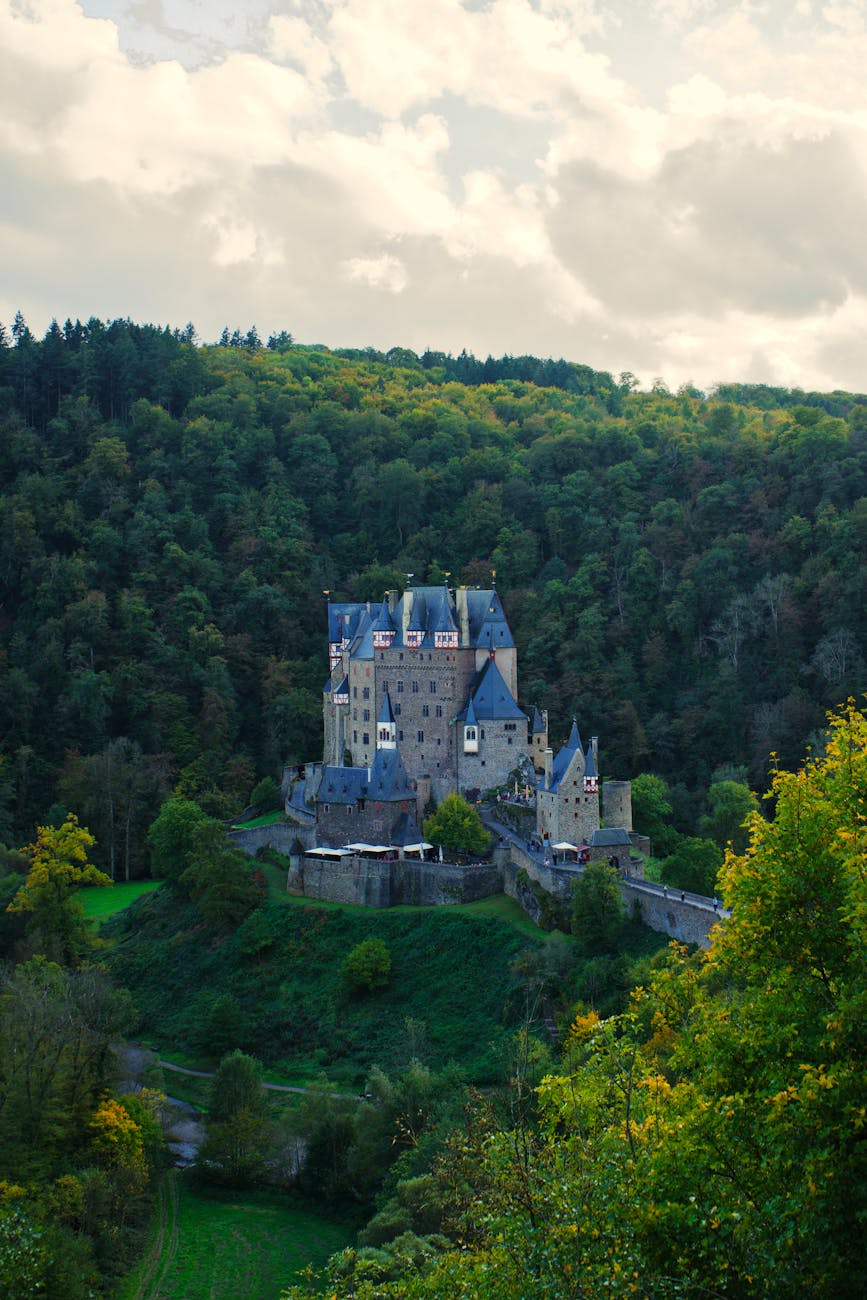
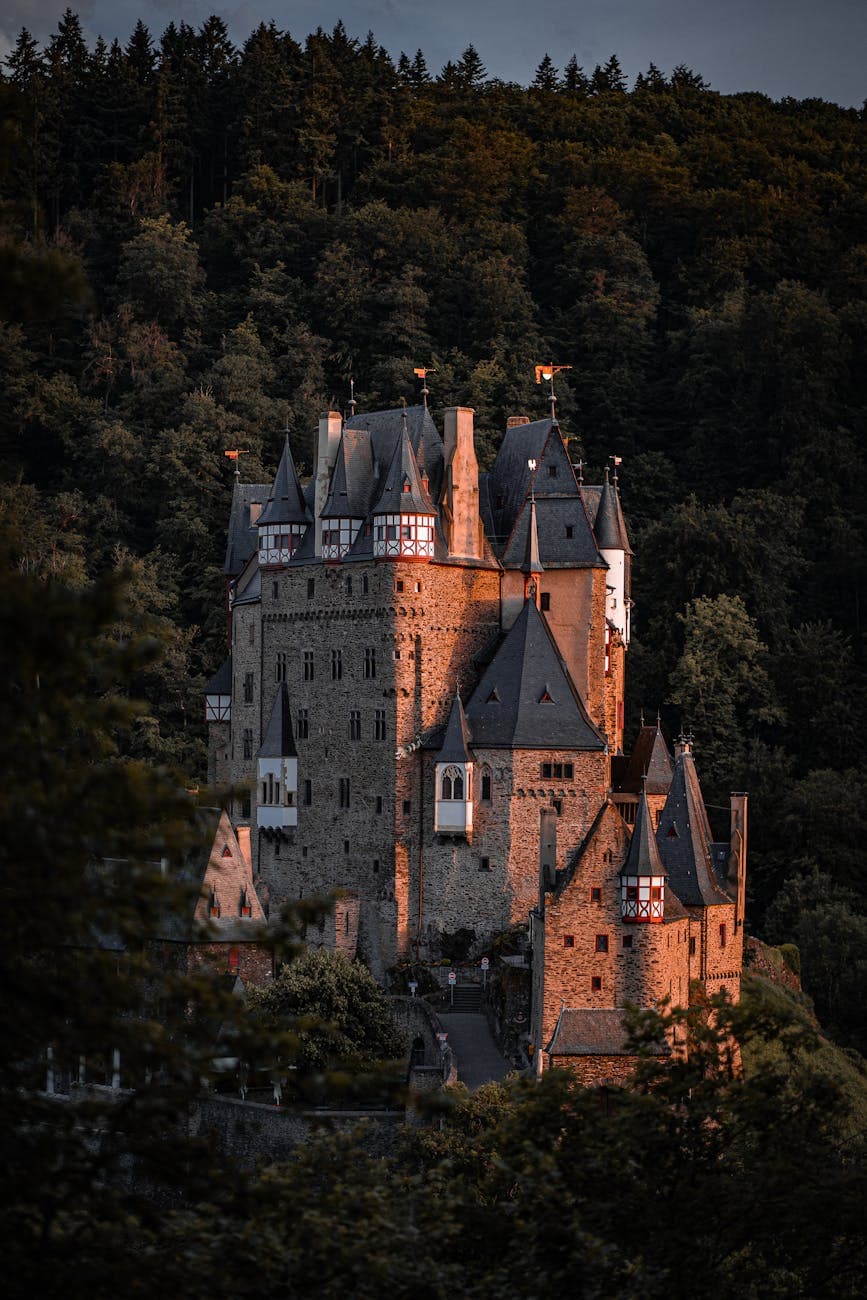
Photo by Oliver S.
Photo by Oliver S.
Preservation and restoration efforts
Eltz Castle has been remarkably well preserved, having never been destroyed throughout its history. It is one of only three castles on the left bank of the Rhine in Rhineland-Palatinate that have remained intact, alongside Bürresheim and Lissingen castles.
In the 19th century, Count Karl zu Eltz led a careful restoration from 1845 to 1888, investing significant resources to preserve the castle’s authentic medieval character rather than romanticizing it as many other restorations of the period did. This approach respected the castle’s historical fabric and architectural details.
A fire in 1920 caused damage to parts of the castle, including the southern Kempenich house, chapel, archive, and upper floors of the Rodendorf house. Restoration was completed by 1930, restoring the damaged sections faithfully.
More recently, between 2009 and 2012, extensive structural stabilization and restoration were undertaken to address threats to the castle’s tall buildings. Stainless steel anchors up to 25 meters long were installed to reinforce the structure. These works also conserved historic plaster, half-timber facades, and Gothic wall paintings. The outer walls and ancillary buildings, including the Goldsmith’s House and the Old Bastion, have been maintained to preserve the castle’s integrity for future generations.
Eltz Castle today and visitor experience
Today, Eltz Castle remains privately owned by the Eltz family, with Dr. Karl Graf representing the 33rd generation. The castle is a popular tourist destination, with parts of it open to the public, including the Rübenach and Rodendorf family residences. Visitors can explore the castle’s treasury, featuring gold, silver, and porcelain artifacts, as well as the armory displaying medieval weapons and suits of armor.
The castle’s impressive towers, some reaching up to 40 meters in height, and its over 100 rooms provide a vivid glimpse into medieval noble life. The castle’s location, architectural complexity, and continuous family ownership make it an exceptional cultural and historical monument in Germany.
From 1965 to 1992, the castle’s engraving appeared on the German 500 Deutsche Mark banknote, underscoring its national significance and iconic status.
Frequently asked questions (FAQ)
- How do I get to Eltz Castle from Koblenz?
- Eltz Castle is approximately 30 kilometers from Koblenz and can be reached by car or public transport. Visitors often drive to the nearby parking area and then walk about 15 minutes through a forested path to the castle entrance.
- What is the best time of year to visit Eltz Castle?
- The castle is open year-round, but the best time to visit is during late spring to early autumn when the weather is mild, and the surrounding landscape is lush and green. This period also offers longer daylight hours for exploring.
- Can I tour the interior of Eltz Castle?
- Yes, guided tours are available for parts of the castle, including the Rübenach and Rodendorf family residences. Visitors can view the treasury, armory, and various historical rooms showcasing medieval architecture and artifacts.
- Is Eltz Castle accessible for visitors with mobility issues?
- Due to its medieval hilltop location and historic structure, Eltz Castle has limited accessibility for visitors with mobility impairments. The path to the castle involves uneven terrain and stairs, so visitors should plan accordingly.
- What are the opening hours and ticket prices for Eltz Castle?
- Eltz Castle is typically open daily from 9:30 AM to 5:30 PM during the main tourist season. Ticket prices vary, with adult admission around €12 and discounts for children, students, and groups.
Photo gallery

Photo by Clément Proust
Photo by Clément Proust


Information
Website
Visit websiteSources & official resources
Verify the information above using these authoritative references.
Loading map...
Visitor reviews
No reviews yet. Been here? Write the first review and help other travelers!
Write the first reviewVisited this castle? Share your experience
Your review helps other travelers and adds first-hand knowledge to our encyclopedia.