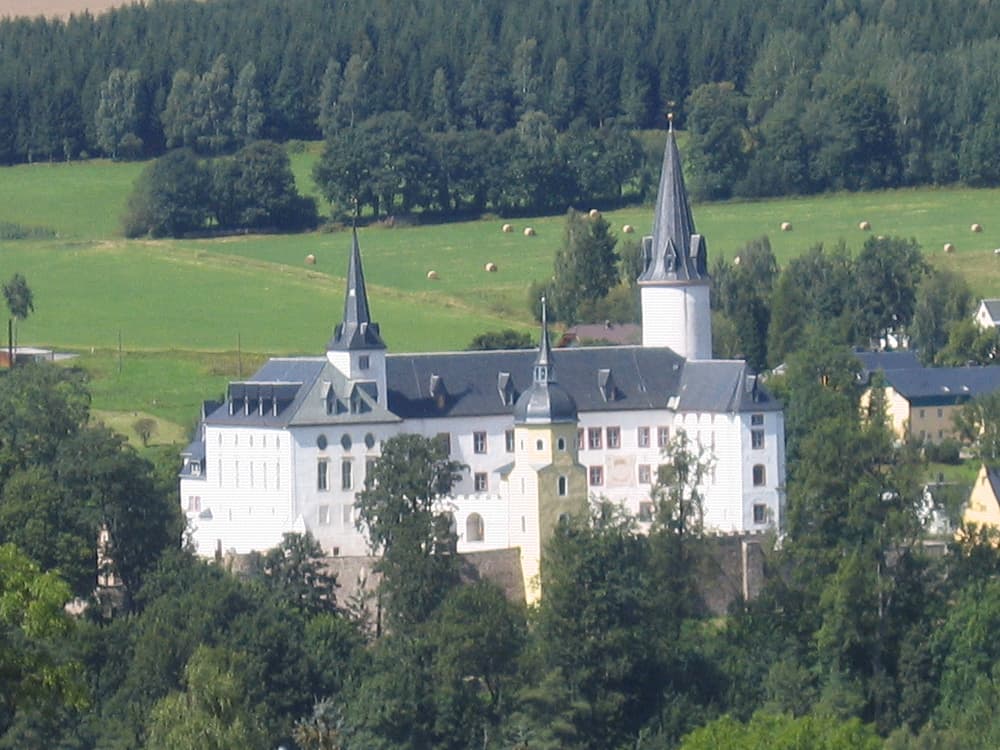
Purschenstein Castle
Purschenstein Castle, located on a south-facing hill above the Flöha River near Neuhausen in Germany, is a remarkable example of a medieval hill castle that evolved through centuries of historical events and architectural transformations. Founded around the late 12th century, most likely circa 1200 by Boresch I (Borso) of the Slavic Hrabischitz family, the castle originally served as a toll and escort fortress. Its strategic purpose was to protect the vital salt trade route known as the Old Bohemian Steig, which connected Leipzig in Central Germany to Prague in Bohemia, passing through the Deutscheinsiedler Saddle near Neuhausen.
Medieval origins and strategic significance
The castle's initial name, "Castrum Borsensteyn", reflects its founder's name and its early medieval roots. The first documented mention of Purschenstein Castle dates to 1289, under this name. During the high medieval period, the castle played a crucial role in controlling and securing trade routes that were essential for economic exchange between German and Bohemian territories. Its location on a hill spur provided commanding views of the surrounding landscape, including the nearby Schwartenberg hill and the town church of Neuhausen, underscoring its strategic importance.
Ownership transitions and feudal ties
Throughout the 13th and 14th centuries, the castle changed hands several times. The Margraves of Meissen acquired the castle and its lands in the 13th century, and in 1350 it was granted as a fief to the von Riesenburg family. However, only two years later, control reverted to Margrave Friedrich the Strict. Around two decades after that, the castle passed to the von Schönberg family, who maintained ownership for over 500 years. The von Schönbergs were influential nobles whose legacy is still visible in the castle park, where their family crypt is located.
Architectural evolution and styles
Originally constructed as a spur castle with defensive features typical of the high medieval period, Purschenstein Castle underwent significant architectural transformations reflecting changing tastes and needs. In 1550, the von Schönberg family initiated a major renovation, converting the medieval fortress into a Renaissance-style castle. This period saw the introduction of more refined residential and decorative elements, moving beyond purely military functions.
Baroque modifications and expansions
The castle suffered considerable damage during the Thirty Years' War (1618–1648), particularly in 1642 and 1643, when large parts were burned or ruined. Subsequent restoration and expansion in the 18th century under Adam Rudolph von Schönberg introduced Baroque architectural elements. Between 1776 and 1789, the south wing was transformed into a Baroque chapel, and the north wing was remodeled in the Baroque style, adding elegance and grandeur to the castle’s appearance.
Medieval defensive features
Despite these stylistic changes, some original medieval defensive structures remain. The most prominent is the bergfried (keep), a tall tower standing 42 meters high with walls nearly 3 meters thick, dating from the 13th or 14th century. Archaeological investigations have revealed remnants of a moat and outer ramparts that once enhanced the castle's defenses, although these features have been partially obscured by later landscaping and construction.
Fires, damage, and restoration efforts
The castle's history is marked by several destructive fires and damage incidents. A lightning strike in 1800 caused serious harm, followed by a near-total destruction by fire in 1842. After World War II, the castle was expropriated from the von Schönberg family and experienced periods of neglect and varied uses, including as a party school, a Catholic children’s home, and a cultural center for the Free German Trade Union Federation (FDGB).
A devastating fire in April 1989 caused extensive damage to the structure. Restoration efforts began in 1990 and continued until 2001, focusing on preserving and stabilizing the remaining historic elements. These efforts allowed the castle to be adapted for new uses while respecting its architectural heritage.
Modern adaptation and current use
In 2005, the castle was purchased by Dutch businessman Roelof Praagman, who undertook extensive renovations to convert Purschenstein Castle into a luxury hotel known as the Schlosshotel Purschenstein. Today, it offers elegant accommodations, dining, and wellness facilities, blending historic charm with modern comfort. The castle also houses a museum dedicated to East German motorcycles, adding a unique cultural dimension to the site.
Heritage and archaeological significance
Purschenstein Castle is officially registered as an archaeological monument since 1968, recognizing its importance as a cultural and historical landmark. Its layered history from the high medieval period through the Renaissance and Baroque eras, combined with its survival through multiple destructions and restorations, makes it a valuable example of evolving castle architecture and regional history.
Castle layout and surviving structures
The castle complex originally extended approximately 170 meters in length and 50 meters in width, divided into three main sections at different elevations. The northern elevated core, about 75 by 50 meters, became the site of the Renaissance palace. The southern areas descended in terraces, with the middle section measuring roughly 50 by 40 meters, and the lowest section about 40 by 30 meters.
Archaeological digs in 1983 uncovered a moat surrounding the northern core, 8 to 10 meters wide and around 2 meters deep, along with an outer rampart about 8 meters wide. These medieval defensive features, while partially obscured, highlight the castle's original military function.
Today, the most striking medieval remnant is the bergfried, a testament to the castle’s defensive origins. The Baroque chapel in the south wing and the remodeled north wing showcase the castle’s architectural evolution. The castle’s hillside position continues to offer commanding views and a strong visual presence in the landscape around Neuhausen.
Frequently asked questions (FAQ)
- How do I get to Purschenstein Castle?
- Purschenstein Castle is located in Neuhausen, Germany, and can be easily reached by car or public transport. If you are driving, there are parking facilities available nearby. For those using public transport, the nearest train station is a short bus ride away.
- What is the historical significance of Purschenstein Castle?
- Purschenstein Castle dates back to the 13th century and has played a vital role in the region's history. It served as a defensive stronghold and residence for noble families, showcasing the architectural styles of various periods. The castle also has fascinating stories related to local legends and historical events.
- When was Purschenstein Castle last renovated?
- Purschenstein Castle underwent significant renovations in the late 20th century to restore its historical features and ensure visitor safety. The restoration focused on preserving its medieval architecture while enhancing the visitor experience. Ongoing maintenance is conducted to keep the castle in excellent condition.
- Can I take guided tours of Purschenstein Castle?
- Yes, guided tours are available at Purschenstein Castle, providing a deeper insight into its history and architecture. Tours are conducted in multiple languages and typically last about an hour. It is advisable to book in advance, especially during peak tourist seasons.
- Why is Purschenstein Castle a popular tourist destination?
- Purschenstein Castle is popular due to its stunning architecture, rich history, and picturesque location. Visitors are drawn to its beautiful views of the surrounding area and the chance to explore a well-preserved medieval castle. The castle also hosts various cultural events throughout the year, adding to its appeal.
- Is it possible to visit Purschenstein Castle with children?
- Absolutely! Purschenstein Castle is family-friendly and offers activities that engage children. The castle grounds provide plenty of space for exploration, and guided tours are tailored to be interesting for all ages.
- What are the opening hours for Purschenstein Castle?
- Purschenstein Castle is typically open to visitors from 10 AM to 6 PM during the summer months and has reduced hours in the winter. It is recommended to check the official website or contact the castle directly for the most current opening hours. Special hours may apply during holidays or events.
- What are the ticket prices for visiting Purschenstein Castle?
- Ticket prices for Purschenstein Castle vary depending on age and group size, with discounts available for children and families. Adult tickets are generally priced around 8 euros, while children may enter for a reduced fee or for free on certain days. Group rates are also available for larger parties.
- What nearby attractions should I visit while at Purschenstein Castle?
- While visiting Purschenstein Castle, consider exploring the nearby town of Neuhausen, which offers charming shops and local cuisine. Additionally, hiking trails in the surrounding area provide stunning views and outdoor activities. Other historical sites, such as local museums and parks, are also within easy reach.
Photo gallery

Information
Website
Visit websiteSources & official resources
Verify the information above using these authoritative references.
Loading map...
Visitor reviews
No reviews yet. Been here? Write the first review and help other travelers!
Write the first reviewVisited this castle? Share your experience
Your review helps other travelers and adds first-hand knowledge to our encyclopedia.


