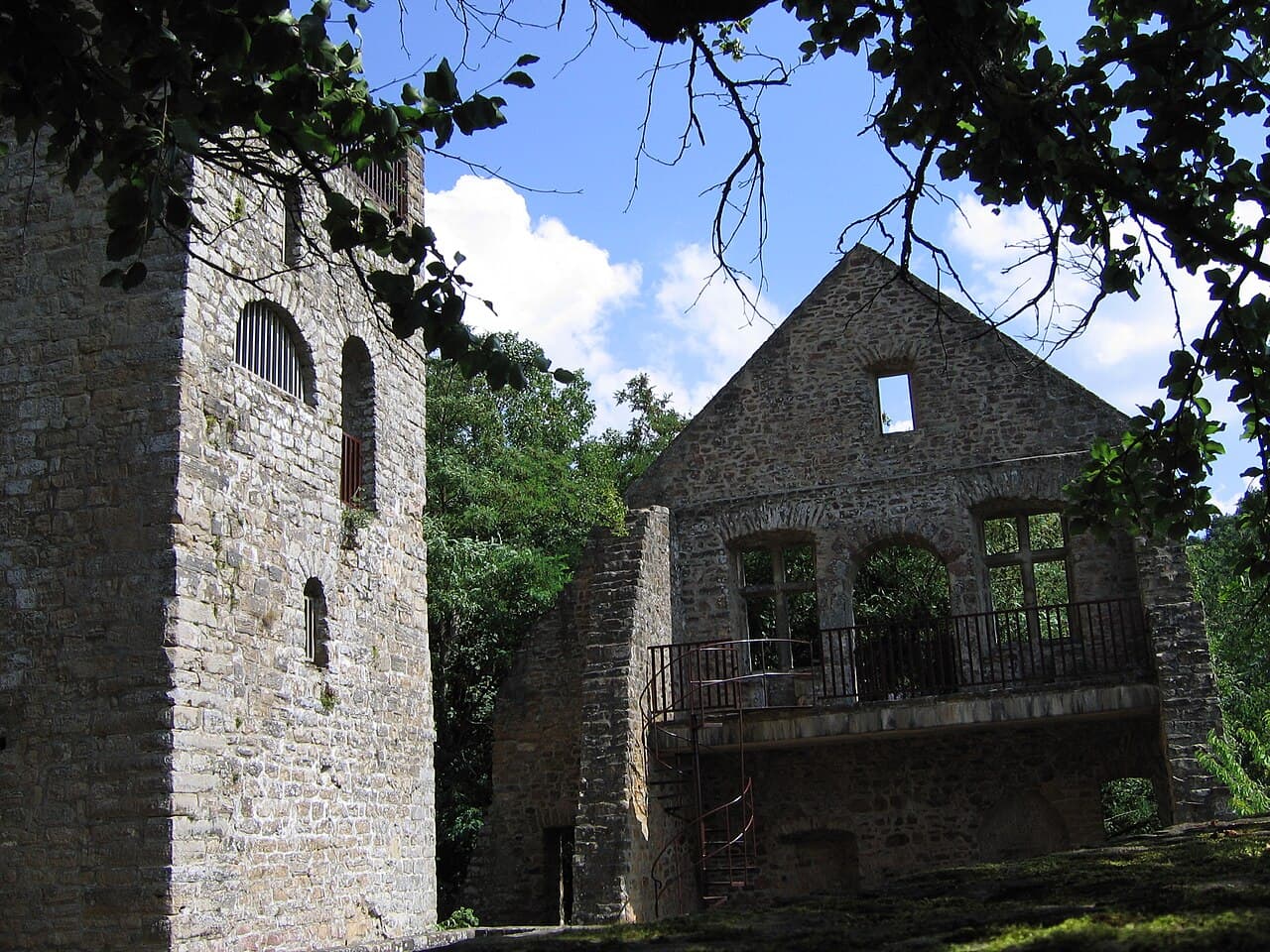
Prüm Castle
Prüm Castle, also known locally as Prümerburg, stands as a significant high medieval hill castle ruin perched above the village of Prümzurlay, south of Bitburg in the Rhineland-Palatinate region of Germany. This castle is a remarkable example of medieval fortification architecture and noble residence, with origins tracing back to the 12th century. Its strategic location on a roughly 30-metre-high lias-sandstone rock provided commanding views over the upper valley of the Prüm River, making it a formidable defensive site in its time.
Early history and construction
The origins of Prüm Castle are believed to date from the 12th century, likely constructed by a paladin named Matfried, who was associated with the legacy of Charlemagne. Although the castle is first documented in records from 1337, archaeological and historical evidence suggests its establishment during the high medieval period. The castle initially served as a fief under the counts and dukes of Luxembourg, reflecting the complex feudal allegiances of the region.
Interestingly, the castle's site is adjacent to the remains of a much earlier prehistoric hillfort (known locally as Wallburgen), indicating the long-standing strategic importance of this elevated position.
Architectural features and layout
Today, visitors can observe the consolidated remains of the castle's 12th and 13th-century pentagonal bergfried (a type of fortified tower typical in German castles), which served as a central defensive stronghold and lookout point. The bergfried's unique pentagonal shape distinguishes Prüm Castle from many other medieval castles, reflecting specific defensive adaptations to the terrain.
In addition to the bergfried, remnants of a 15th and 16th-century palace facade are visible, indicating that the castle was not only a military fortress but also a noble residence that evolved architecturally over the centuries. A cellar structure also survives, providing insight into the storage and domestic arrangements of the castle's inhabitants.
Nearby, the late Gothic chapel of St. Nicholas has endured, located northwest in the valley below the main castle site. This chapel is an important religious and cultural landmark, representing the spiritual life connected to the castle's community.
Historical significance and ownership
The castle's history is intertwined with notable noble families and feudal lords. The first recorded vassal was Walter of Meysenburg in 1337. By 1351, the castle was held by Godfrey of Meysenburg and his wife, Catharina of Homburg. Subsequently, the lordship of Prümzurlay passed to the lords of Brandenburg, a side line of the counts of Vianden.
Later, the castle was associated through marriage with the families of von Vinstingen and von Haracourt, reflecting the common practice of consolidating power and property through noble alliances. In the early modern period, a branch of the von der Heyden family acquired the lordship, which included Prüm Castle along with nearby estates such as Niederweis and Stolzemburg.
Destruction and current state
Prüm Castle suffered significant damage during the Dutch-French War in 1658, when it was burnt down. Since then, it has remained a ruin, with various conservation efforts undertaken to stabilize and preserve the remaining structures.
The site is freely accessible to the public, offering visitors a tangible connection to the medieval past through its ruins. The castle's pentagonal keep, palace facade, and cellar remain the primary visible elements, consolidated to prevent further decay.
Cultural and touristic importance
As a ruined hill castle with a rich history spanning from the high medieval period through the early modern era, Prüm Castle holds significant cultural heritage value in the Rhineland-Palatinate region. It attracts history enthusiasts, architectural scholars, and tourists interested in medieval fortifications and noble residences.
The castle's location offers scenic views of the Prüm valley and surrounding landscapes, enhancing its appeal as a destination for hiking and historical exploration. The nearby chapel of St. Nicholas adds religious and architectural interest to the visit.
Access and visitor information
The ruins of Prüm Castle are open to the public free of charge, with no formal visitor facilities on site. The terrain involves a climb up the sandstone rock, so visitors should be prepared for a moderate hike. The site is best visited during daylight hours and favorable weather conditions to fully appreciate the castle's historical context and natural setting.
Architectural legacy
Prüm Castle exemplifies typical features of high medieval hill castles in Germany, including the use of natural rock formations for defense, the construction of a bergfried as a last refuge, and the evolution of castle architecture from purely military to residential functions over time. Its pentagonal bergfried is a distinctive architectural element, rare among German castles, highlighting the ingenuity of medieval builders in adapting to site-specific challenges.
Frequently asked questions (FAQ)
- How do I get to Prüm Castle?
- Prüm Castle is located above the village of Prümzurlay in Rhineland-Palatinate, Germany. Visitors can reach the site by local roads leading to An der Wallburg, followed by a short hike up the sandstone rock where the ruins stand.
- What is the historical significance of Prüm Castle?
- Prüm Castle dates back to the 12th century and was a fief of the counts and dukes of Luxembourg. It played a role in regional feudal politics and was associated with several noble families over the centuries.
- Can I visit the ruins of Prüm Castle?
- Yes, the ruins of Prüm Castle are freely accessible to the public. There are no entrance fees, but visitors should be prepared for uneven terrain and a moderate climb to the castle site.
- When was Prüm Castle destroyed?
- Prüm Castle was burnt down in 1658 during the Dutch-French War and has remained a ruin since then.
- What architectural features remain at Prüm Castle?
- The main surviving features include the pentagonal bergfried from the 12th and 13th centuries, a palace facade from the 15th and 16th centuries, and a cellar. The nearby late Gothic chapel of St. Nicholas also survives.
Photo gallery

Information
Address
An der Wallburg, Prümzurlay, Germany
Loading map...
Visitor reviews
No reviews yet. Been here? Write the first review and help other travelers!
Write the first reviewVisited this castle? Share your experience
Your review helps other travelers and adds first-hand knowledge to our encyclopedia.



