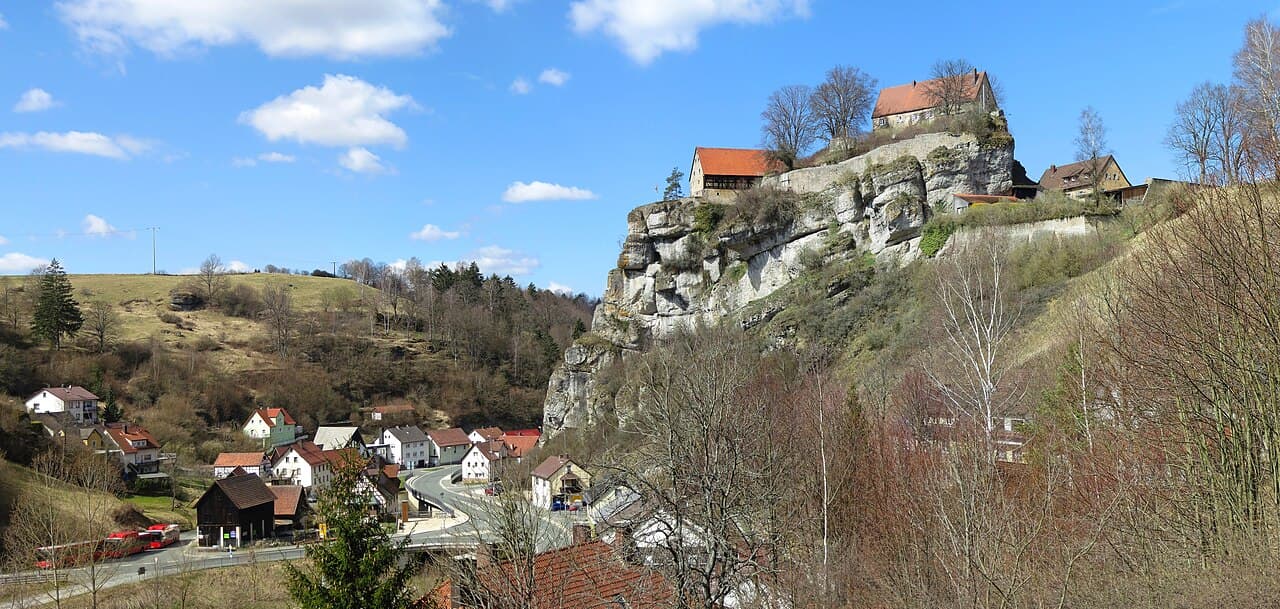
Pottenstein Castle
Pottenstein Castle stands as one of the most ancient and historically significant castles in Franconian Switzerland, a picturesque region in the German state of Bavaria. Perched atop a commanding rock outcrop overlooking the town of Pottenstein, this hill castle offers a striking example of medieval fortification and architectural evolution spanning nearly a millennium. It remains a prominent cultural landmark, housing a museum that presents a rich collection of artifacts reflecting the castle's multifaceted history and the broader heritage of the region.
Constructed between 1057 and 1070 by Boto, younger brother of Count Palatine Aribo II, Pottenstein Castle was originally established to secure the strategic area between the Upper Main and Pegnitz rivers. Its location atop a west-facing hill spur at approximately 410 meters elevation provided natural defensive advantages, overseeing the valleys of the Püttlach and Weihersbach rivers. The castle's foundation marked the beginning of a centuries-long role as a military stronghold and administrative center within the Bishopric of Bamberg.
Early history and strategic significance
Before Boto's construction, the site belonged to Margrave Otto of Schweinfurt around 1050 and was passed to his daughter Judith, who married Boto after her first husband's death. This alliance fortified Boto's claim, who took the title "Count of Pottenstein," asserting control over the region. Although some unverified theories suggest the castle's origins may date back to King Conrad I around 918, no archaeological or documentary evidence supports this.
Following Boto's death in 1104 without heirs, the castle was sold to the Bishopric of Bamberg around 1102. It then became the seat of a ministerialis family—unfree knights serving the bishopric—who adopted the name von Pottenstein. Prominent family members included Wezelo (circa 1121), Rapoto (1169), Erchenbert (1185–1221), and Conrad (1240–1248). The castle's role shifted from a noble residence to a fortified administrative hub.
Administrative role and architectural development
From the early 14th century, Pottenstein Castle served as the administrative center (Amt) for the Bishopric of Bamberg, overseeing a growing judicial district that absorbed smaller offices until the mid-17th century. The castle was managed by a vogt or advocate, who resided in the Vogteihaus in the lower ward. By the 18th century, due to the difficult ascent, the vogt and later the pfleger (administrator) moved their residence to buildings in the town below.
The castle complex includes an upper main building featuring notable rooms such as the Knight's Hall, the Red Salon, and the Elizabeth Room. The Elizabeth Room, located in the former residential tower on the west side of the palas (main living quarters), commemorates the stay of Saint Elizabeth of Thuringia during 1227–1228, an event of religious and cultural significance.
Military history and conflicts
Pottenstein Castle's strategic importance meant it was involved in several significant conflicts. During the Peasants' War of 1525, the castle was occupied and plundered by peasants but spared from destruction to maintain local protection against external forces such as the Count Palatine, the Margrave, and the city of Nuremberg.
In the Second Margrave War, the castle was bombarded and captured by margravial troops on 18 May 1553. This assault caused heavy damage, including the destruction of the castle chapel in the upper ward, which was never rebuilt. The castle also withstood a Swedish raid during the Thirty Years' War in 1634, when defenders repelled the attack by raising the drawbridge after a deceptive approach by a trumpeter, who was subsequently executed.
During the War of the Spanish Succession (1703–1704), a garrison was stationed at Pottenstein Castle. An oven was installed in the dilapidated bergfried (main tower) in 1703 to serve the soldiers. The castle's military role diminished after 1712, leading to its eventual abandonment as a fortress.
Decline, preservation, and museum establishment
Following the secularization of 1803, when the Bishopric of Bamberg's properties were transferred to the Bavarian state, Pottenstein Castle fell into ruin. In 1878, it was purchased by Heinrich Kleemann, a pharmacist from Nuremberg, who initiated preservation efforts. After his death in 1890, the castle was neglected until 1918, when it was acquired by the von Wintzingerode family, who have maintained it as a private residence and museum.
Today, the castle operates as a museum displaying prehistoric and early historical artifacts, collections of weapons, books, autographs, and ethnographic objects. The museum's rooms, including the Knight's Hall, Red Salon, and Elizabeth Room, offer visitors an immersive experience of the castle's medieval and Renaissance heritage.
Architectural features and castle grounds
Pottenstein Castle is a classic example of a spur castle built on a natural rock outcrop, utilizing the terrain for defense. Its construction primarily employs local stone, contributing to its robust and enduring structure. The castle's bergfried, though partially ruined, remains a prominent feature, symbolizing the medieval military architecture. The installation of an oven in the bergfried during the early 18th century illustrates adaptations for garrison use.
The Vogteihaus in the lower ward, once the residence of the castle's vogt, was known as the "Old Vogtei" by the 18th century. Due to accessibility challenges, administrative functions gradually moved to the town. The castle grounds also include a well house exhibiting collections of porcelain, glass, ceramics, and ethnographic artifacts.
Visitors can explore the upper floors of the main building, the remains of the bergfried, and the well house, as well as the castle gardens that offer panoramic views over Pottenstein and the surrounding countryside. The gardens enhance the visitor experience by combining natural beauty with historical ambiance.
Cultural and heritage significance
Pottenstein Castle is not only a monument of military and administrative history but also a cultural beacon reflecting the region's evolution from the High Middle Ages through the Renaissance and beyond. Its association with figures such as Saint Elizabeth of Thuringia adds spiritual and historical depth. The ongoing preservation by the von Wintzingerode family ensures that the castle remains a vital link to Bavaria's medieval past and a valuable resource for education and tourism.
The castle's museum and exhibitions contribute to the understanding of regional history, showcasing artifacts that span prehistoric times to early modern periods. This continuity of heritage makes Pottenstein Castle a unique destination for those interested in history, architecture, and culture.
Frequently asked questions (FAQ)
- How do I get to Pottenstein Castle?
- Pottenstein Castle is located on a hill above the town of Pottenstein in Bavaria, Germany. It is accessible by foot via a well-marked path from the town center, which takes about 10-15 minutes to climb.
- What are the opening hours of Pottenstein Castle museum?
- The museum at Pottenstein Castle is open daily from 10:00 to 16:00. It is advisable to check for seasonal variations or special closures before planning your visit.
- What is the historical significance of Pottenstein Castle?
- Pottenstein Castle is one of the oldest castles in Franconian Switzerland, built in the 11th century. It served as a military stronghold, administrative center for the Bishopric of Bamberg, and was involved in several historical conflicts including the Peasants' War and the Second Margrave War.
- Can I tour the castle gardens?
- Yes, visitors can explore the castle gardens, which offer panoramic views of the town of Pottenstein and the surrounding countryside, enhancing the historical experience.
- Is there an entrance fee for Pottenstein Castle?
- Yes, there is an entrance fee to visit the castle museum. Tickets cost €5 for adults and €3 for children, supporting the maintenance and preservation of the site.
Photo gallery

Photo by Rainer Lippert, bearbeitet durch Alchemist-hp This image was created with Hugin.•CC0
Information
Sources & official resources
Verify the information above using these authoritative references.
Loading map...
Visitor reviews
No reviews yet. Been here? Write the first review and help other travelers!
Write the first reviewVisited this castle? Share your experience
Your review helps other travelers and adds first-hand knowledge to our encyclopedia.



