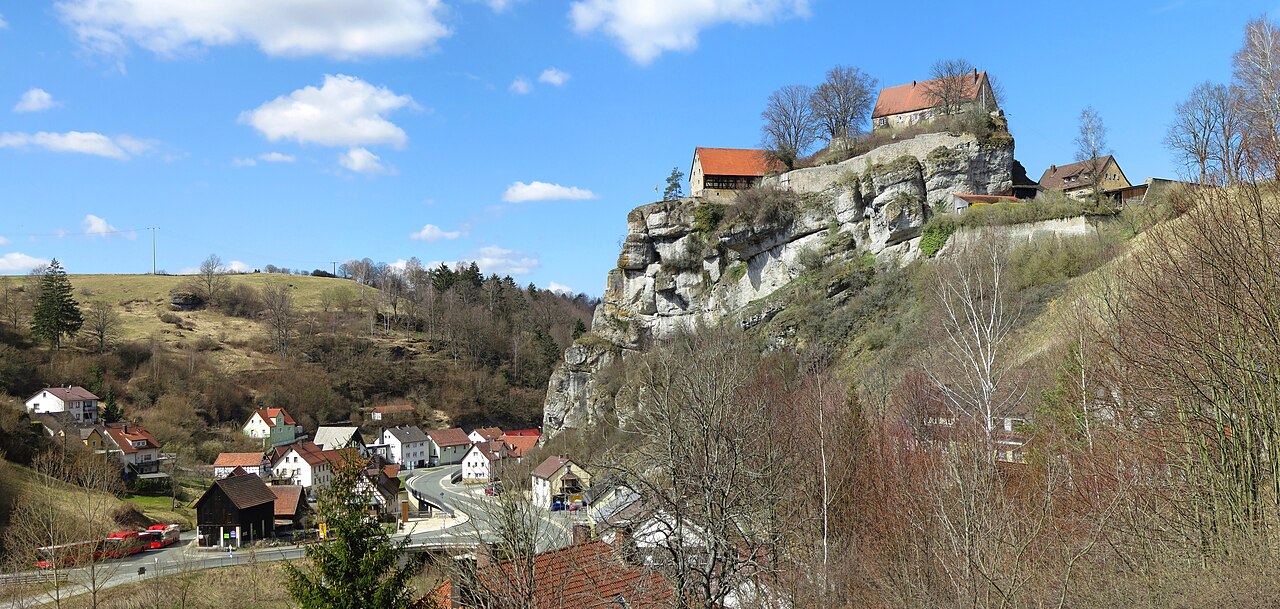
Lower Tüchersfeld Castle
Lower Tüchersfeld Castle, known in German as Burgruine Niederntüchersfeld, is a notable medieval ruin located in the village of Tüchersfeld within the municipality of Pottenstein, in the Upper Franconian county of Bayreuth, Bavaria. This spur castle is perched on a prominent rock pinnacle at the heart of the village, with the remains of the adjacent Upper Tüchersfeld Castle situated on a nearby rock tower. The castle's strategic position reflects its historical importance in controlling the surrounding landscape of the Franconian Switzerland region.
Early history and construction
The castle was originally constructed in the 13th century, with the first documented mention dating to 1269. It was established during the high medieval period as a fortified stronghold typical of the era, designed to secure territorial control and oversee trade routes. On 27 May 1262, the castle was acquired by Bishop Berthold of Leiningen of Bamberg, indicating its significance within the ecclesiastical and regional power structures of the time.
Ownership and feudal status
By the mid-14th century, the castle's two parts were distinguished in official records. The Upper Castle served as the seat of a district or Amt established before 1323–27, functioning as an administrative center. Meanwhile, Lower Tüchersfeld Castle was held as a fief by the noble family Groß of Trockau, illustrating the feudal complexities of the region. This division of ownership highlights the castle's dual role in governance and military defense.
Architectural features
Lower Tüchersfeld Castle was built as a spur castle, a type of fortification constructed on a projecting rock spur, utilizing natural rock formations to enhance its defenses. The castle included a rock tower and defensive walls adapted to the rugged terrain. While much of the original structure has been lost, surviving remnants include sections of walls and the rock tower that once formed part of the castle's defensive core.
Destruction and decline
The castle endured significant damage during several historic conflicts. In 1430, it was destroyed amid the Hussite Wars, a series of religious and political conflicts in Central Europe. The fief holder, Groß, undertook reconstruction efforts following this devastation. However, the castle faced further destruction in 1525 during the Peasants' War, when widespread uprisings led to the razing of many noble estates.
The final blow came during the Thirty Years' War in 1636, when the castle was destroyed once again. By 1691, official records described the site as "totally desolate," marking the end of its military and residential use as a noble fortress.
Post-medieval history and Jewish settlement
Following its decline as a fortress, the castle ruins became the site of a Jewish settlement around 1700. This community, known as the "Jew's Court" or Judenhof, grew to include 44 residents by 1755. The settlement was destroyed by fire in 1758, but the ruins were integrated into new buildings constructed between 1758 and 1762.
In 1959, the site was sold to private owners. A major renovation took place from 1981 to 1983, after which the Franconian Switzerland Museum opened in 1985, preserving the cultural heritage of the area and providing public access to the historic site.
Current condition and cultural significance
Today, Lower Tüchersfeld Castle remains a ruined fortress with only a few wall fragments and the rock tower surviving. Despite its ruined state, the site is an important cultural landmark in Franconian Switzerland, reflecting the region's medieval history, its role in regional conflicts, and its later significance as a Jewish settlement site. The castle's integration into the museum complex allows visitors to explore the layered history of this unique location.
Frequently asked questions (FAQ)
- What is the historical significance of Lower Tüchersfeld Castle?
- Lower Tüchersfeld Castle, located in Pottenstein, Germany, dates back to the 12th century and served as a stronghold for the local nobility. It played a crucial role in the region's defense and governance during the medieval period, showcasing the architectural style and strategic importance of castles in that era.
- When was Lower Tüchersfeld Castle built?
- The construction of Lower Tüchersfeld Castle began in the early 12th century, making it one of the oldest castles in the region. Over the centuries, it underwent various renovations and expansions, reflecting the changing architectural styles and historical needs of its inhabitants.
- Can I visit Lower Tüchersfeld Castle?
- Yes, Lower Tüchersfeld Castle is open to the public, allowing visitors to explore its historic grounds and appreciate the stunning views of the surrounding landscape. Guided tours are often available, providing insights into the castle's rich history and architecture.
- What are the opening hours for Lower Tüchersfeld Castle?
- Lower Tüchersfeld Castle typically opens its doors to visitors from April to October, with specific hours varying by season. It’s recommended to check the official website or contact the castle administration for the most current opening hours before planning your visit.
- Is it possible to access Lower Tüchersfeld Castle with mobility issues?
- While Lower Tüchersfeld Castle is a historic site, accessibility may be limited due to its medieval structure and terrain. Visitors with mobility challenges are encouraged to contact the castle administration in advance to inquire about available accommodations and options for accessible routes.
- What is the best time to visit Lower Tüchersfeld Castle?
- The best time to visit Lower Tüchersfeld Castle is during the late spring and early autumn when the weather is mild and ideal for exploring the outdoor areas. Additionally, these seasons often feature fewer crowds, allowing for a more enjoyable experience.
- Are there any nearby attractions to visit while in Pottenstein?
- Yes, Pottenstein offers several nearby attractions, including the famous Pottenstein caves and scenic hiking trails in the Franconian Switzerland region. Visitors can also explore charming local shops and enjoy traditional German cuisine in the area.
- What are the ticket prices for Lower Tüchersfeld Castle?
- Ticket prices for Lower Tüchersfeld Castle are generally affordable, with discounts often available for students and seniors. It’s advisable to check the official website for the latest pricing information and any special offers before your visit.
Information
Loading map...
Visitor reviews
No reviews yet. Been here? Write the first review and help other travelers!
Write the first reviewVisited this castle? Share your experience
Your review helps other travelers and adds first-hand knowledge to our encyclopedia.