Potstejn Castle
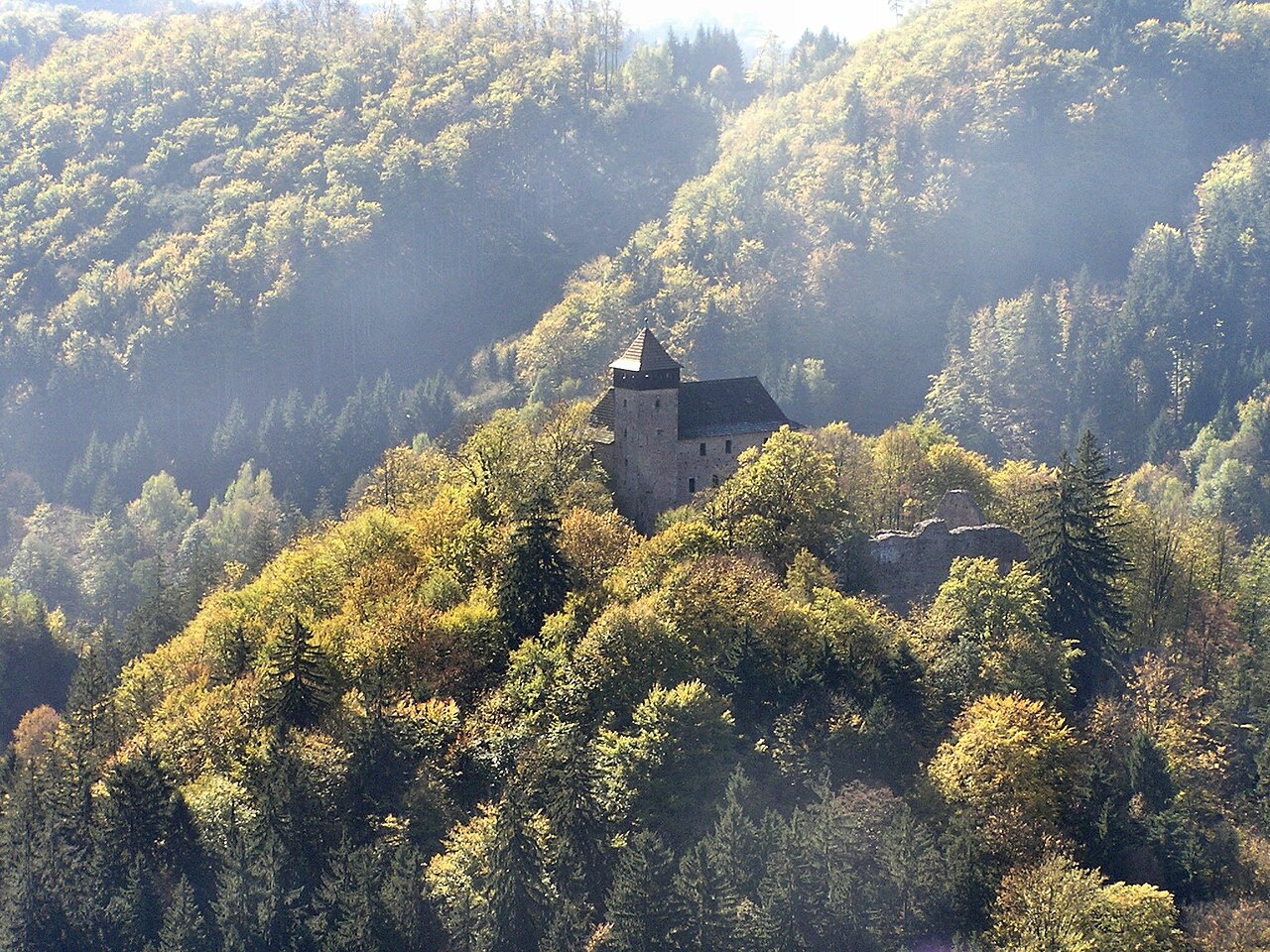
Potštejn Castle stands as a significant medieval hill castle in the Czech Republic, perched atop a forested conical hill near the village of Potštejn. Its origins date back to the late 13th century, marking it as a noteworthy example of high medieval fortification in the Bohemian region. The castle’s name derives from its founder, Půta of the Drslavic family, originally known as "Puttenstein," which evolved into Potštejn over time.
The castle played a turbulent role during the early 14th century when it was controlled by Procek and his son Mikuláš of Potštejn. Mikuláš became infamous as a robber knight, opposing the Luxembourg dynasty and provoking a siege in 1339 led by the future Emperor Charles IV. The castle was conquered and destroyed during this siege, and Mikuláš perished. Despite this, the royal authority restored much of the family’s holdings, though the castle itself remained under crown control. Charles IV later purchased Potštejn in 1356, initiating reconstruction efforts that enhanced its status as a royal estate.
Medieval origins and early history
Potštejn Castle was established during a period of regional colonization along the Divoká Orlice river, serving as a strategic stronghold in the Bohemian lands. The castle’s layout originally centered around a bergfried, a tall fortified tower typical of medieval fortresses, which served as the primary defensive stronghold.
Throughout the 14th and 15th centuries, the castle changed hands multiple times due to pledges, sales, and debts. It served as a refuge for the Hussite commander Bedřich ze Strážnice, who died there in 1459. The castle’s role during this period reflects the complex political and military landscape of Bohemia during the Hussite Wars and subsequent decades.
Renaissance rebuilding and architectural evolution
The castle’s most significant transformation occurred after its purchase in 1495 by Vilém II of Pernštejn, a powerful nobleman who undertook extensive rebuilding efforts. These renovations, carried out in the early 16th century, adapted the castle to the evolving demands of warfare by incorporating Renaissance defensive features. The upper castle was reshaped with the addition of an access corridor, two new curtain walls, and several semicircular bastions designed to accommodate firearms, reflecting the transition from medieval to early modern military architecture.
The curtain walls were robust, averaging 1.4 meters in thickness and about six meters high, topped with a battlemented wall walk that allowed defenders to move and fire along the ramparts. The bastions featured gunports for mounting heavy artillery, indicating the castle’s adaptation to the introduction of gunpowder weaponry.
Defensive features and layout
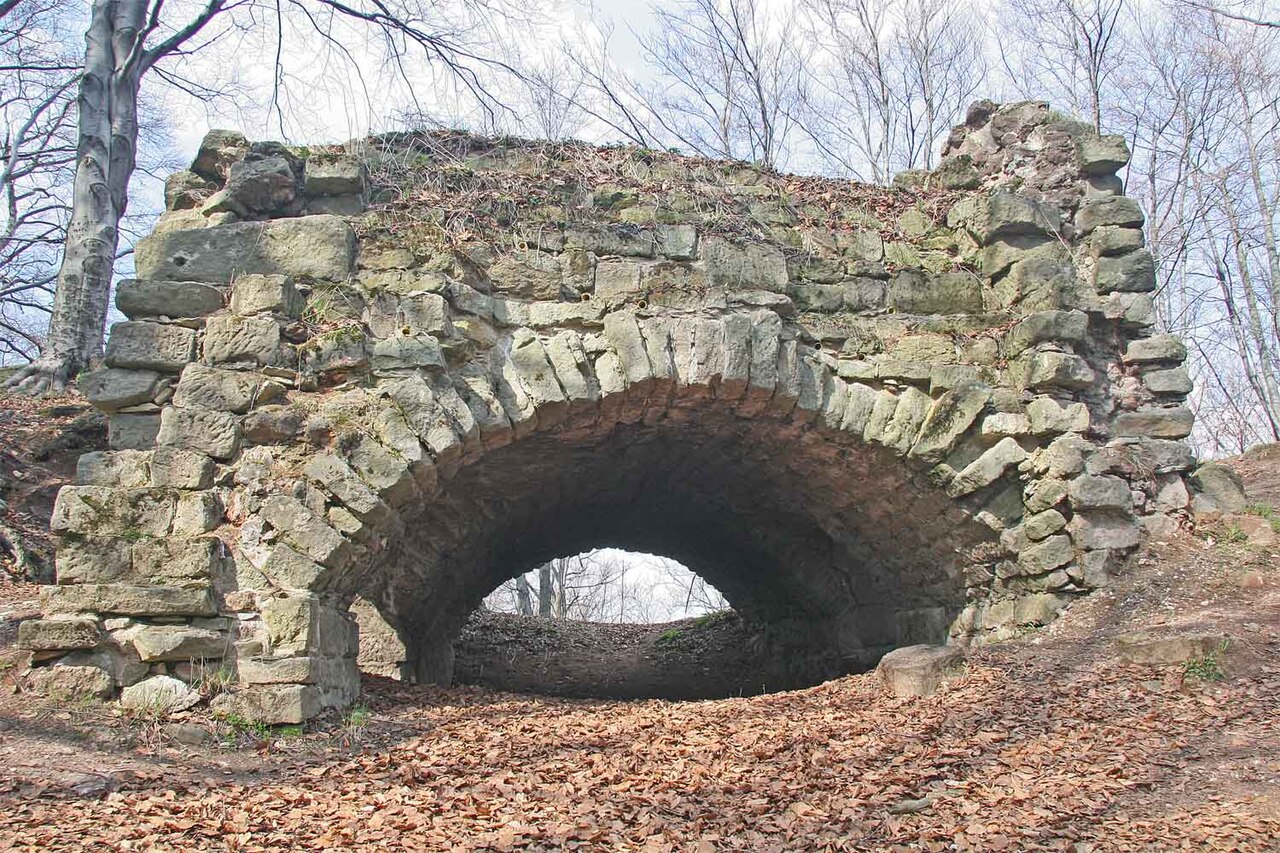
A key defensive element is the second gate, approached over a double masonry transverse ditch spanned by a drawbridge. The corridor leading to this gate is vaulted, and the adjacent bastion is earth-covered, forming a bolwerk—a fortified artillery outwork enhancing the castle’s resistance to siege. A cylindrical tower protected the castle’s well, connected to the corridor wall by a masonry neck, ensuring secure water access during attacks.
The upper castle was nearly enclosed by perimeter buildings with numerous stone architectural details, transforming it into a comprehensive defensive and residential complex. In the late 16th century, Renaissance modifications commissioned by Adam Šťastný of Harasov introduced residential upgrades, including adding a fourth floor to the fifth gate and renovating the northeast wing. These works, designed by the Italian architect Burian Gozzi, integrated Renaissance stylistic elements into the medieval structure.
Baroque additions and later history
In the 18th century, the noble family Harbuval Chamaré acquired the estate and added Baroque religious constructions within the castle precincts. The Chapel of the Holy Stairs, built between 1762 and 1766, remains well preserved and stands between the lower courtyard and the upper castle’s outer bailey. Another chapel dedicated to St. John of Nepomuk, constructed in the early 1750s, suffered fire damage shortly after completion, was repaired, but eventually fell into ruin.
A Baroque Stations of the Cross pathway connects the town church to the castle, culminating in a central Calvary near the northern part of the bolwerk by the second gate. These additions reflect the castle’s transition from a military fortress to a noble residence with religious significance during the Baroque period.
Decline, preservation, and cultural significance
By the 17th century, Potštejn Castle experienced economic decline, leading to partial abandonment and disrepair. The nearby town of Potštejn also suffered bankruptcy. The estate changed hands multiple times, with the Dobřenský of Dobřenice family owning it until 1945, when their properties were confiscated following political changes.
In the late 19th and 20th centuries, the ruins attracted visitors as a historical curiosity. Conservation efforts began in the 1930s but were interrupted by World War II. After 1989, the local municipality took ownership and opened the site to the public in 1994, initiating comprehensive preservation and adaptation works that continue today.
Potštejn Castle holds cultural importance as the setting for Alois Jirásek’s historical novel "Poklad" ("The Treasure"), which popularized legends of hidden treasure beneath its ruins. Despite numerous treasure hunts inspired by local folklore and a misinterpreted Latin inscription from the 18th century, no medieval hoards have been found.
Archaeological findings and current remains
Archaeological investigations at Potštejn have uncovered evidence of earlier settlement near the castle, including prehistoric artifacts linked to Lusatian and Silesian-plateau cultures. Medieval finds include pottery fragments, metal objects, and roof tiles, attesting to the site’s long history of occupation.
The surviving ruins occupy the summit of the hill and primarily represent the upper castle area. They include fragments of the palace, residential chambers, the chapel, extensive curtain walls with bastions, and two main gates. Conservation efforts in the late 20th century involved clearing vegetation, stabilizing structures, roofing the fourth gate, and partially restoring the front section of the fifth gate, which now serves as a prominent visual landmark.
Visitors to Potštejn Castle today can explore these ruins and enjoy panoramic views of the surrounding foothills and mountains, gaining insight into the castle’s architectural evolution from a medieval fortress to a Renaissance residence with Baroque additions.
Frequently asked questions (FAQ)
- How do I get to Potštejn Castle?
- Potštejn Castle is located near the village of Potštejn in the Pardubice Region of Czechia. It is accessible by car and local roads from nearby towns, with parking available near the village. Walking paths lead up to the castle ruins on the hill.
- What is the best time to visit Potštejn Castle?
- The best time to visit Potštejn Castle is during late spring to early autumn when the weather is favorable for exploring the hilltop ruins and enjoying panoramic views. The castle is open to visitors primarily during daylight hours.
- Are there guided tours available at Potštejn Castle?
- Guided tours are occasionally available, especially during the tourist season and special events. Visitors should check with the local municipality or visitor center for current information on tours and educational programs.
- What architectural styles are visible at Potštejn Castle?
- Potštejn Castle exhibits a blend of <strong>high medieval</strong> fortification features with significant <strong>Renaissance</strong> modifications and <strong>Baroque</strong> religious additions. The castle’s evolution reflects changing military and residential needs over several centuries.
- Is Potštejn Castle suitable for families and children?
- Yes, Potštejn Castle is suitable for families, offering an educational experience about medieval and Renaissance architecture and history. However, visitors should be prepared for uneven terrain and some climbing to reach the ruins on the hilltop.
Information
Sources & official resources
Verify the information above using these authoritative references.
Loading map...
Visitor reviews
No reviews yet. Been here? Write the first review and help other travelers!
Write the first reviewVisited this castle? Share your experience
Your review helps other travelers and adds first-hand knowledge to our encyclopedia.