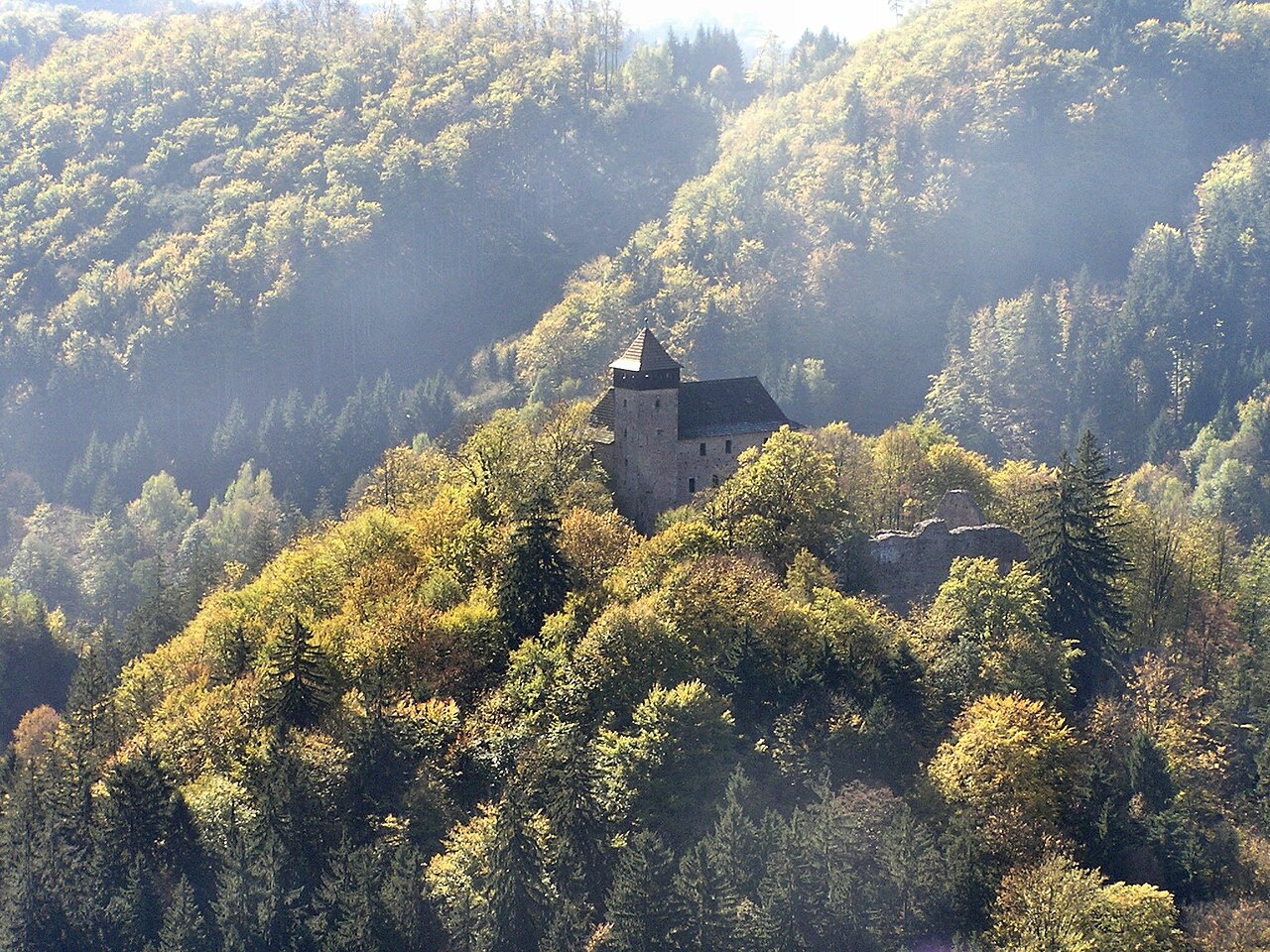
Brandýs nad Orlicí Castle
Brandýs nad Orlicí Castle stands as a significant medieval ruin in the Czech Republic, perched on a wooded hill between two waterways at the eastern edge of the town of Brandýs nad Orlicí. This hill castle reflects the strategic military architecture and noble residence typical of the Kingdom of Bohemia during the medieval period. Though once mistakenly attributed to Jindřich of Prostiboř, recent scholarship confirms the castle's existence by the early 14th century, linked to Sezema de Brandis, a noble figure documented as a financial guarantor near Českých Heřmanic.
Historical development and ownership
The castle's history is marked by a succession of prominent noble families, illustrating the shifting political and social landscape of Bohemia. In the early 14th century, Oldřich de Brandeiz resided nearby and was involved in disputes with the Lanšperk monastery estates, indicating the castle's role in regional power dynamics. The Boskovic family took control in the latter half of the 14th century, with Tas and his son Jan Všembera maintaining ownership until at least 1423. The castle briefly passed to Smil of Šternberk during the early 15th century, a period that coincides with the turbulent Hussite Wars.
By 1457, the Kostka family of Postupice acquired the castle, marking a new phase in its history. The castle was first explicitly mentioned as a notable structure in 1483. In 1506, Vilém of Pernštejn incorporated Brandýs nad Orlicí into his extensive East Bohemian estates. Following this acquisition, the castle's function as a noble residence ceased, and it was intentionally partially dismantled, leading to its decline into ruin.
Jan IV of Pernštejn sold the estate in 1544 back to Bohuš Kostka of Postupice, who adapted the old castle for habitation but soon began construction of a new chateau within the town. This transition marked the end of the castle as a dwelling place. Bohuš's architectural modifications represent the final significant changes to the castle's structure. After his death around 1557, ownership passed briefly to King Ferdinand I and then to Libuše of Lomnice, Bohuš's widow, and subsequently to Jan the Elder of Žerotín. The Žerotín family held the property until 1636, by which time the castle was recorded as deserted and in ruins.
Architectural features and defensive design
The castle's ruins occupy an elongated promontory, strategically positioned between a river and a stream, utilizing natural waterways for defense. The complex is divided into three main sections by artificial moats, enhancing its defensive capabilities. The first outer bailey retains traces of defensive walls and the remains of a rectangular building likely used for administrative or support functions.
The second outer bailey is marked by a large shield wall with rounded edges facing outward, a feature probably constructed after the Hussite Wars in response to evolving military technology, particularly artillery. This massive wall provided passive protection against cannon fire. Behind it lie the ruins of a rectangular building and fortifications including a ditch and earthen embankments that reinforced the castle's northern defenses.
At the core of the castle lies a rectangular central complex, believed to date from the initial construction phase. Within this core is a mound-like structure interpreted as a bergfried, a tall tower serving as a last refuge during sieges. The main residential building was modest in size, with only ground depressions indicating its former footprint.
Vaulted rooms with barrel-shaped stone ceilings survive in the southwestern and western sectors, suggesting later construction phases focused on reinforcing the castle's defensive and residential quarters. These vaulted chambers occupy space originally designated as the parkán or outer bailey, which surrounded the main palace and lined the southern edge of the core.
A prominent quadrangular extension projects from the southeastern part of the core, dating to the late 16th century. This structure represents some of the last significant architectural activity at the site. Its perimeter wall was stabilized during conservation efforts in 2013 and remains visible from the nearby valley, especially when the surrounding foliage is sparse.
The original entrance to the castle remains uncertain, with several scholarly theories proposing access from the northern side, the southern slope of the hill, or a western path crossing the neck ditch. This ambiguity reflects the complex defensive layout designed to control and delay attackers.
Decline, conservation, and archaeological findings
Brandýs nad Orlicí Castle fell into decline after the early 16th century as noble residences transitioned to more modern chateaux. By the mid-16th century, it was no longer occupied and was documented as deserted by 1632. The castle's gradual decay was recorded from the late 19th century through drawings, photographs, and postcards, showing a steady deterioration.
Efforts to preserve the site began with the local Beautification Society in 1884, which improved accessibility but did not undertake structural repairs. After 1944, the Czech Tourist Club leased the castle and initiated conservation work, focusing on securing walls, particularly on the southern side. Plans for further restoration were halted by political changes in 1948.
The castle gained legal protection as a cultural monument in the 1950s, preventing destructive modernization such as a proposed concrete viewing platform in the early 1960s. A wooden lookout tower built in 1964 was later removed due to safety concerns. Renewed preservation efforts resumed after 1989, culminating in the formation of the Association for the Rescue of Brandýs nad Orlicí Castle in 2004–2005. This organization directs ongoing reconstruction and stabilization based on detailed conservation plans and modern surveying techniques.
Archaeological metal detector surveys conducted between 2009 and 2011 uncovered medieval metal artifacts including arrowheads, horse equipment fragments, and various tools associated with daily and craft activities. These finds provide tangible evidence of the castle's active medieval life and function as a noble stronghold.
Visitor experience and cultural significance
Today, the ruins of Brandýs nad Orlicí Castle offer visitors a glimpse into the layered history and architectural evolution of a medieval Bohemian fortress. The site, surrounded by woodland and natural waterways, retains a romantic and evocative atmosphere enhanced by the visible remains of its defensive walls, vaulted chambers, and the bergfried mound.
Conservation efforts have stabilized the ruins, allowing safe exploration of the site and appreciation of its strategic layout. The castle's position on a hilltop provides scenic views of the surrounding East Bohemian landscape, making it a popular destination for history enthusiasts and hikers.
Interpretive signage and guided tours help visitors understand the castle's historical context, architectural features, and the significance of its noble owners. The ongoing archaeological work continues to enrich knowledge about the medieval period in this region.
Frequently asked questions (FAQ)
- When was Brandýs nad Orlicí Castle built?
- Brandýs nad Orlicí Castle was constructed during the medieval period, with the earliest confirmed records dating back to the early 14th century.
- What architectural features distinguish Brandýs nad Orlicí Castle?
- The castle features a rectangular core with a bergfried tower, multiple baileys separated by moats, a large post-Hussite shield wall, vaulted chambers, and a late 16th-century quadrangular extension.
- Is Brandýs nad Orlicí Castle accessible to visitors today?
- Yes, the castle ruins are accessible to visitors and have been stabilized through conservation efforts. The site offers scenic views and interpretive information to enhance the visitor experience.
- Why did Brandýs nad Orlicí Castle fall into ruin?
- The castle was partially dismantled after its acquisition by Vilém of Pernštejn in 1506 and ceased to be used as a noble residence, leading to its gradual decline and eventual abandonment by the early 17th century.
- What archaeological discoveries have been made at the castle?
- Metal detector surveys have uncovered medieval arrowheads, horse equipment fragments, and various craft and farm tools, providing insights into the castle's medieval occupation and daily life.
Information
Website
Visit websiteSources & official resources
Verify the information above using these authoritative references.
Loading map...
Visitor reviews
No reviews yet. Been here? Write the first review and help other travelers!
Write the first reviewVisited this castle? Share your experience
Your review helps other travelers and adds first-hand knowledge to our encyclopedia.