Litice Castle
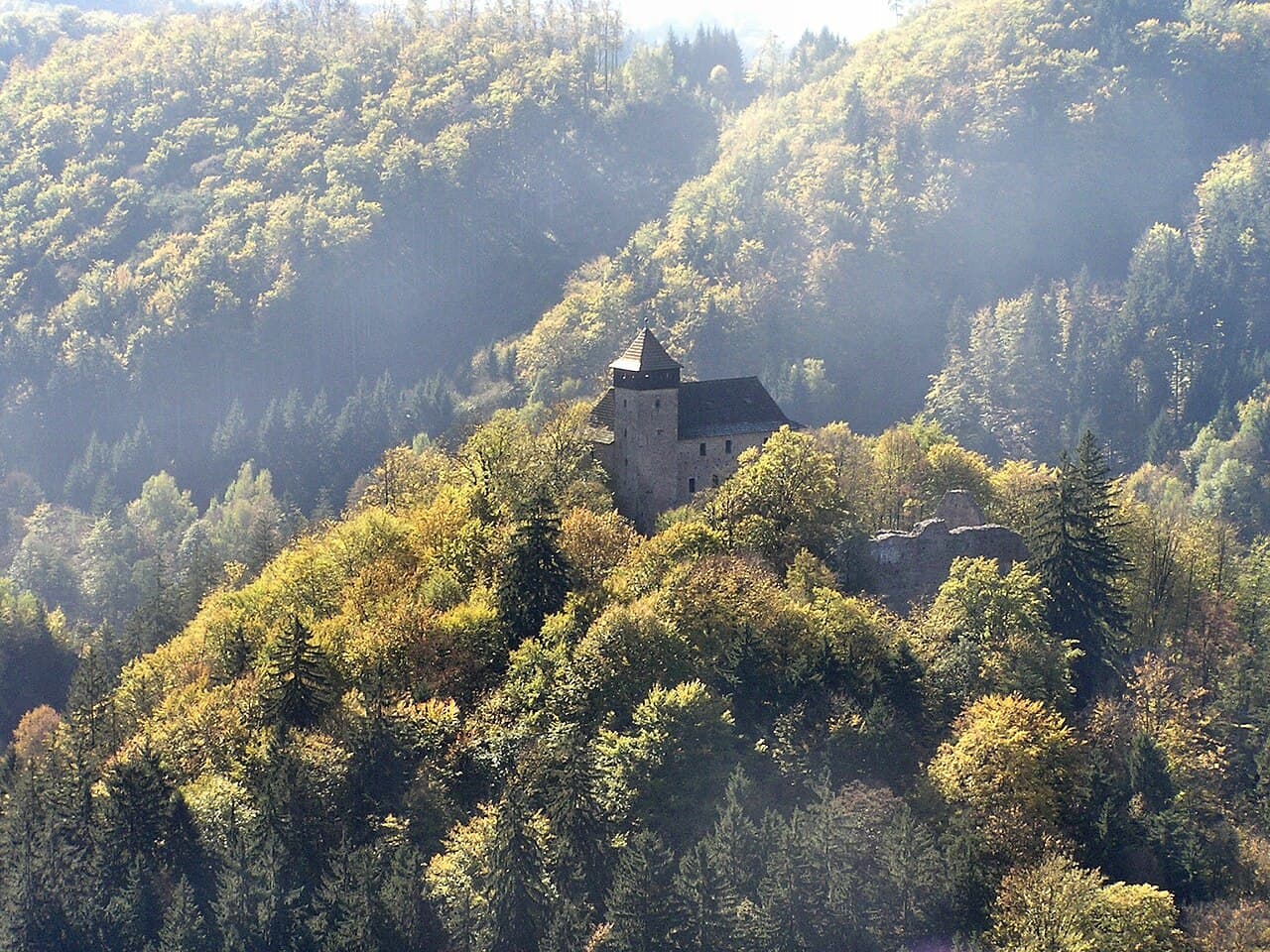
Litice Castle stands as a remarkable example of a medieval hill castle in the northeastern region of Bohemia, present-day Czechia. Founded in the late 13th century, it was strategically constructed atop a steep hill surrounded on three sides by a winding river, leveraging the natural landscape for defense. This location, in the forested borderlands of the time, was sparsely inhabited and under royal ownership, making the castle an essential stronghold for securing the region.
The castle was established by the Drslavic family, originally from southwestern Bohemia near Plzeň, who named the fortress after their ancestral home. Over centuries, Litice Castle evolved both architecturally and historically, reflecting the changing political and military landscape of Bohemia from the High medieval period through the Late medieval era.
Historical significance and ownership
In the early 14th century, Litice Castle gained political importance when it served as a prison for notable nobles such as Jindřich z Lipé in 1309. The castle's ownership shifted multiple times between influential families and royalty. After its founding family, the Drslavics, the castle came under the control of the royal family when King John of Bohemia pledged it to Jindřich mladší z Lipé in 1316. Later, in 1333, it was reacquired by Emperor Charles IV, a pivotal figure in Bohemian history, who consolidated royal power.
Subsequently, the castle passed to the Lords of Lichtenburk and then to the Kunštát family by 1371, who presided over it for nearly 150 years. Viktorin of Kunštát, a Hussite sympathizer closely allied with the general Jan Žižka, owned the castle during the turbulent Hussite Wars. In 1421, the fortress endured a siege by Silesian princes, sustaining damage but withstanding the assault.
Following the wars, Jiří z Kunštátu a Poděbrad undertook significant rebuilding and expansion in the mid-15th century, enhancing the castle's fortifications and residential spaces. His efforts transformed Litice into a principal family stronghold. Notably, his grandson Jiří Münsterberský was born within the castle walls in 1470.
Economic and political shifts in the late 15th century led to the castle's decline in strategic importance. After 1495, burdened by debts from conflicts with Matthias Corvinus, Jiří Münsterberský sold Litice to Vilém of Pernštejn. Pernštejn shifted the regional administrative center to nearby Potštejn, reducing Litice's prominence. The castle remained with the Pernštejn family until 1556, after which it passed briefly to Ernest of Bavaria and then to Václav Okrouhlický.
In 1562, Mikuláš of Bubna acquired Litice, initially making it his family seat before building other residences and gradually abandoning the castle. By the mid-17th century, Litice had fallen into partial ruin, repurposed mainly for storage. Minor repairs in 1681 and 1776 slowed deterioration but did not restore the castle to its former glory.
The 19th and early 20th centuries saw renewed interest in preservation under the ownership of the Parish family. Between 1933 and 1935, key structural stabilization and visitor access improvements were implemented. Archaeological investigations in the 1980s revealed early masonry and informed conservation strategies. After further restoration, Litice Castle reopened to the public in 1992, though it required temporary closure for emergency repairs in 2015–2016.
Architectural features and fortifications
Layout and defensive structures
The castle's roughly elliptical layout is defined by a rocky hilltop surrounded by a moat and an earth rampart. A secondary moat protects the northern approach, enhancing the natural defenses provided by the winding river encircling the site. The core buildings date primarily to the late 13th and 14th centuries, with significant expansions in the mid-15th century.
At the heart of Litice Castle are two palaces facing each other, complemented by a tall square tower and various economic buildings. The outer courtyard on the northern and western sides is enclosed by a thick defensive wall reinforced by two bastions designed to resist artillery, a reflection of evolving military technology during the Poděbrady family era. Although these fortifications were somewhat behind the latest military architectural trends of the period, they were formidable and well-suited to the castle's strategic needs.
Gatehouse and heraldry
The main gate on the northern side features a tower with separate entrances for pedestrians and carriages, accessed by crossing two drawbridges over a partially filled moat. The gate façade is richly decorated with carved heraldic symbols, including the Kunštát family coat of arms, as well as those of Bohemia, Moravia, and Upper Lusatia. The date 1468 is inscribed above the entrance, marking the completion of the significant reconstruction under Jiří z Poděbrad.
Above the carriage entrance are three human figure reliefs, with the central figure believed to represent King Jiří (George of Poděbrady). The gatehouse contained a guardroom and a spiral staircase leading to upper defensive levels, highlighting the castle's dual role as a residence and fortress.
Palaces and tower
The southern palace originally had three stories and housed the more prestigious rooms, notable for their rib-vaulted ceilings and large windows designed to maximize natural light. Access to the first floor was through a grand portal, emphasizing the importance of this wing. Opposite, the northern palace was smaller and served as living quarters for servants and administrative staff. Although now largely in ruins, it remains a crucial part of the castle's layout.
The five-story tower is a key architectural element featuring rib vaulting on the third and fifth floors. It was originally topped with a wooden defensive gallery and a steep roof. The tower interiors connected to the southern palace via wooden walkways, facilitating movement within the fortress. 20th-century renovations introduced a steep hipped roof on the southern palace and added wooden ceilings between floors. Concrete staircases and walkways installed inside the tower, including a viewing platform, altered some original vaulting but were later softened visually with wooden cladding to preserve the castle's historic ambiance.
Archaeological research and conservation efforts
Archaeological work in the 1980s uncovered sections of the castle's oldest masonry, providing valuable insights into its original construction phases. Conservation efforts from the 1990s onward have focused on stabilizing the stonework and improving visitor access, particularly in the southern palace and tower areas.
The castle's defensive system includes a rectangular bastion protecting the gate area, corner fortifications, and a circular bastion within the inner walls. These structures feature embrasures—openings designed for firearms—reflecting the adaptation of the fortress to early gunpowder weaponry during the Poděbrady family's ownership.
Today, Litice Castle offers visitors a well-preserved glimpse into medieval fortification architecture that evolved through several historic phases. It combines military functionality with residential comfort, illustrating the complexities of castle life in Bohemia from the High medieval through the Late medieval periods.
Frequently asked questions (FAQ)
- How do I get to Litice Castle?
- Litice Castle is located in Litice nad Orlicí in the Hradec Králové Region of Czechia. It is accessible by car and local public transport, with signage directing visitors from nearby towns.
- What is the best time to visit Litice Castle?
- The best time to visit Litice Castle is during the warmer months from late spring to early autumn when the weather is pleasant and the castle grounds are fully accessible.
- Is Litice Castle suitable for families with children?
- Yes, Litice Castle offers a family-friendly environment with accessible pathways and engaging historical displays that can captivate visitors of all ages.
- Can I take guided tours at Litice Castle?
- Guided tours are available at Litice Castle, providing detailed insights into its history, architecture, and significance. Check the official website or visitor center for tour schedules.
- What architectural style characterizes Litice Castle?
- Litice Castle primarily features Gothic architectural elements, including rib-vaulted ceilings and fortified bastions typical of the late medieval period.
- Are there any special events held at Litice Castle?
- The castle occasionally hosts cultural events, medieval reenactments, and educational programs that highlight its historical importance and engage the community.
Photo gallery

Information
Opening hours
10:00-16:00, daily
Ticket prices
€5 adult, €3 child
Current owner
State
Website
Visit websiteSources & official resources
Verify the information above using these authoritative references.
Loading map...
Visitor reviews
No reviews yet. Been here? Write the first review and help other travelers!
Write the first reviewVisited this castle? Share your experience
Your review helps other travelers and adds first-hand knowledge to our encyclopedia.