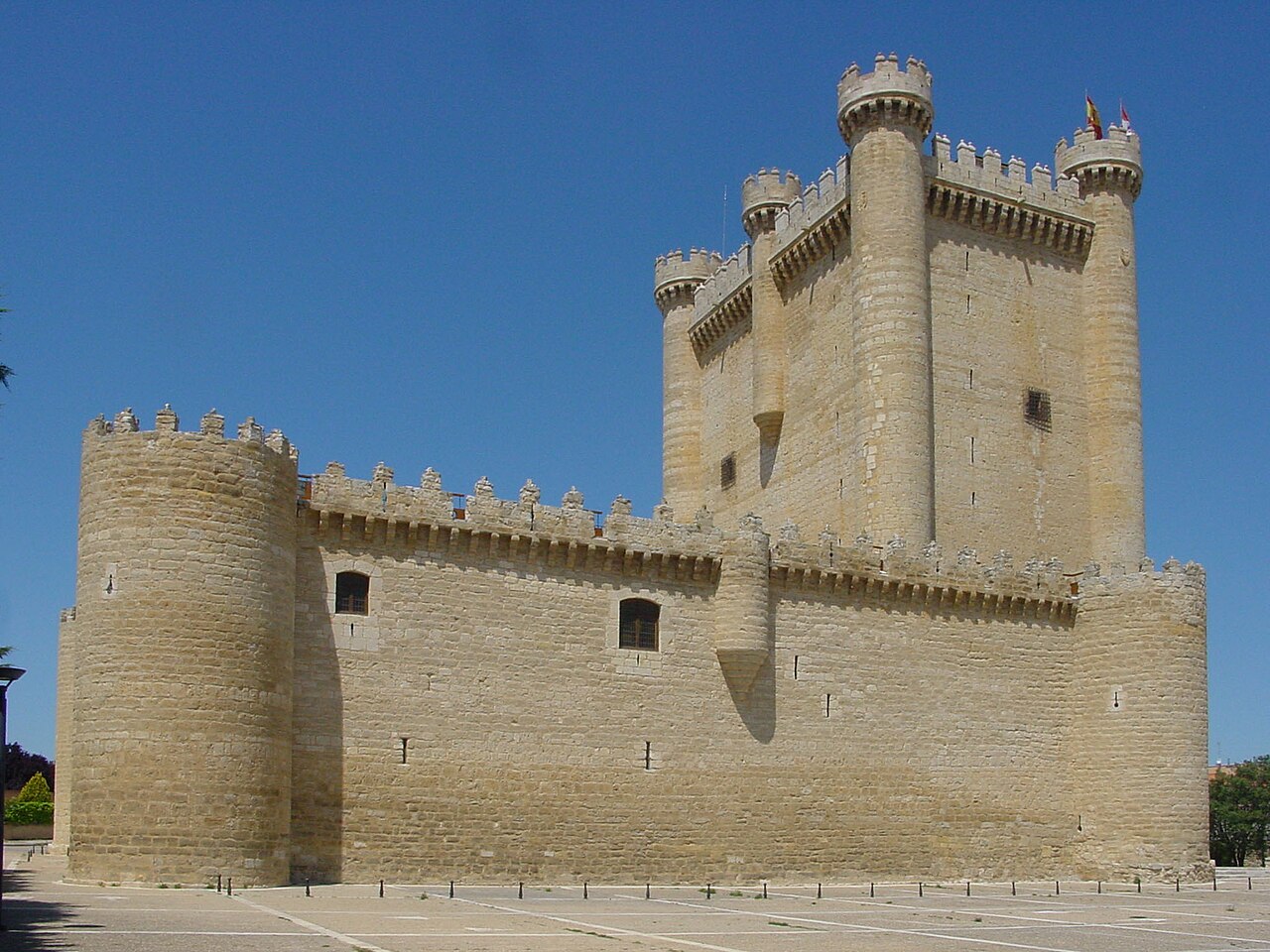
Portillo Castle
Portillo Castle stands as a remarkable example of a late medieval hill castle in the municipality of Portillo, Valladolid province, Spain. Its strategic location atop a hill allowed it to dominate the surrounding landscape, serving both defensive and administrative roles throughout its history. The castle's origins trace back to at least the 10th century, when the site was fortified during the period of Moorish incursions under Abd al-Rahman III. However, the visible remains and primary construction date predominantly to the 14th and 15th centuries, reflecting the architectural and political developments of medieval Castile.
The castle’s historical significance is deeply intertwined with the turbulent politics of Castile during the 15th century. It is renowned more for its role as a prison for prominent figures than for military engagements. Among its most notable prisoners was King Juan II of Castile, briefly held captive in 1444 before escaping through bribery. Another key figure was Don Álvaro de Luna, the powerful constable and favorite of Juan II, who was detained at Portillo prior to his trial and execution in 1453. The fortress also held Don Enrique, brother of the admiral Don Fabrique y de Suero de Quiñones, imprisoned for conspiracy against the crown.
Historical context and ownership
The earliest significant construction phase of Portillo Castle is attributed to Infante Tello, son of King Alfonso XI of Castile, in the 14th century. This phase established the castle as a noble fortress overseeing the Tierra de Pinares region. Throughout the 14th and 15th centuries, the castle changed hands among prominent noble families and the Crown. Initially held by the Sandoval family, it was confiscated in 1392 by King Juan II and granted to Ruy Díaz de Mendoza in 1438.
In the mid-15th century, King Enrique IV ordered extensive restorations and expansions, including raising the height of the keep and adding a palace section. These renovations reflected the architectural style known as the school of Valladolid, which balanced military functionality with noble prestige. Later, Alonso Pimentel, Count of Benavente, further enhanced the castle by adding an outer defensive wall with deep moats, modifying the courtyard, and constructing a deep well with underground chambers.
Ownership passed through several noble houses, including the House of Osuna by marriage in the 19th century. In the 20th century, the castle was declared a national monument in 1931 and is currently owned by the University of Valladolid, which preserves its historical legacy.
Architectural features and layout
Overall structure
Portillo Castle is characterized by a square layout with a prominent keep or tower of homage positioned at the southwest corner, facing the town. The keep measures approximately 13 meters on each side and rises about 28 meters high, dominating the fortress silhouette. Surrounding the main enclosure is an outer barbican, also square, featuring cylindrical towers at the corners and midpoints of the walls. The battlements are crenellated with merlons reaching nearly two meters in height, designed for defensive purposes.
Defensive elements
The castle originally had three main gates located on the north, south, and west sides, with the west gate serving as the principal entrance. This gate is designed as a bent or angled passage to slow attackers, featuring a semicircular sentry box above and a pointed inner arch. Defensive apertures include rectangular and cruciform arrow slits for bows and crossbows, alongside circular gunports added in the 15th century to accommodate early firearms.
Machicolations, supported by stone corbels, are present along the battlements, allowing defenders to drop projectiles or boiling substances on attackers below. The presence of a portcullis groove on the second gate indicates the use of a heavy sliding gate for added defense. These layered fortifications created kill zones and traps, enhancing the castle’s resilience against sieges.
Interior courtyard and chambers
The castle’s interior features a large central courtyard, known as the patio de armas, surrounded by arcaded galleries supported by five octagonal columns approximately four meters tall. Residential rooms and a chapel once occupied the courtyard, though the chapel no longer survives. At the courtyard’s center lies a deep well over 30 meters deep, accessible via a spiral staircase with roughly 113 steps leading to three vaulted chambers with wall niches. This well was constructed under Alonso Pimentel’s direction, serving as a vital water source during sieges.
The oldest architectural elements are found on the ground floor of the inner enclosure, including Gothic pointed arches and rib vaults supported by transverse arches, dating to the 14th century. Enrique IV’s renovations raised the keep’s height and added a palace section reflecting the Valladolid school style, blending military and noble architectural features.
Keep details
The keep’s exterior is austere, with minimal decoration except for Gothic conopial windows—arched windows with pointed, lobed shapes—and heraldic shields of the Counts of Benavente displayed above four windows, each repeated three times. Access to the keep is via a spiral staircase beginning on the second floor from the battlements, designed to impede attackers.
Inside, the keep contains vaulted chambers such as the "Don Álvaro chamber," named after Álvaro de Luna. This chamber features rib vaults and a narrow arrow slit providing natural light. The keep’s design emphasizes defense and control, with thick walls and limited access points.
Historical significance and legacy
Portillo Castle’s history is marked by its role as a noble residence, military fortress, and prison for important political figures during the late medieval period. Its association with prominent Castilian nobles and royalty highlights its importance in the region’s power struggles and governance.
The castle’s architectural evolution reflects broader trends in medieval fortification, adapting to advances in military technology such as the introduction of firearms. Its preservation and status as a national monument underscore its cultural and historical value.
Today, Portillo Castle offers visitors a well-preserved glimpse into medieval military architecture and noble life. Its imposing keep, defensive walls, and subterranean chambers attract historians, architects, and tourists alike, contributing to the understanding of Castilian history and medieval fortifications.
Visitor information and accessibility
Portillo Castle is open to the public for guided tours and educational visits, managed by the University of Valladolid. Visitors can explore the castle’s courtyards, towers, and underground chambers, gaining insight into its construction and historical use.
The castle’s hilltop location provides panoramic views of the surrounding Tierra de Pinares landscape, enhancing the visitor experience. Facilities include informational signage and occasional cultural events that celebrate the castle’s heritage.
Visitors are advised to wear comfortable footwear due to uneven surfaces and staircases. Accessibility may be limited for those with mobility impairments, given the medieval structure’s design.
Frequently asked questions (FAQ)
- How do I get to Portillo Castle?
- Portillo Castle is located in the small town of Portillo, Spain, which is easily accessible by car or public transport. The nearest major city is Valladolid, from where you can take a bus or drive for about 30 minutes to reach the castle.
- What is the historical significance of Portillo Castle?
- Portillo Castle dates back to the 15th century and played a vital role in the defense of the region during the medieval period. It is a remarkable example of historical military architecture and offers insight into the strategic importance of the area during its time.
- When was Portillo Castle built?
- Portillo Castle was constructed in the late 15th century, specifically around the year 1470. It was built under the reign of the Catholic Monarchs and has since undergone various restorations to preserve its structure and historical features.
- Can I visit Portillo Castle year-round?
- Yes, Portillo Castle is open to visitors throughout the year, although the best time to visit is in the spring and early fall when the weather is mild. It’s advisable to check the specific opening hours before your visit, as they may vary seasonally.
- Why is the architecture of Portillo Castle notable?
- The architecture of Portillo Castle is notable for its blend of Gothic and Renaissance styles, characterized by its imposing towers and fortified walls. The castle's design reflects the military needs of its time while also showcasing the artistic influences of the period.
- Is it possible to take guided tours of Portillo Castle?
- Yes, guided tours are available at Portillo Castle, providing visitors with a deeper understanding of its history and architecture. These tours are often led by knowledgeable guides who share fascinating stories and details about the castle’s past.
- What are the ticket prices for visiting Portillo Castle?
- Ticket prices for Portillo Castle are generally affordable, with discounts available for students, seniors, and groups. It’s recommended to check the official website or contact the castle directly for the most current pricing information.
- What are the opening hours of Portillo Castle?
- Portillo Castle typically opens to visitors from 10 AM to 7 PM during the peak tourist season, but hours may vary in the off-season. Always check in advance for any changes in schedule or special holiday hours.
- What nearby attractions can I visit while at Portillo Castle?
- While visiting Portillo Castle, you can explore the charming town of Portillo, which features quaint streets and local shops. Additionally, the city of Valladolid, with its rich cultural heritage and attractions like the National Sculpture Museum, is just a short drive away.
Information
Website
Visit websiteSources & official resources
Verify the information above using these authoritative references.
Loading map...
Visitor reviews
No reviews yet. Been here? Write the first review and help other travelers!
Write the first reviewVisited this castle? Share your experience
Your review helps other travelers and adds first-hand knowledge to our encyclopedia.