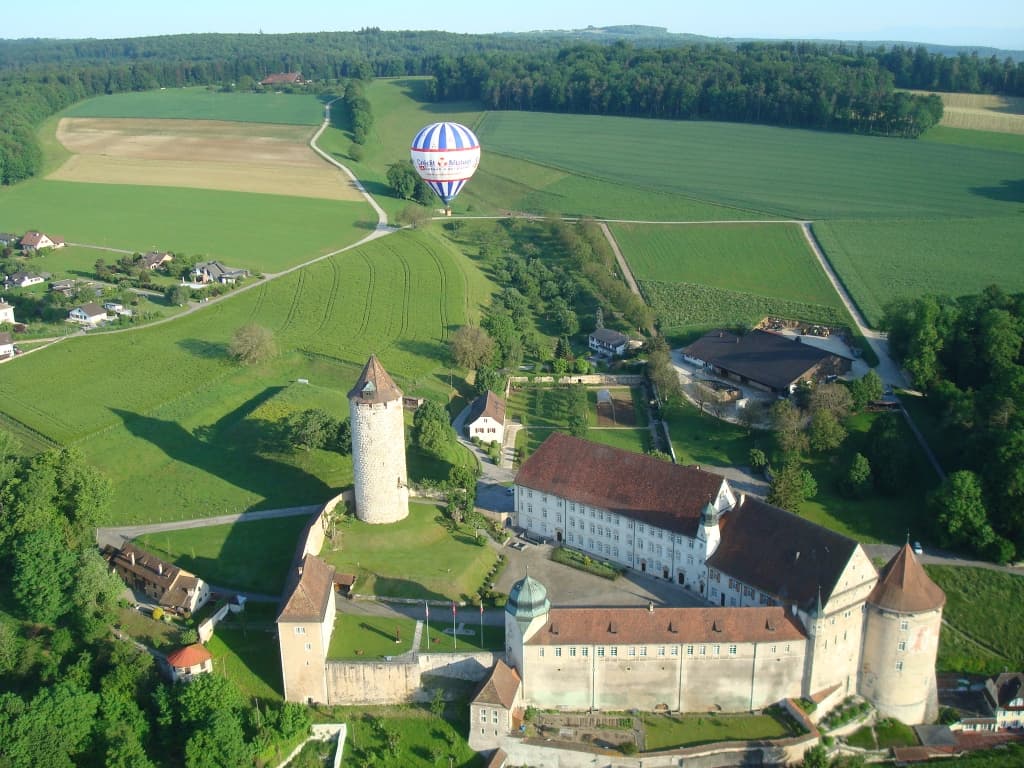
Porrentruy Castle
Porrentruy Castle stands as a prominent hill castle in the municipality of Porrentruy, Switzerland. Its origins date back to the mid-13th century, with construction spanning several centuries until the early 18th century. The castle's strategic location atop a natural elevation allowed it to serve as a formidable defensive stronghold and a symbol of ecclesiastical power in the region. The castle is best known for its role as the exile residence of the prince-bishops of Basel from 1527 to 1792, following their expulsion from the city of Basel during the Swiss Reformation.
The castle's earliest surviving structure is the Réfous Tower, a massive circular donjon dating to around 1271. This tower, with its thick walls up to 4.5 meters at the base and an elevated entrance 9 meters above ground, exemplifies medieval military architecture designed for defense and delay of attackers. The surrounding 14th-century ramparts on the western and northern sides further attest to the castle’s defensive significance during the High Medieval period.
Historical background and episcopal significance
The castle came under the ownership of the prince-bishops of Basel in 1271, marking the beginning of its long association with this ecclesiastical authority. The prince-bishops exercised both spiritual and temporal power, and Porrentruy Castle became their principal seat after their exile from Basel in 1529 amid the upheavals of the Protestant Reformation. Despite losing control of the city, they retained most of their territories outside Basel and governed from Porrentruy.
Before the prince-bishops' permanent residence, the castle had experienced various phases of ownership and conflict. The Counts of Montbéliard briefly held the castle before it reverted to the prince-bishopric in the mid-15th century. The castle endured destructive fires in 1337 and 1558, the latter devastating many archival records. Later, the castle played a role during the Thirty Years’ War, enduring sieges and military occupation.
Architectural evolution and renovations
Medieval foundations and fortifications
Initially, the castle was a wooden fortress likely established in the 12th century, featuring defensive ditches, palisades, and a wooden tower atop an artificial mound. This early structure was replaced in the 13th century by stone masonry, reflecting the era’s advancements in fortification techniques. The surviving Réfous Tower and the 14th-century stone ramparts illustrate this transition and the castle’s defensive priorities.
Renaissance and baroque expansions
Between 1588 and 1597, under the direction of Prince-Bishop Jacques-Christophe Blarer de Wartensee, the castle underwent significant reconstruction. The architect Nicolas Frick was responsible for the design and execution of the new Residence building, which introduced Renaissance architectural elements such as vaulted cellars and ornate portals. The interiors were later embellished with early 18th-century stucco work, including heraldic decorations representing the influential Reinach family.
The castle’s courtyard is enclosed to the south by the Princess Christina Wing, named after Princess Christina of Saxony, who visited the castle and was abbess of Remiremont in the late 18th century. This wing, dating to the early 18th century, features a large historic kitchen and reflects the residential and ceremonial functions of the castle during this period.
The Chancery building, attached to the Residence, showcases 18th-century architectural features including vaulted cellars that once served as prison spaces, a square stair turret with an onion dome, and a sundial. The Tour du Coq (Hahnenturm), a round tower from the mid-18th century, served as the episcopal archive repository and is decorated with painted coats of arms.
Fires, military use, and later adaptations
The castle suffered a major fire in 1697 that damaged several outbuildings, including stables and the Tour du Trésor, which was later shortened and given a bulbous roof. The castle’s military significance declined after the prince-bishops fled in 1792 during the French Revolutionary Wars, when revolutionary forces took control and the castle was incorporated into the French administrative region of Mont-Terrible.
Throughout the 19th and 20th centuries, the castle adapted to various civic roles. It housed an orphanage and poorhouse from 1841 to 1930, then served as military barracks during World War II. Later, it became the seat of district government and, since 1979, the home of the cantonal court of Jura. These changes reflect the castle’s ongoing importance as a center of administration and justice.
Architectural features and surviving structures
Réfous tower and defensive walls
The Réfous Tower remains the castle’s most iconic medieval feature. Standing 32 meters tall with a 12-meter diameter base, its thick walls and elevated entrance reflect typical defensive strategies of the era. The surviving 14th-century ramparts on the western and northern sides provide insight into the castle’s fortified perimeter.
Residence and chapel
The Renaissance-style Residence building features vaulted cellars, ornate portals, and richly decorated interiors. Attached to it is the Maison de Luppach, a square tower-like structure that contains the private chapel of Prince-Bishop Jean-Conrad de Roggenbach (1656–1693). The chapel is notable for its early Baroque stuccoed vaulted ceiling, highlighting the religious significance within the castle complex.
Other notable buildings
- The Princess Christina Wing with its historic kitchen and residential quarters.
- The Chancery building with its prison cellars and distinctive onion dome stair turret.
- The Tour du Coq, decorated with episcopal and family coats of arms.
- The Tour du Trésor, shortened after the 1697 fire and topped with a bulbous roof.
- The guardhouse and remnants of 14th and 15th-century towers adapted in the 18th century.
- The Orangerie, built in 1726, with archaeological traces of Baroque gardens and earlier defenses.
- A deep well dating from the late 17th century, essential for the castle’s water supply.
Cultural importance and current use
Today, Porrentruy Castle is a symbol of the historical and cultural heritage of the Canton of Jura. It houses the cantonal court and judicial authorities, maintaining its administrative role. While the castle's interior is not generally open to the public on weekends, its well-preserved exterior and grounds attract visitors interested in medieval and early modern architecture.
The castle’s layered history, combining military, religious, and administrative functions, offers a rich narrative of the region’s past. Its architectural evolution from a medieval fortress to a Renaissance residence and later civic building illustrates the adaptability and enduring significance of this Swiss landmark.
Frequently asked questions (FAQ)
- What is the historical significance of Porrentruy Castle?
- Porrentruy Castle, dating back to the 13th century, is a remarkable example of medieval architecture and has played a crucial role in the region's history. It served as the residence of the Prince-Bishops of Basel and is a testament to the political and religious power held by the church during this era.
- When was Porrentruy Castle built?
- The construction of Porrentruy Castle began in 1260 and was completed in the 14th century. Over the centuries, it has undergone various renovations and restorations, reflecting the architectural styles of different periods.
- Can I visit Porrentruy Castle?
- Yes, Porrentruy Castle is open to the public, and visitors can explore its impressive grounds and learn about its rich history through informative displays. Guided tours are also available for those who wish to delve deeper into the castle's past.
- What are the opening hours of Porrentruy Castle?
- Porrentruy Castle is typically open from Tuesday to Sunday, with specific hours depending on the season. It’s advisable to check the official website or contact the castle for the most current opening times before your visit.
- Is it possible to access Porrentruy Castle with a wheelchair?
- While Porrentruy Castle has made efforts to accommodate visitors with mobility challenges, some areas may still be difficult to access due to the castle's historical architecture. It is recommended to contact the castle in advance to inquire about specific accessibility options.
- What is the best time to visit Porrentruy Castle?
- The best time to visit Porrentruy Castle is during the spring and early autumn months when the weather is pleasant for exploring the outdoor areas. Additionally, visiting during these times often means fewer crowds, allowing for a more enjoyable experience.
- Are there any nearby attractions to visit?
- Yes, the town of Porrentruy itself is rich in history and charm, featuring beautiful streets and other historical sites such as the Cathedral of St. Pierre. The surrounding Jura region also offers stunning natural landscapes that are perfect for hiking and outdoor activities.
- What are the ticket prices for Porrentruy Castle?
- Ticket prices for Porrentruy Castle are generally quite affordable, with discounts available for students, seniors, and families. It is best to check the official website for the latest pricing and any special offers that may be available during your visit.
Photo gallery

Information
Website
Visit websiteSources & official resources
Verify the information above using these authoritative references.
Loading map...
Visitor reviews
No reviews yet. Been here? Write the first review and help other travelers!
Write the first reviewVisited this castle? Share your experience
Your review helps other travelers and adds first-hand knowledge to our encyclopedia.


