Por-Bazhyn — Russia castle

Por-Bazhyn

Por-bazhyn: 8th-century uyghur palace ruins in tuva
Early Medieval (5th–10th c.)
Ruins

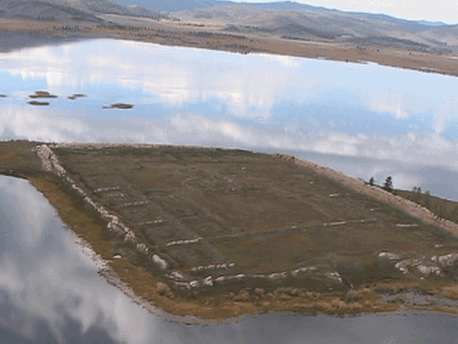
Por-Bazhyn is a remarkable archaeological site located on an island in a mountain lake in southern Tuva, Russian Federation. This early medieval structure dates back to the 8th century and is believed to have been constructed as a Uyghur palace. The name Por-Bazhyn translates to "clay house" in the Tuvan language, reflecting the building materials and its cultural context.

Historical background and cultural context

The site of Por-Bazhyn was built during a period when the Uyghur Khaganate was a dominant power in Central Asia. The palace's construction coincides with the height of Uyghur influence and their interactions with neighboring cultures, including the Tang dynasty of China. Shortly after its initial use as a palace, archaeological evidence suggests that Por-Bazhyn was converted into a Manichaean monastery, indicating a religious transformation aligned with the spread of Manichaeism among the Uyghurs.

This religious phase was brief, as the site was soon abandoned. The reasons for abandonment remain uncertain, but the structure was ultimately destroyed by natural disasters, specifically an earthquake followed by a fire.

Architectural features and construction techniques

Por-Bazhyn showcases construction methods and architectural styles strongly influenced by the Tang Chinese tradition. The site is surrounded by a massive rectangular wall enclosing a complex of buildings arranged around a central courtyard. The walls were built using clay bricks, a material typical for the region and period, which contributed to the name "clay house."

The layout reveals a sophisticated design incorporating defensive features such as thick perimeter walls and corner towers, typical of fortresses from the era. The buildings within the enclosure include residential quarters, ceremonial halls, and religious spaces, reflecting the site's dual function as a palace and later a monastery.

Site layout and defensive elements

The fortified complex measures approximately 220 by 220 meters and is situated on an island in Lake Tere-Khol, providing natural protection. The island's elevation and isolation added to the defensibility of the site. The walls have multiple gates aligned with cardinal directions, and the corners are reinforced with towers that would have served both as lookout points and defensive bastions.

Archaeological investigations and findings

Excavations at Por-Bazhyn have revealed a wealth of artifacts and structural details that illuminate its history and use. Pottery shards, tools, and remnants of wall paintings have been uncovered, providing insights into the daily life and cultural practices of its occupants.

The archaeological work also confirmed the site's abrupt abandonment, as layers of ash and earthquake debris were found, indicating a sudden destructive event. The preservation of the ruins allows researchers to study the fusion of Central Asian and Chinese architectural influences during the early medieval period.

Significance and preservation status

Today, Por-Bazhyn is classified as archaeological ruins and is an important cultural heritage site in the Russian Federation. Its unique combination of Uyghur and Tang Chinese architectural elements makes it a valuable example of cross-cultural exchange along the Silk Road.

The site remains in a state of ruins, with ongoing efforts to protect and study the complex. Its remote location and the fragile condition of the clay brick structures pose challenges for preservation, but it continues to attract interest from historians, archaeologists, and visitors intrigued by its mysterious past.

Frequently asked questions (FAQ)

What is the historical significance of Por-Bazhyn?
Por-Bazhyn is a unique architectural monument located in the Russian Federation, dating back to the 8th century. It is believed to have been a Buddhist monastery, showcasing the cultural exchanges that occurred in the region during the early Middle Ages. The site offers valuable insights into the history and development of early Siberian civilizations.
How do I get to Por-Bazhyn?
To reach Por-Bazhyn, visitors can take a flight to the nearest major city, which is Ulaanbaatar in Mongolia, and then travel by road. Alternatively, there are local buses and tours available from nearby towns. It is advisable to check local travel information for the best routes and transportation options.
When is the best time to visit Por-Bazhyn?
The best time to visit Por-Bazhyn is during the summer months, from June to August, when the weather is milder and the site is more accessible. Spring and early autumn can also be pleasant, but winter temperatures can be extremely cold. Planning your visit during the summer allows visitors to enjoy outdoor exploration comfortably.
Is it possible to access Por-Bazhyn year-round?
While Por-Bazhyn can be visited year-round, accessibility may be limited during the winter months due to snow and harsh weather conditions. It is recommended to visit during the warmer months for a more enjoyable experience. Always check local conditions before planning your trip.
Can I take guided tours at Por-Bazhyn?
Yes, guided tours are available at Por-Bazhyn, providing visitors with in-depth knowledge about the castle's history and architecture. Local guides can enrich your experience with fascinating stories and insights. Booking a tour in advance is recommended to ensure availability.
What are the opening hours for Por-Bazhyn?
Por-Bazhyn is generally open to visitors from 9 AM to 6 PM during the summer season. However, hours may vary depending on the time of year and special events, so it is best to verify current opening hours before your visit. Checking the official website or local tourism offices can provide the most accurate information.
Are there nearby attractions to visit while at Por-Bazhyn?
Yes, there are several nearby attractions worth visiting, including beautiful natural landscapes and historical sites. The surrounding area offers opportunities for hiking and exploring local flora and fauna. Additionally, local cultural experiences can enrich your visit, making it a more comprehensive trip.
What are the ticket prices for visiting Por-Bazhyn?
Ticket prices for Por-Bazhyn are generally affordable, with discounts available for students and seniors. It is advisable to check the official website or local tourism information for the most up-to-date pricing. Group rates may also be available, making it an economical option for those traveling with friends or family.

Photo gallery

Por-Bazhyn
Click to view

Photo by Oschtan•Public domain

1 photo • Click any image to view in full screen

Information

Archaeological Site / Ruins

Loading map...

Visitor reviews

No reviews yet. Been here? Write the first review and help other travelers!

Write the first review

Visited this castle? Share your experience

Your review helps other travelers and adds first-hand knowledge to our encyclopedia.
Write a review

(5/5)

0/2000 characters

Your review will be visible after admin approval

Nearby castles

706.9 km
Chebaki fortress — Russia castle

Chebaki fortress

, Russia

Chebaki fortress, also known as Sve Chebaki, is a remarkable ancient mountain fortress sanctuary dating back to the Bronze Age in the 2nd millennium BC. Located on the right bank of the Black Iyus river, it sits atop Chebaki mount Takh (Tag), approximately 4.5 km northeast of the village of Chebaki in the Shirinsky district of the Republic of Khakassia, Russian Federation. Historical context and significance The fortress is one of the oldest known fortifications in the region, representing a significant archaeological and cultural heritage site. Its origins in the Bronze Age place it among the earliest examples of defensive architecture in Siberia. The site is believed to have served both as a sanctuary and a stronghold for local tribes, reflecting the complex social and spiritual life of ancient communities in this area. Location and strategic importance Chebaki fortress's position on Chebaki mount Takh provided a commanding view of the surrounding terrain and the Black Iyus river valley. This elevated location was strategically chosen for defense and surveillance, enabling inhabitants to monitor approaching groups and control access routes through the mountainous landscape. The fortress’s placement highlights the tactical considerations of Bronze Age societies in this part of Siberia. Architectural features and construction The fortress is classified as a bastioned fortress, a term that generally refers to fortifications featuring projecting bastions for improved defense, though in the case of Chebaki fortress, this classification reflects the complex layout of its defensive walls and ramparts adapted to the natural contours of the mountain. The construction techniques involved the use of local stone materials, skillfully arranged to create robust walls and enclosures that could withstand attacks and environmental wear over millennia. Archaeological studies have revealed remnants of walls, bastions, and possibly gates, indicating a well-planned defensive system. The fortress’s design integrates natural rock formations, enhancing its defensive capabilities and making it difficult for enemies to breach. Cultural and archaeological importance Chebaki fortress is a key site for understanding the Bronze Age cultures of Siberia. Excavations have uncovered artifacts that shed light on the daily lives, religious practices, and social structures of its builders. The fortress likely functioned as a sanctuary, with evidence suggesting ritual activities alongside its defensive role. Its preservation provides valuable insights into the early development of fortified settlements in this region, contributing to the broader knowledge of prehistoric architecture and community organization in Eurasia. Present condition and accessibility Today, Chebaki fortress remains a partially preserved archaeological site. While much of the original structure has weathered the passage of time, significant portions of the walls and bastions are still visible, allowing visitors and researchers to appreciate its scale and design. The site is accessible from the village of Chebaki, though it requires a hike up the mountain, making it a destination for those interested in history, archaeology, and natural landscapes. Visiting Chebaki fortress Visitors to Chebaki fortress can explore the ruins and enjoy panoramic views of the surrounding Siberian landscape. The site offers a unique opportunity to connect with ancient history in a remote and rugged setting. Due to its status as an archaeological site, visitors are encouraged to respect the preservation efforts and avoid disturbing the remains. Nearby attractions and cultural context The Republic of Khakassia is rich in historical and natural sites, including other ancient fortresses, burial mounds, and petroglyphs. Exploring Chebaki fortress can be combined with visits to these locations, providing a comprehensive experience of the region's prehistoric heritage.

Early Medieval (5th–10th c.)
Details
778 km
Kuznetsk Fortress — Russia castle

Kuznetsk Fortress

, Russia

Kuznetsk Fortress is a notable example of an 18th-century bastioned fortress located in the Russian Federation. Constructed during the post-Renaissance period, this fortress represents a significant phase in military architecture characterized by the adaptation of bastion fortifications designed to withstand artillery assaults. The fortress was built to serve as a strategic military stronghold, reflecting the evolving needs of defense in the era of gunpowder warfare. Historical context and construction The Kuznetsk Fortress was erected in the 18th century, a time when the Russian Empire was expanding its territories and fortifying its borders. The fortress was part of a broader network of military installations aimed at protecting key regions from external threats. Its construction incorporated the bastioned fortress design, which was prevalent in European military architecture following the Renaissance, emphasizing angular bastions that allowed defenders to cover adjacent walls with gunfire. The fortress's location was strategically chosen to control important routes and to serve as a defensive position against potential invasions. While the exact city location within Russia is not specified, the fortress's design aligns with the military engineering principles of the time, focusing on maximizing defensive capabilities through geometry and robust construction. Architectural features and design Kuznetsk Fortress exemplifies the bastioned fortress typology, featuring angular bastions projecting outward from the main walls. These bastions were designed to eliminate blind spots and provide overlapping fields of fire, a critical advancement over earlier medieval castles. The walls were constructed to absorb and deflect cannon fire, often built with thick masonry and earthworks. The fortress likely included a surrounding moat or ditch to hinder attackers and additional defensive structures such as ravelins and curtain walls. The internal layout would have accommodated barracks, armories, and command centers, supporting a garrison capable of sustained defense. Military significance and use During the 18th century, bastioned fortresses like Kuznetsk played a crucial role in the military strategy of the Russian Empire. They served as both defensive bulwarks and bases for projecting military power in the region. The fortress would have been garrisoned by troops trained in artillery and infantry tactics suited to the era's warfare. While specific battles or sieges involving Kuznetsk Fortress are not documented here, its construction reflects the period's emphasis on fortifications capable of withstanding sieges involving cannon and other artillery. Preservation and current condition The current condition of Kuznetsk Fortress is not detailed, but bastioned fortresses from this period often survive in various states ranging from well-preserved to ruins. Preservation efforts for such sites typically focus on maintaining structural integrity and providing historical interpretation for visitors. Given its architectural and historical value, the fortress may be of interest to historians, architects, and tourists interested in military history and post-Renaissance fortification design. Architectural legacy and cultural importance Kuznetsk Fortress stands as a representative example of post-Renaissance military architecture in Russia. The bastioned design influenced the development of fortifications well into the modern era, marking a transition from medieval defensive structures to those adapted for artillery warfare. The fortress contributes to the understanding of Russia's military and architectural history, illustrating how European fortification principles were adopted and adapted in the Russian context during the 18th century.

Post-Renaissance (17th–18th c.)
Details
1049.1 km
Gaochang — China castle

Gaochang

, China

Gaochang (Chinese: 高昌; pinyin: Gāochāng; Old Uyghur: Qocho), also known by its alternate names Khocho, Karakhoja, Qara-hoja, Kara-Khoja, or Karahoja (قاراغوجا in Uyghur), was a significant ancient oasis city located on the northern edge of the Taklamakan Desert in present-day Sanbu Township, Xinjiang, China. This city served as a vital hub along the Silk Road, facilitating trade and cultural exchange between East and West for centuries. The site is also referenced in historical and archaeological literature under various names such as Chotscho, Khocho, Qocho, or Qočo. The origins of Gaochang trace back to approximately the 1st century BC, when it was established as a fortified settlement. Its strategic location in the oasis region allowed it to thrive as a commercial center, providing respite and supplies for caravans navigating the harsh desert environment. The city expanded over time, developing extensive walls, palace complexes, residential quarters, and religious buildings that reflected a blend of cultural influences including Chinese, Uyghur, and Central Asian architectural styles. Historical significance and silk road role Gaochang was a bustling trading center on the northern rim of the Taklamakan Desert, acting as a critical stopover for merchant traders traveling the Silk Road. Its location enabled it to control and facilitate the flow of goods such as silk, spices, precious metals, and other valuable commodities between China and Central Asia. The city was also an important cultural crossroads, where Buddhism, Manichaeism, and other religions were practiced and artistic styles merged. During the Yuan dynasty and Ming dynasty, Gaochang was known as "Halahezhuo" (哈拉和卓) or Qara-khoja, and later as Huozhou. The city’s prominence declined after it was destroyed in wars during the 14th century. Despite its ruin, the remains of the palace ruins, city walls, and other structures both inside and outside the city boundaries are still visible today, providing valuable archaeological insights into its past. Architectural features and archaeological remains The ruins of Gaochang reveal a well-fortified city with large defensive walls constructed from rammed earth, a common building technique in the region. The city’s layout included a central palace complex, multiple temples, residential areas, and marketplaces. Archaeological excavations have uncovered remnants of Buddhist temples adorned with murals and statues, reflecting the religious diversity and artistic achievements of the city. Gaochang’s urban planning demonstrates the integration of Chinese city design principles with local adaptations suited to the desert environment. The use of courtyards, narrow streets, and water management systems highlights the ingenuity of its builders in creating a sustainable oasis city. Cultural legacy and world heritage status Gaochang’s historical and cultural significance has been recognized internationally. In 2014, it was inscribed as part of the Silk Roads: the Routes Network of Chang'an-Tianshan Corridor UNESCO World Heritage Site. This designation underscores its role in facilitating the exchange of goods, ideas, and cultures along the ancient Silk Road network. Nearby the Gaochang ruins lie the Astana tombs, another major archaeological site that provides further understanding of the region’s history and the people who inhabited this part of Xinjiang. Preservation and current condition Today, Gaochang exists as archaeological ruins with much of its original structures in a ruined state due to centuries of natural decay and historical conflicts. Conservation efforts focus on protecting the site from further deterioration and enabling scholarly research. Visitors can explore the remains and gain insight into the city's past importance as a thriving oasis and Silk Road center. Access to the site allows for an educational experience about the early medieval period in Central Asia and the complex interactions between nomadic and settled cultures along one of history’s most famous trade routes.

Early Medieval (5th–10th c.)
Details