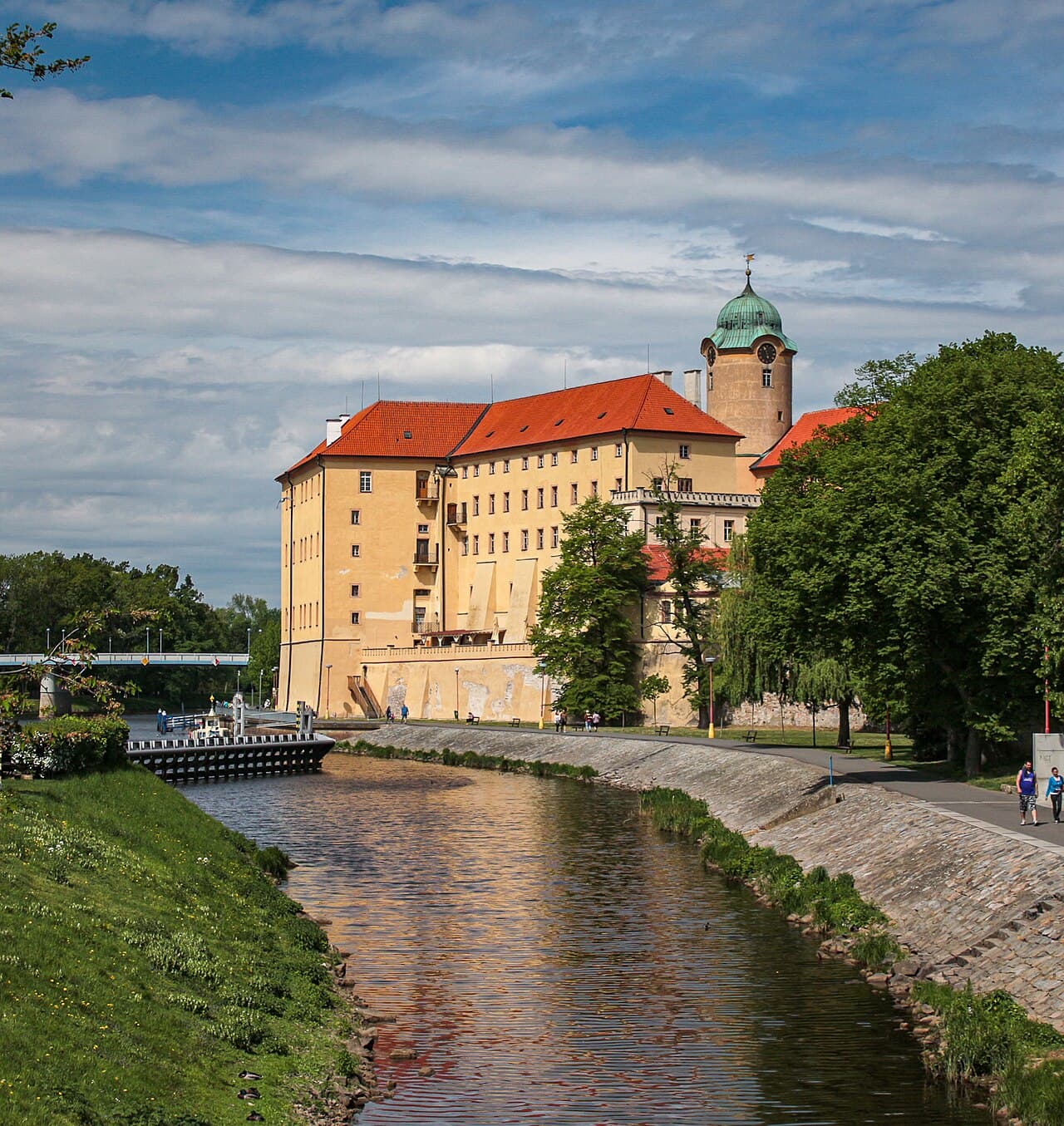
Podebrady Castle
Podebrady Castle stands as a remarkable example of a historic hill castle in the heart of the Czech Republic, located in the town of Poděbrady. Its origins date back to the early 12th century, when a wooden fortress was first established on the site. This initial stronghold was soon replaced by a stone castle under the reign of King Ottokar II of Bohemia in the 13th century, marking the beginning of the castle's evolution into a significant royal residence and defensive structure. Over the centuries, Podebrady Castle has witnessed numerous architectural transformations and played a pivotal role in Bohemian history.
The medieval origins and early development
The castle's earliest form was a wooden fortress, constructed shortly after 1108 amidst the political turmoil following the collapse of the Slavník principality. This early fortress laid the foundation for the stone castle that King Ottokar II commissioned, enhancing its defensive capabilities and establishing it as the seat of the Lordship of Poděbrady. The castle's strategic location on an elevated hill overlooking the Elbe River allowed it to control key approaches to Prague from the east, underscoring its military and political importance.
In 1345, King John of Bohemia pledged the lordship and castle to Hynek of Lichtenburg. The castle then passed into the hands of the Kunštát family through marriage when Hynek's daughter Eliška married Boček I of Poděbrady in 1350. This union marked the beginning of the Poděbrady line of the Kunštát family, with Boček adopting the title "of Poděbrady" after receiving the castle as a hereditary possession from Emperor Charles IV.
Architectural transformations and Renaissance influence
The castle underwent significant architectural development during the High Medieval period and later experienced a profound transformation in the Renaissance era. Between 1548 and 1580, Podebrady Castle was reconstructed in the Renaissance style, guided by architects Giovanni and Ulrico Aostalli and Hans Vienna. This renovation introduced characteristic Renaissance elements such as arcades and decorative stucco coats of arms, which remain visible in parts of the castle today.
The castle's layout forms an irregular L-shape around a central courtyard, with wings varying in height from two to four stories. A distinctive feature is the cylindrical tower with its unique bell-shaped roof, originally built as a Renaissance-era aqueduct with a walkway for water transport. This tower was later repurposed as a prison during the reign of Vladislav Jagiellon, illustrating the castle's adaptive use over time.
Baroque remodeling and later history
Following the devastation of the Thirty Years' War, the castle lost much of its military significance but gained new life through extensive Baroque remodeling between 1723 and 1780. Under the direction of builder Franz Maximilian Kanka, the castle's appearance was reshaped with Baroque architectural features, while preserving elements from earlier periods. This period also saw the addition of service buildings in the "front castle" area, which housed kitchens, bakeries, stables, and living quarters for staff.
The castle was a favored residence of Maria Theresa, Queen of Bohemia, who stayed there on several occasions. Under her son, Joseph II, Podebrady Castle served as a residence for retired Imperial Army officers. The castle remained under the ownership of the Bohemian Crown until 1839, when it was sold to the Viennese banker Georg Simon Sina. Later, through marriage, it passed to the Counts of Ypsilanti in 1884.
Significance of King George of Poděbrady and cultural heritage
King George of Poděbrady, one of the most notable historical figures associated with the castle, was born there in 1420. His legacy as a Bohemian king who sought peace in Central Europe is commemorated within the castle and the town, including an equestrian statue by sculptor Bohuslav Schnirch in the town square. The castle's chapel contains fragments of late Gothic frescoes, blending religious and secular themes that reflect the cultural milieu of the period.
The castle's prison tower, once used to detain rebel leaders during the reign of Vladislav Jagiellon, adds to its rich historical narrative. Archaeological excavations have revealed continuous habitation of the site since prehistoric times, underscoring its longstanding strategic and cultural importance.
Structural features and current use
Podebrady Castle's defensive system includes a curtain wall and a masonry moat, accessed by a bridge leading to the main gate adorned with three mid-16th century stucco coats of arms: the Habsburg double-headed eagle flanked by the kingdoms of Bohemia and Hungary. The original drawbridge mechanism is evidenced by pulley windows above the gate arch.
A notable medieval feature is the deep well carved into marl rock within the inner courtyard, dating from the 13th century. Although sealed in the 1940s, restoration efforts have preserved this vital water source. Renaissance arcades along the courtyard's north side remain as architectural traces of the castle's stylistic evolution.
In recent years, the northern wing has been adapted into a theater, integrating cultural activities with the castle's historic fabric. The castle cellar houses a lapidarium, showcasing stone artifacts that narrate the castle's layered history. Podebrady Castle is now a national cultural monument and part of the Poděbrady urban conservation zone, attracting visitors interested in its rich architectural and historical heritage.
Modern history and spa town development
In the early 20th century, a significant discovery by Count Bülow of a water spring beneath the castle courtyard led to the establishment of Poděbrady as a renowned spa town. This discovery shifted the castle's role towards health and wellness, with management transitioning to a spa joint-stock company.
Throughout the 20th century, Podebrady Castle served various institutional functions, including hosting the Ukrainian Economic Academy (1922-1935), the Middle Bohemian Boarding School named after King George of Poděbrady (1946-1953), and later the Charles University Distance Education Center (2004-2011). The castle also saw use by the Hitler Youth during World War II and was utilized by technical university faculties and cultural organizations in the post-war period.
Frequently asked questions (FAQ)
- How do I visit Podebrady Castle and what are the opening hours?
- Podebrady Castle is open to visitors with varying hours depending on the season; it is best to check the official website or local tourist information for current opening times and guided tour availability.
- What architectural styles are visible at Podebrady Castle?
- The castle showcases a blend of <strong>High Medieval</strong> origins with significant <strong>Renaissance</strong> and <strong>Baroque</strong> modifications, visible in its arcades, stucco decorations, and structural layout.
- Why is King George of Poděbrady significant to the castle's history?
- King George of Poděbrady was born in the castle in 1420 and is remembered for his efforts to promote peace in Central Europe; his legacy is celebrated within the castle and the town.
- Is Podebrady Castle accessible for visitors with mobility issues?
- While the castle has some adaptations, its historic structure includes uneven surfaces and stairs; visitors with mobility concerns should inquire in advance about accessibility options.
- What are some notable features to see inside Podebrady Castle?
- Visitors can explore the castle chapel with its late Gothic frescoes, the "birth room" exhibition dedicated to King George, the lapidarium in the cellar, and the Renaissance arcades.
Photo gallery

Information
Sources & official resources
Verify the information above using these authoritative references.
Loading map...
Visitor reviews
No reviews yet. Been here? Write the first review and help other travelers!
Write the first reviewVisited this castle? Share your experience
Your review helps other travelers and adds first-hand knowledge to our encyclopedia.


