Plon Castle
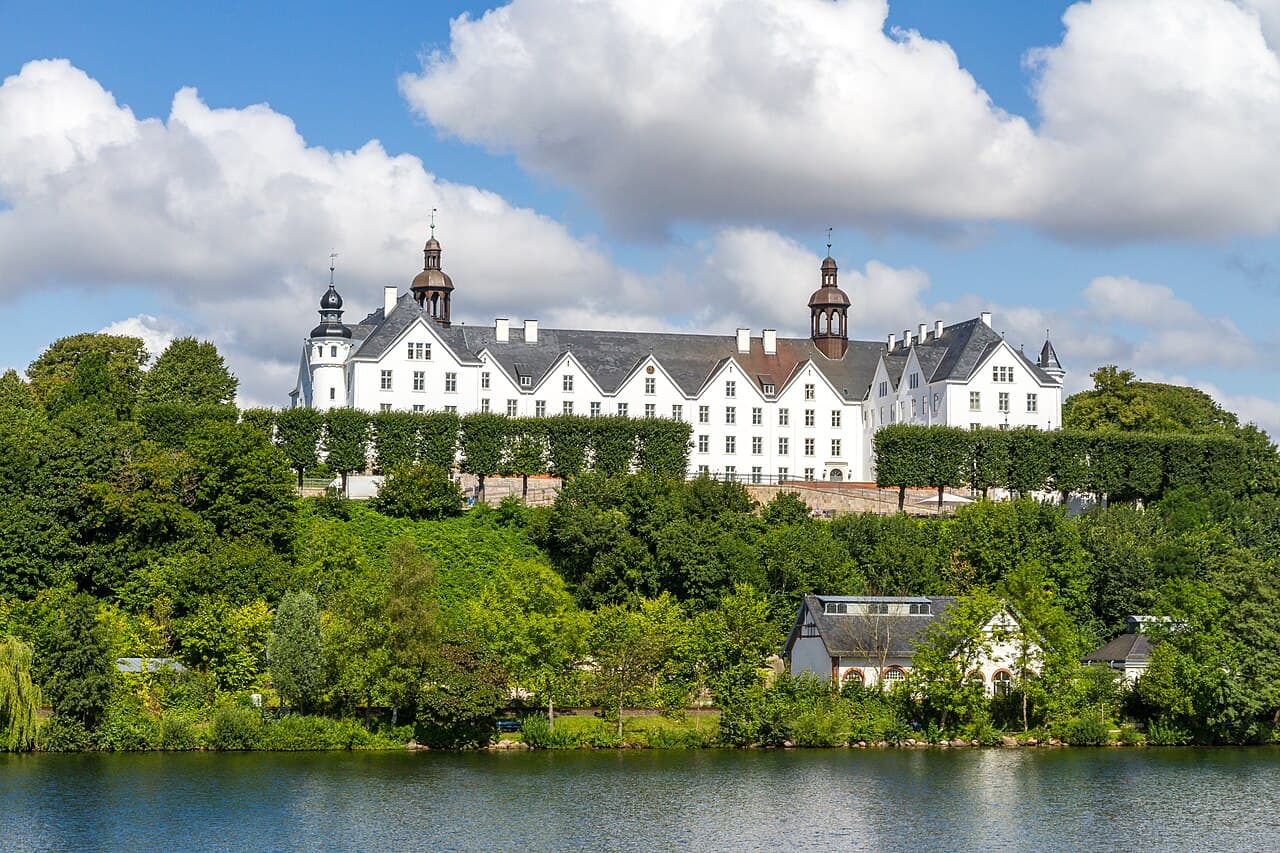
Plon Castle stands as one of the most significant and largest castles in the northern German state of Schleswig-Holstein. Distinguished as the only major castle in the region constructed on a hill, it commands a prominent position overlooking the town of Plön and the surrounding landscape. This impressive fortress is renowned for its rich history, architectural grandeur, and its multifaceted roles throughout centuries of regional development.
The castle's origins trace back to the early medieval period, with the earliest known fortification called Plune established in the 10th century on the island of Olsborg in Lake Plön. This initial stronghold was a Wendish defensive structure, reflecting the region's Slavic heritage before Germanic expansion. After its destruction in 1158, the castle was relocated in 1173 to the Bischofsberg hill, the site of the present-day Plon Castle. This move was part of the broader efforts by Count Adolphus II of Holstein to consolidate control and colonize the formerly Slavic territories.
Historical development and architectural evolution
Medieval foundations and the Count's Feud
During the turbulent period of the Count's Feud between Lübeck and Denmark in the early 16th century, the castle suffered significant damage. In 1534, it was burned down during a raid by Lübeck forces. The destruction paved the way for a substantial reconstruction that incorporated parts of the original Romanesque foundations, blending medieval defensive elements with emerging Renaissance architectural styles.
Renaissance transformation under the dukes of Schleswig-Holstein-Plon
The current form of Plon Castle dates primarily from the 17th century, when it was rebuilt as a Renaissance residence during the Thirty Years War. The project was initiated by Joachim Ernest of Schleswig-Holstein-Plön, the first duke of the newly established duchy. Demolishing the old medieval castle in 1632, he commissioned a new palace that would serve as a fitting home for his family and symbolize his ducal authority.
The castle was completed remarkably quickly, within just three years, despite the ongoing conflict. Its design reflects the Renaissance ideals of symmetry, proportion, and classical detailing. The structure features robust stone walls, elegant gables, and large windows that allowed natural light to fill the interior halls. The Renaissance style is evident in the castle's balanced façade and the incorporation of decorative elements such as pilasters and cornices.
Baroque and rococo enhancements in the 18th century
From 1729 onwards, under the reign of Frederick Charles, the last duke of Schleswig-Holstein-Plön, the castle experienced a cultural and architectural flourish. Frederick Charles introduced a baroque court atmosphere and commissioned extensive interior decorations in the rococo style. He also expanded the castle complex by adding several auxiliary buildings around the courtyard, including the royal stables, the riding hall, and the garden palace, now known as the Princes' House.
The castle's varied roles through history
Residence and ducal library
While Plon Castle served as the residence of the ducal family, it was never the primary seat of state power, which was centered at Gottorf Castle. Nevertheless, it housed a significant ducal library founded by Joachim Ernest and expanded by his successors to encompass around 10,000 volumes. The duke's interest in physics and optics was notable, and he collected various optical instruments, making the castle a center of scientific curiosity during his time.
Transition to military and educational use
Following the death of Frederick Charles in 1761, the duchy reverted to the Danish crown. The castle was used as a widow's residence until 1779 and later served as the seat of the bailiff. In the 19th century, it became a summer residence for King Christian VIII of Denmark, who renovated it in a Classicist style. After the Second Schleswig War in 1864, the castle came under Prussian control and was converted into a military academy, serving as a cadet school for the Prussian military. Notably, the sons of Emperor William II were educated here in the late 19th century.
20th century transformations and current use
In the 20th century, Plon Castle underwent several functional changes. It was used as a state educational institution in the 1920s and later as a National Political Institute during the Nazi regime, temporarily named after Ernst Röhm. The castle survived both World Wars without damage and was subsequently occupied by British forces as their regional headquarters.
Since 2002, the castle has been owned by the Fielmann Akademie Schloss Plon. After extensive renovations, it now functions as a training and qualification center for optometry. While it remains primarily an educational institution, the castle is open to visitors on a limited basis, allowing the public to appreciate its historic architecture and cultural significance.
Architectural highlights and castle grounds
Structural features
Plon Castle is classified as a hill castle, unique in Schleswig-Holstein for its elevated position. The main building exhibits classic Renaissance architectural features, including symmetrical layouts, stone masonry walls, and decorative gables. The courtyard is surrounded by several ancillary buildings erected in the 18th century, which complement the main residence with their baroque and rococo details.
Ancillary buildings and garden palace
The royal stables and riding hall constructed during Frederick Charles's reign remain well-preserved, showcasing the castle's role as a ducal residence with equestrian facilities. The Princes' House, originally a garden palace, was expanded in the late 19th century to accommodate the education of royal cadets.
Interior decorations
The interior historically featured elaborate rococo decorations, reflecting the tastes of the 18th-century ducal court. Although many original furnishings were removed or lost, especially during the Prussian military conversion, some decorative elements remain, illustrating the castle's artistic heritage.
Visiting Plon Castle today
Today, visitors can explore the castle's exterior and selected interior spaces during limited opening hours. The Fielmann Akademie offers guided tours that highlight the castle's architectural evolution, its historical significance as a ducal residence, and its modern role in optometric education. The castle's hilltop location provides scenic views over the town of Plön and the nearby lakes, enhancing its appeal as a cultural and historical landmark.
Plon Castle's rich history, architectural grandeur, and adaptive reuse make it a fascinating destination for those interested in Renaissance architecture, German ducal history, and military heritage.
Frequently asked questions (FAQ)
- How do I get to Plon Castle?
- Plon Castle is easily accessible by public transport, with regular train services connecting it to major cities in Germany. If you're driving, the castle is conveniently located just off the A20 motorway, with parking available nearby.
- What is the historical significance of Plon Castle?
- Plon Castle, originally built in the late 12th century, served as a residence for the Dukes of Plön and played a vital role in the region's history. Its architecture reflects various styles, showcasing the evolution of castle design over the centuries.
- When was Plon Castle built?
- Plon Castle was constructed in the late 12th century, with significant renovations and expansions taking place in the following centuries. This long history has contributed to its rich architectural heritage.
- Can I take guided tours of Plon Castle?
- Yes, guided tours of Plon Castle are available and provide an in-depth look at its history, architecture, and the royal family that once resided there. Check the castle’s official website for tour schedules and availability.
- Why is Plon Castle a popular tourist destination?
- Plon Castle is a popular tourist destination due to its stunning architecture, beautiful gardens, and rich history. Visitors are drawn to its picturesque surroundings and the chance to learn about the region’s noble past.
- Is it possible to host events at Plon Castle?
- Yes, Plon Castle offers facilities for hosting various events, including weddings, corporate gatherings, and cultural events. The unique setting provides a memorable backdrop for any occasion.
- What are the opening hours of Plon Castle?
- Plon Castle is typically open to visitors from 10 AM to 6 PM during the main tourist season, with reduced hours in the off-season. It’s advisable to check the official website for any seasonal changes or special closures.
- What are the ticket prices for visiting Plon Castle?
- Ticket prices for Plon Castle vary depending on the type of tour or event you choose to attend. Generally, adult tickets are around €8, while discounts are available for students and seniors.
- When is the best time to visit Plon Castle?
- The best time to visit Plon Castle is during the spring and summer months when the gardens are in full bloom and outdoor events are often held. Additionally, pleasant weather enhances the overall experience of exploring the castle grounds.
- Are there any nearby attractions to Plon Castle?
- Yes, nearby attractions include the picturesque Plön Lake, perfect for boating and picnics, as well as the charming town of Plön with its shops and restaurants. Visitors can also explore the beautiful Holstein Switzerland Nature Park located close by.
Photo gallery

Information
Website
Visit websiteSources & official resources
Verify the information above using these authoritative references.
Loading map...
Visitor reviews
No reviews yet. Been here? Write the first review and help other travelers!
Write the first reviewVisited this castle? Share your experience
Your review helps other travelers and adds first-hand knowledge to our encyclopedia.