Kiel Castle
Kiel Castle, located in the city of Kiel in northern Germany, stands as a monument to centuries of architectural evolution and regional history. Established in the early 13th century by the medieval noble Adolf IV of Schauenburg, the castle originated as a fortress built around 1242 to protect the growing settlement on a narrow peninsula between the Kieler Förde and Kleiner Kiel waterways. This strategic location underscored the castle’s importance as a defensive stronghold and administrative center in the region.
Throughout its history, Kiel Castle underwent numerous transformations reflecting the changing political, cultural, and military circumstances of Schleswig-Holstein. In the 15th century, control passed to King Frederick I of Denmark following the Treaty of Ripen. Frederick I initiated significant expansions and modernizations, turning the medieval fortress into a more refined castle complex. His son, Adolf I, founder of the Duchy of Schleswig-Holstein-Gottorf, incorporated Kiel Castle as a secondary residence for the dukes, complementing their principal seat at Gottorf Castle.
Medieval origins and early expansions
The original fortress was constructed on the western side of today’s castle square, where the current Rantzaubau wing stands. This early structure was demolished in 1502 to make way for a new residential palace erected by King Frederick I around 1512. This west wing formed the core of the castle’s Renaissance development. Later, between 1558 and 1568, Duke Adolf I added a substantial east wing facing the water, completing the castle’s characteristic three-winged, C-shaped layout. The east wing featured four adjacent roofs with decorative gables, two slender stair towers, and a richly decorated castle chapel, embodying Renaissance architectural principles.
Baroque remodeling and ducal residence
After structural failure led to the collapse of the older west wing in 1685, Duchess Friederike Amalie commissioned architect Domenico Pelli to rebuild it between 1695 and 1697. This reconstruction, known as the Rantzaubau wing, remains one of the best-preserved parts of the historic complex. The 18th century saw further changes to the east wing, including mid-century Baroque remodeling by Rudolph Matthias Dallin and later renovations by Ernst Georg Sonnin from 1763 to 1766. These alterations removed the original Renaissance gables and introduced a large mansard roof, significantly altering the castle’s silhouette. The southwest tower was also adapted to serve as an observatory.
Historical significance and notable residents
Kiel Castle played a pivotal role during the Thirty Years’ War, enduring military occupations, damage, and looting. It also hosted the foundation celebrations of the University of Kiel in 1665, then known as Christiana-Albertina. The castle was the birthplace of Karl Peter Ulrich, later Russian Tsar Peter III. When he ascended the throne, his wife, Catherine the Great, transformed the castle from its Renaissance origins into a substantial Baroque palace. The castle was also the site of the Treaty of Tsarskoye Selo in 1773, which formalized the transfer of Holstein to Danish rule.
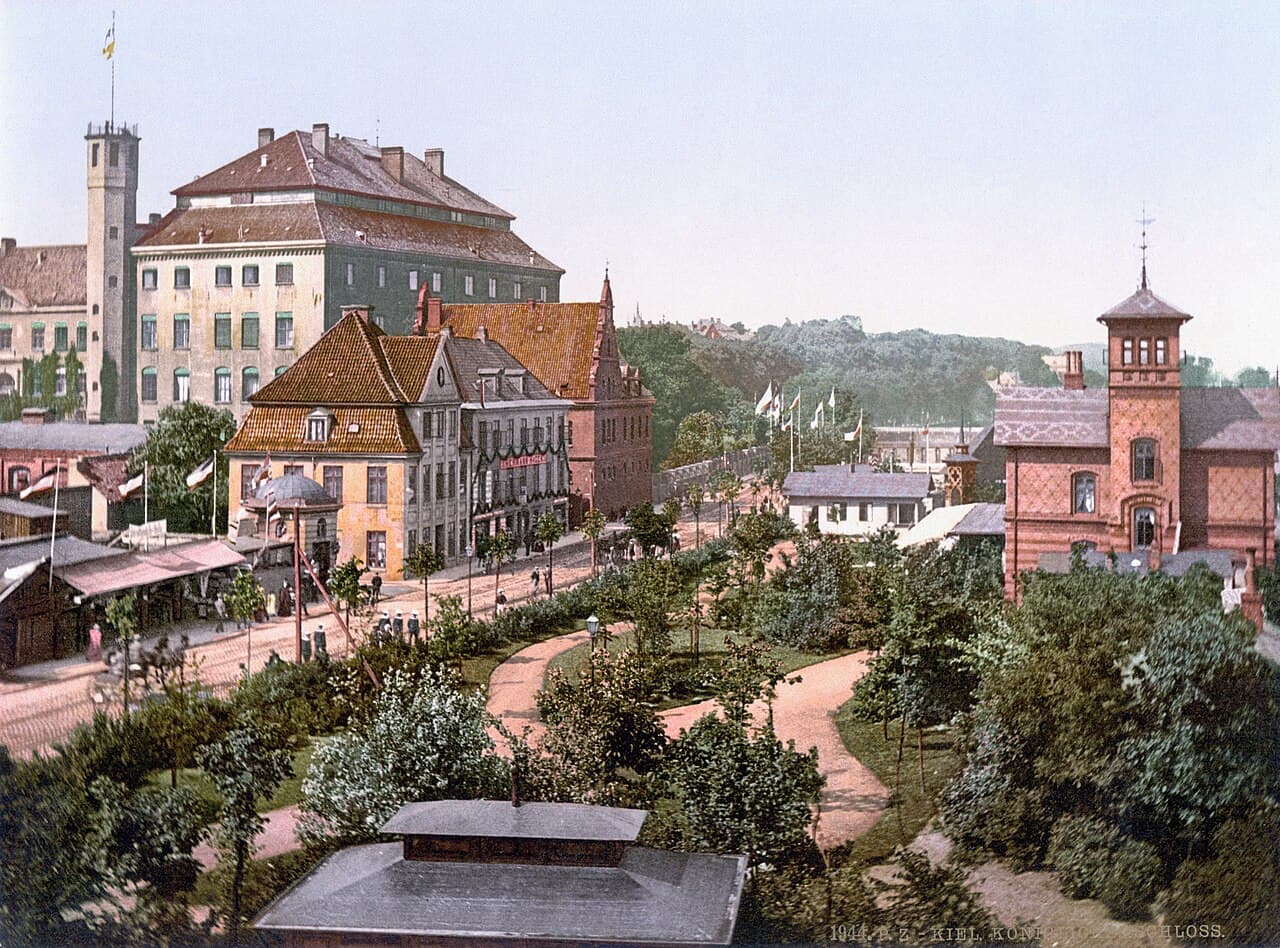
In the 19th century, the castle adapted to the region’s shifting political landscape. It housed university faculties, served as the Schleswig-Holstein Land Assembly seat between 1848 and 1851, and functioned as a military hospital and command center during the German-Danish War. From 1888 to 1918, it was the residence of Prince Heinrich of Prussia, commander of the Imperial Navy’s Baltic fleet.
Destruction and postwar reconstruction
The castle suffered extensive damage during World War II bombing on January 4, 1944, with large sections destroyed by fire. This devastation resulted in the loss of many valuable furnishings and historic collections. Postwar reconstruction efforts between 1961 and 1963, led by architects Sprotte and Neve, included building a new east wing on the original foundations and preserving the surviving Rantzaubau wing. The rebuilt complex incorporated modern architectural elements, such as a flat-roofed concert hall and a foyer elevated on stilts, adapting the castle to cultural uses including a concert venue, regional broadcasting studio, and adult education facilities.
Architectural features and current state
Kiel Castle originally combined medieval, Renaissance, and Baroque architectural elements in its three-winged, water-adjacent layout. The surviving Rantzaubau wing represents the late 17th-century Baroque reconstruction, while the postwar east wing reflects mid-20th-century design. The castle’s historic chapel, vaulted halls, stair towers, and decorative gables illustrate its architectural evolution. Despite wartime destruction, the castle remains a protected historic monument since 2005, embodying nearly eight centuries of regional history and architectural development.
Frequently asked questions (FAQ)
- How do I visit Kiel Castle?
- Kiel Castle is open daily from 10:00 to 17:00 with free admission. Visitors can explore the castle grounds and attend cultural events held in the concert hall and other facilities.
- What architectural styles are featured at Kiel Castle?
- Kiel Castle showcases a blend of medieval, Renaissance, and Baroque architectural elements, with later 20th-century additions reflecting modern design.
- When was Kiel Castle originally built?
- The original fortress was constructed around 1242 by Adolf IV of Schauenburg to protect the growing settlement that became Kiel.
- Can I see the original parts of the castle?
- Yes, the Rantzaubau wing from the late 17th century remains largely preserved and is a key historic feature visitors can see today.
- What happened to Kiel Castle during World War II?
- Kiel Castle was heavily damaged by bombing on January 4, 1944, resulting in large fires that destroyed much of the castle and its valuable furnishings.
Photo gallery

Photo by Unknown authorUnknown author•Public domain
Information
Opening hours
10:00-17:00, daily
Ticket prices
Free
Current owner
Municipality of Kiel
Website
Visit websiteSources & official resources
Verify the information above using these authoritative references.
Loading map...
Visitor reviews
No reviews yet. Been here? Write the first review and help other travelers!
Write the first reviewVisited this castle? Share your experience
Your review helps other travelers and adds first-hand knowledge to our encyclopedia.