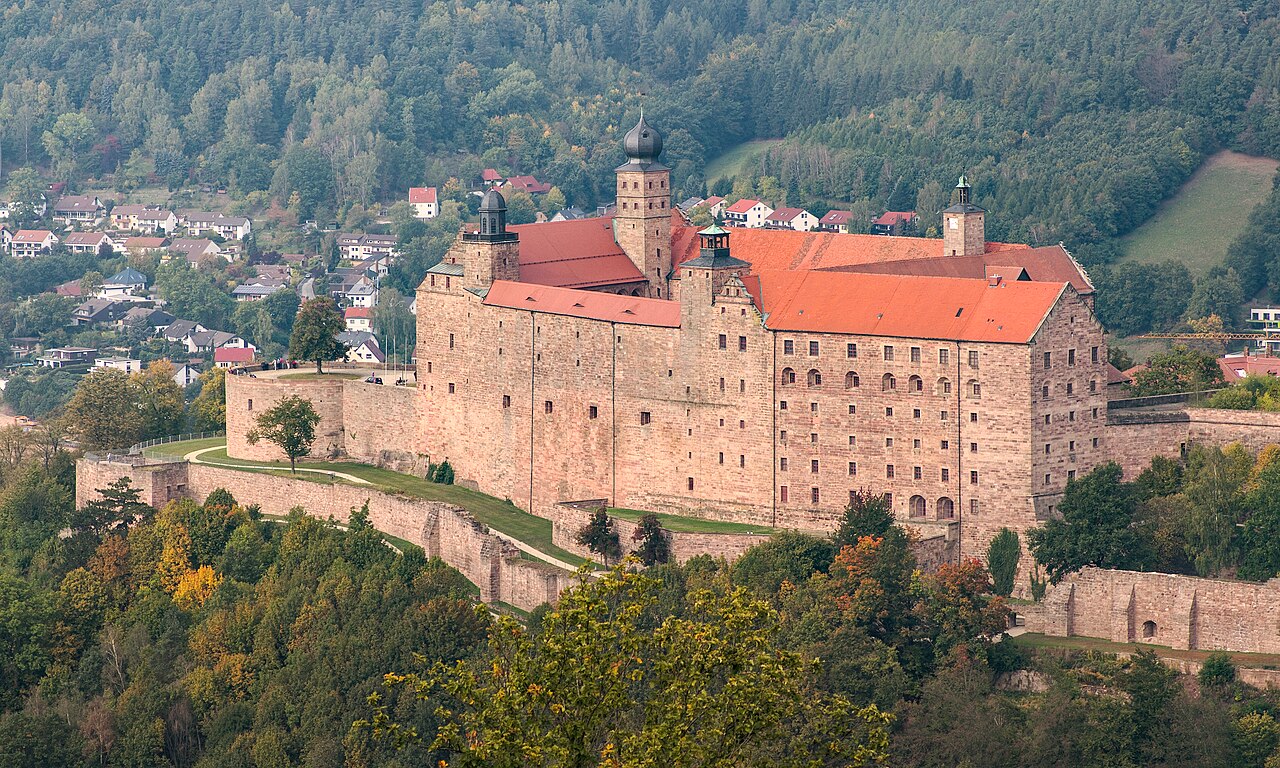
Plassenburg Castle
Plassenburg Castle is one of Germany's most impressive hill castles and a defining symbol of Kulmbach in Bavaria. First documented in 1135, it served as a strategic fortress and noble residence for centuries. The castle's origins trace to the High Medieval period, built initially as a fortified seat for the Plassenberg family, ministerials to the Counts of Andechs, who later became the dukes of Andechs-Meranien. Over time, it became the administrative and military center for various ruling houses, most notably the House of Hohenzollern from the 14th century until the late 18th century.
Located on a commanding hill overlooking Kulmbach, Plassenburg was originally constructed in the 12th century to control the surrounding regions of the Upper Main and Franconian Forest. Its position was of great strategic importance, overseeing key trade and military routes. The castle complex evolved through multiple phases of construction, destruction, and rebuilding, reflecting the changing political and military landscape of Franconia and broader Germany.
Early history and medieval significance
The earliest records from 1135 identify Plassenburg as a fortified residence linked to the Plassenberg family. This family held ministerial status under the counts of Andechs, and the castle was their seat of power. The House of Guttenberg, a notable Franconian noble lineage, traces its ancestry to a Gundeloh von Plassenberg around 1149. The castle's name and ownership passed through several noble families, including the Counts of Weimar-Orlamünde in the 13th and early 14th centuries.
In 1338, the castle was pledged to the Burgraves of Nuremberg from the House of Hohenzollern. Under Hohenzollern rule, Plassenburg became the administrative center of the Principality of the Mountains, later known as the Margraviate of Brandenburg-Kulmbach. This status made the castle a regional seat of power and governance until the early 17th century.
Fortification and renaissance transformation
During the 16th century, Plassenburg underwent significant military enhancements. Between 1542 and 1554, Margraves Georg the Pious and Albert Alcibiades fortified the castle extensively. They introduced Italian-style bastions and artillery towers, reflecting advances in military architecture and the increasing importance of artillery in siege warfare. The castle's defenses included massive gun rondelles and the prominent Hohe Bastei bastion, constructed with the expertise of an Italian master builder and a workforce of Italian masons.
Despite these improvements, Plassenburg endured a grueling seven-month siege during the Second Margravian War (1552–1554). The castle surrendered in 1554, suffering considerable damage. Reconstruction began in 1557 under architect Caspar Vischer, who transformed Plassenburg into a Renaissance fortress and palace. The rebuilding process, which lasted until around 1607, introduced a large four-winged complex arranged around a central courtyard known as the Schöner Hof (Beautiful Court). This courtyard is distinguished by its richly decorated Renaissance arcades, a hallmark of princely residences of the period.
Architectural features and defensive structures
The castle's Renaissance design harmoniously blends military and residential functions. Its fortifications include massive bastions, artillery towers, and three large gun rondelles. The Hohe Bastei bastion remains a notable example of 16th-century military engineering, showcasing the Italian influence on German fortress design.
The castle chapel, completed by 1569 and vaulted by 1574–75, exemplifies Protestant ecclesiastical architecture. Designed as a cross-shaped church, it emphasizes the pulpit's central role, reflecting the evangelical liturgical reforms inspired by Martin Luther. The chapel underwent significant alterations approximately fifty years later, adapting to evolving religious practices.
Construction materials primarily include durable stone masonry, typical of fortress buildings, combined with Renaissance decorative elements in the residential wings. The interior rooms are spacious and hall-like, featuring simple wooden galleries that underscore the Protestant aesthetic of the era.
Later history and changing roles
Following the Renaissance rebuilding, Plassenburg retained its importance as a noble residence and fortress throughout the 17th and 18th centuries. However, its military significance declined after the Thirty Years’ War. The castle saw partial modernization in the Baroque style during the 1700s, though it remained primarily a noble seat rather than a frontline fortress.
In 1792, Margrave Alexander sold Plassenburg to his cousin, the King of Prussia. The castle's military role effectively ended during the Napoleonic Wars. In 1806, a combined Bavarian and French army led by Jérôme Bonaparte, Napoleon's brother, besieged and captured the fortress. Following its surrender, Napoleon ordered the dismantling of its fortifications, marking the end of Plassenburg as a defensive stronghold.
Institutional uses and 20th-century history
From 1810 onward, Plassenburg served a variety of institutional functions. It was used as a prison, labor camp, internment camp, and military hospital over the 19th and early 20th centuries. During World War II, the Nazi Organisation Todt operated a training camp within the castle grounds. After the war, the castle housed refugees and displaced persons, reflecting the turbulent history of the 20th century.
Cultural significance and museum collections today
Today, Plassenburg Castle functions as a major cultural center and museum complex. It hosts several museums, including the German Tin Figure Museum, the Army Museum of Frederick the Great, the Hohenzollern Museum in Franconia, and the Upper Main Landscape Museum. These institutions preserve and present the castle's rich history and the broader cultural heritage of the region.
The castle's museums feature extensive collections of Prussian military artifacts, portraits, and the largest collection of tin figures in Germany. One of the highlights is a large diorama depicting the destruction of Kulmbach in 1553, providing visitors with a vivid historical narrative.
The Schöner Hof courtyard and castle grounds continue to serve as venues for cultural exhibitions and events, maintaining Plassenburg's role as a vibrant center of heritage and community life. The castle's well-preserved Renaissance architecture and fortifications stand as a testament to its enduring historical and architectural significance.
Architectural legacy and preservation
The present castle complex, largely dating from the Renaissance period, showcases a harmonious blend of fortress design and princely residence aesthetics. Despite partial destruction during the 1554 siege and the dismantling of fortifications in the early 19th century, the main residential buildings and the central courtyard remain remarkably intact.
Unlike many hill castles, Plassenburg does not have underground passages connecting it to the town below, emphasizing its isolated defensive position. The castle's massive stone walls, bastions, and artillery towers reflect the evolution of military architecture from medieval fortifications to Renaissance bastioned strongholds.
Ongoing preservation efforts have maintained Plassenburg as a well-preserved Renaissance hill castle, allowing visitors to experience a significant chapter of German history and castle architecture firsthand.
Frequently asked questions (FAQ)
- When was Plassenburg Castle originally built?
- Plassenburg Castle was originally constructed in the 12th century, with the first recorded mention in 1135.
- What architectural styles are featured at Plassenburg Castle?
- The castle showcases a blend of High Medieval origins with significant Renaissance architectural features, especially in its fortifications and residential wings.
- Can visitors explore the museums within Plassenburg Castle?
- Yes, Plassenburg Castle houses several museums including the German Tin Figure Museum and the Army Museum of Frederick the Great, open to the public.
- Is Plassenburg Castle accessible year-round?
- The castle is generally open to visitors throughout the year, but specific opening hours may vary seasonally or during special events.
- What is the significance of the Schöner Hof courtyard?
- The Schöner Hof is the castle's central courtyard, notable for its richly decorated Renaissance arcades, reflecting the castle's status as a princely residence.
- How did Plassenburg Castle's role change after the Napoleonic Wars?
- After the Napoleonic Wars, the castle's fortifications were dismantled, and it was repurposed for institutional uses such as a prison and military hospital.
Information
Sources & official resources
Verify the information above using these authoritative references.
Loading map...
Visitor reviews
No reviews yet. Been here? Write the first review and help other travelers!
Write the first reviewVisited this castle? Share your experience
Your review helps other travelers and adds first-hand knowledge to our encyclopedia.