Pisz Castle Ruins
Pisz Castle, historically known as Johannisburg, is a significant medieval fortress located in Pisz, Poland. This hill castle was originally established by the Teutonic Order in the late 13th and early 14th centuries on the site of a former Prussian stronghold. The earliest fortifications were composed of wooden and earthworks, managed by a procurator under the command of the nearby Balga fortress. The castle's strategic position above the Pisa River and surrounded by marshy terrain provided natural defenses that were later enhanced with stone construction.
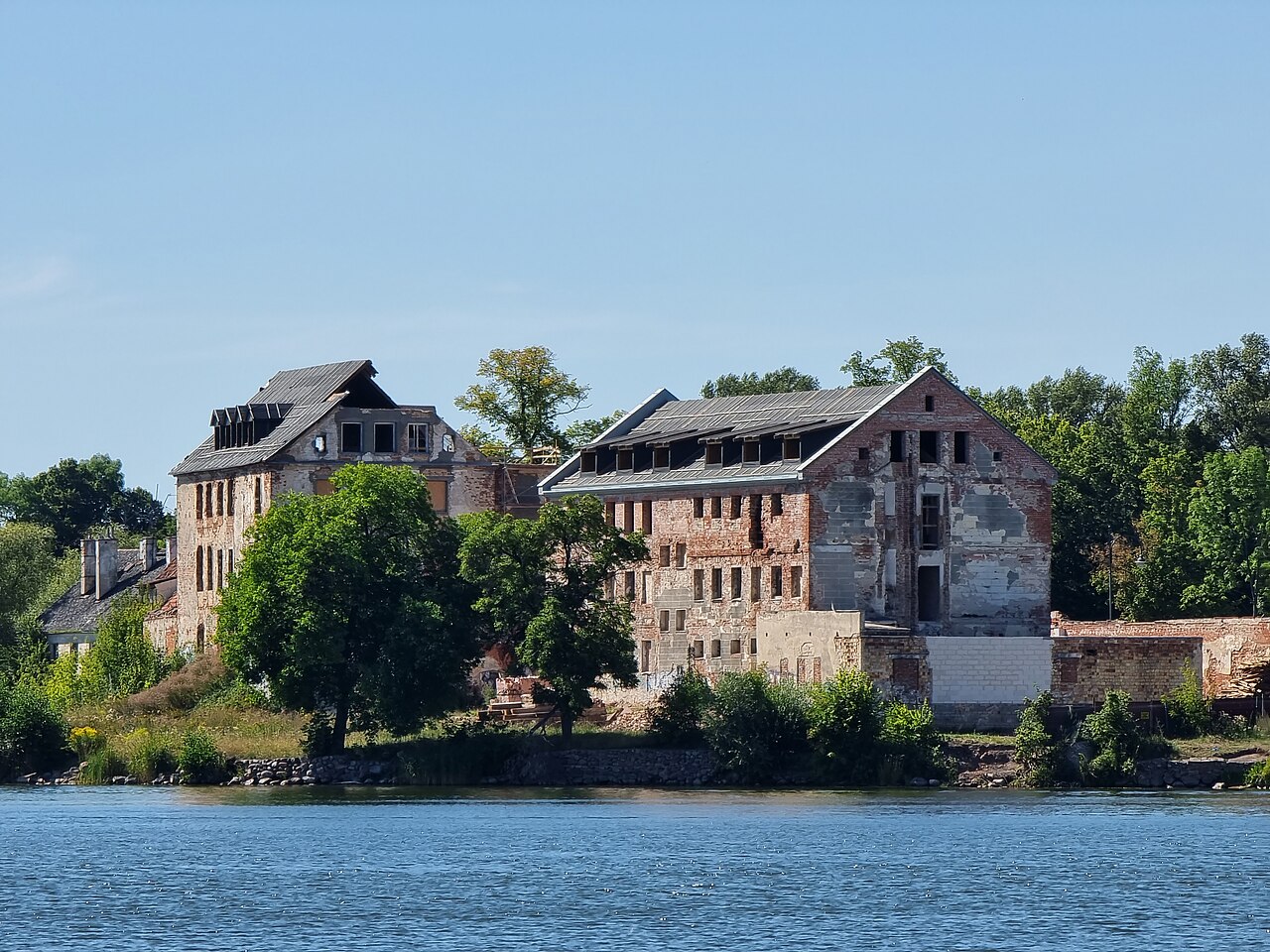
The first documented privilege concerning the settlement around the castle dates back to 1367, marking the beginning of the town's development. Pisz officially gained civic rights in 1645, adopting the castle's name, which locals referred to as "Jańsbork" until 1946. Today, only fragments of the castle's stone walls remain, located near the river within a public park.
Early fortifications and teutonic construction
Between approximately 1289 and 1344, the Teutonic Order constructed a wooden and earth defensive manor on this site. This manor served as a crucial administrative and military center in the region, overseen by a procurator who reported to the commander at Balga. The castle faced several attacks during the 14th century, most notably by Kiejstut, uncle of the Lithuanian ruler Jogaila, in 1361 and 1365. During these sieges, defenders retreated to a detached latrine tower known as the "dansker", which was ultimately set ablaze, forcing surrender.
In response to these assaults, the Teutonic Order rebuilt the fortress in stone during the 1370s. The new castle was strategically placed in a swampy area, leveraging the natural marshes as defensive barriers. This stone castle featured robust fortifications that were adapted over time to meet evolving military technologies, including the introduction of firearms.
Military significance and architectural evolution
During the late 14th century, Pisz Castle served as a base for military campaigns against Mazovia and Lithuania. Notably, in 1392-1393, Grand Marshal Werner von Tettingen led raids from this stronghold. Despite its proximity to the Polish border, the castle saw limited direct conflict during the early 15th-century wars between Poland and the Teutonic Order, including the pivotal battles of 1410 and 1414.
In the 1430s, defensive works were reinforced to accommodate firearms, with thicker walls and possible powder storage towers added. The castle's role shifted during the Thirteen Years’ War (1454–1466), when it was captured by peasant rebels in 1455 and briefly held by Polish mercenaries. Despite the political changes after the Second Peace of Toruń in 1466, the Teutonic Order retained control of Pisz.
From 1525, the castle became the residence of the ducal starost, hosting notable figures such as Duke Albrecht Hohenzollern. It was frequently used as a hunting base in the nearby Piska Forest. The castle also hosted significant political events, including visits by Polish kings August II the Strong in 1698 and Stanisław Leszczyński in 1734, the latter seeking refuge from Russian troops.
Architectural enhancements and fortifications
Between 1561 and 1585, the castle underwent major rebuilding under court architect Christopher Römer, improving both residential and defensive structures. Early 17th-century fortifications were further enhanced under Duke George William, with military engineer Christian Rose and surveyor Wilhelm Treber contributing to the works.
Following the expansion of Pisz town defenses in 1655, the castle's fortifications were integrated into a comprehensive defensive network. The fortress endured attacks during the Swedish Deluge and Tatar raids, although its military importance declined over time. After a damaging fire in 1679, reconstruction and bastion fortifications were implemented until 1698, based on designs by military engineer Adam Freytag and overseen by General von Waldeck. Count Carl Wilhelm Finck von Finckenstein governed the region during much of this period.
Decline, destruction, and archaeological efforts
The early 18th century brought hardships such as the 1709 plague, which drastically reduced the local population. The castle remained in military use until 1787, when it was dismantled and sold off. Subsequent partial demolitions occurred in 1837. The castle structures survived relatively intact until World War II, when heavy damage to Pisz destroyed nearly all remaining buildings.
In the 1960s, the remaining ruins were demolished, leaving only fragments of stone walls near the Pisa River. Archaeological investigations conducted in 2004 aimed to clarify the castle's original layout and explore possibilities for partial restoration. These studies have been essential in understanding the castle's complex history and architectural evolution.
Castle remains and local legends
Today, the surviving remains consist mainly of fragments of the stone walls and foundations, preserved within a park area by the river. The original castle included distinctive features such as the dansker latrine tower, a defensive element unusual in medieval fortifications, and later bastion-style fortifications reflecting military engineering advances.
A local legend tells of a secret underground passage connecting Pisz Castle to a Teutonic farmstead in the village of Łupki, reportedly running beneath the Pisa River. This tale highlights the castle's place in regional folklore and cultural heritage.
Frequently asked questions (FAQ)
- How do I get to Pisz Castle ruins?
- Pisz Castle ruins are located in the town of Pisz in the Warmian-Masurian Voivodeship of Poland. The site is accessible by local roads and is near the Pisa River. Visitors can reach Pisz by car or public transport, with the ruins situated within walking distance from the town center.
- What is the historical significance of Pisz Castle?
- Pisz Castle was a key Teutonic fortress built in the late 14th century, serving as a military base for campaigns against Mazovia and Lithuania. It witnessed numerous conflicts, including the Thirteen Years’ War, and played a role in regional politics through the centuries.
- Can I visit the remains of the castle today?
- Yes, visitors can explore the fragments of the castle's stone walls located near the Pisa River in a park area in Pisz. While only ruins remain, the site offers insight into the castle's medieval architecture and history.
- When was Pisz Castle built?
- The stone castle was constructed in the 1370s, replacing earlier wooden and earth fortifications established by the Teutonic Order between 1289 and 1344.
- Is there any legend associated with Pisz Castle?
- Local legend speaks of a secret underground tunnel connecting the castle to a Teutonic farmstead in Łupki, said to run beneath the Pisa River, reflecting the castle’s place in regional folklore.
Information
Website
Visit websiteSources & official resources
Verify the information above using these authoritative references.
Loading map...
Visitor reviews
No reviews yet. Been here? Write the first review and help other travelers!
Write the first reviewVisited this castle? Share your experience
Your review helps other travelers and adds first-hand knowledge to our encyclopedia.