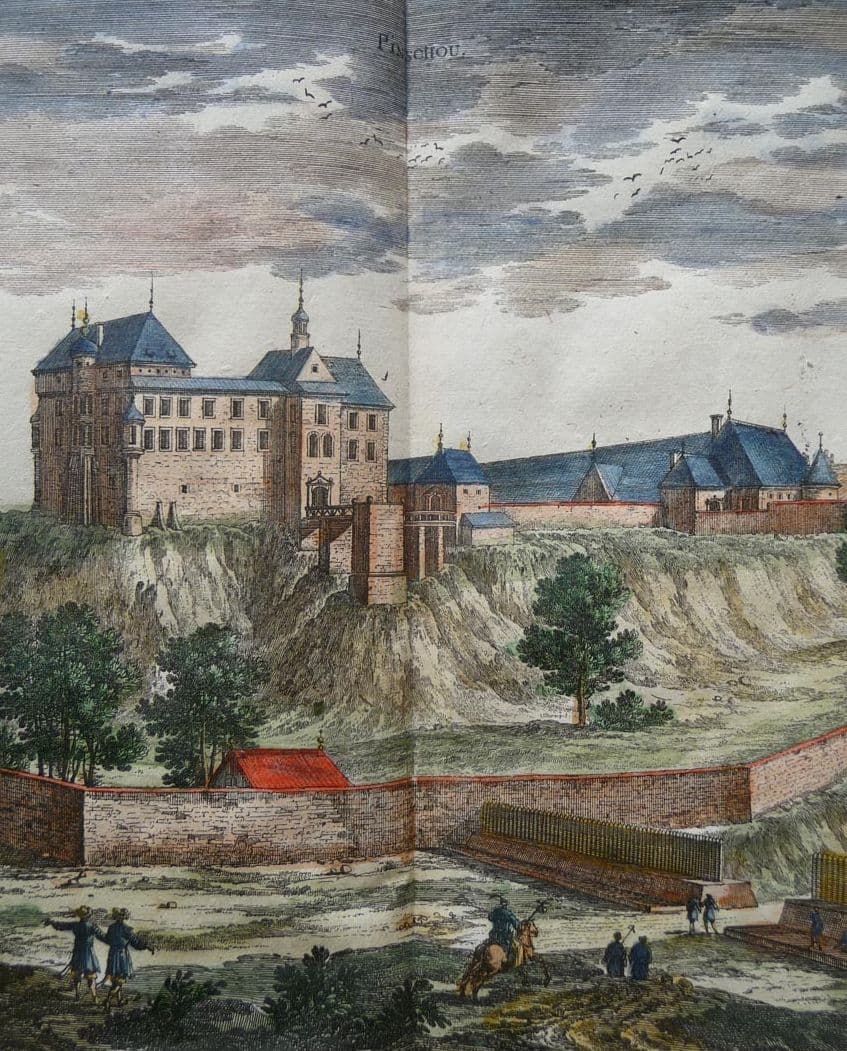
Pińczów
Pińczów castle stands as a significant example of a late medieval hill castle in Poland, with a rich history dating back to the early Middle Ages. The site originally hosted a defensive stronghold at the turn of the 11th and 12th centuries, positioned strategically on a promontory on the left bank of the Nida River. This early fortification was succeeded by a more permanent stone castle erected in the late 13th century, although the identity of its founder remains uncertain.
The castle's original medieval structure featured an irregular plan adapted to the shape of the hill, with a prominent large cylindrical tower located on the eastern side of the elevation. This early castle served as a formidable defensive site but was later replaced following its acquisition in 1424 by Bishop Zygmunt Oleśnicki of Kraków. The bishop demolished the old castle and commissioned the construction of a new, grander fortress that combined both defensive and residential functions, reflecting the evolving architectural and social needs of the period.
Architectural design and construction
The new castle, completed after approximately 30 years of construction, became one of the most impressive structures within the Kingdom of Poland at the time. It was built using carefully hewn stone blocks, emphasizing durability and aesthetic quality. The castle was designed on a quadrangular plan, harmonizing with the natural contours of the hill.
Main structures and fortifications
At the southwestern tip of the hill stood a two-storey building measuring 13 by 23 meters. This building featured a large oriel window on its outer wall, supported by four buttresses, which was a distinctive architectural element. Two smaller oriels flanked the sides of this building, adding to the castle's decorative and functional complexity.
The defensive walls were reinforced with two square towers located at the eastern and northern corners. The eastern tower was larger and projected beyond the wall line, enhancing its defensive capabilities. Adjacent to this tower, in the southern wall, was the gate tower which uniquely housed a chapel on its upper floor, illustrating the integration of religious space within the military architecture.
Access to the castle was via a stone bridge supported by a massive pillar, with the entrance path bending at a right angle towards the northeast, a design intended to slow down and expose attackers.
Renaissance modifications and later history
In 1586, the castle came under the ownership of the Myszkowski family, who undertook significant renovations that introduced Renaissance architectural features. During this period, a lower castle (podzamcze) was established, surrounded by an earthen rampart, expanding the defensive perimeter and residential space.
The Myszkowski family maintained ownership until 1727, after which the castle passed to the Wielopolski family. This transition marked the beginning of the castle's decline. The new owners gradually shifted their residence to the nearby town, leading to neglect of the fortress.
By 1799, Franciszek Wielopolski authorized the dismantling of the castle, which led to the loss of much of its original fabric. Today, only fragments of the walls remain, although the site still conveys the historical significance and architectural grandeur of its past.
Historical significance and cultural heritage
Pińczów castle exemplifies the transformation of medieval fortifications into multifaceted residences that balanced defense and comfort. Its construction under Bishop Oleśnicki reflects the power and influence of the Kraków episcopate in the 15th century. The later Renaissance modifications demonstrate the adaptation of military architecture to new aesthetic and functional paradigms.
Despite its partial ruinous state, the castle remains a valuable cultural heritage site, offering insights into Polish medieval and Renaissance architecture, as well as the social history of the region. Its location on a hill overlooking the Nida River adds to its strategic importance and scenic appeal.
Architectural features in detail
The defensive walls and towers
The castle’s fortifications were thoughtfully designed to maximize defense. The quadrangle plan allowed for comprehensive coverage of the perimeter. The two square towers served as strongpoints for archers and artillery, with the eastern tower’s projection enabling flanking fire along the walls.
The residential buildings and chapel
The two-storey residential building with its prominent oriel windows was both a statement of status and a functional space for the castle’s inhabitants. The chapel within the gate tower highlights the integration of spiritual life within the castle complex, a common feature in noble residences of the period.
The bridge and entrance design
The stone bridge and the angled entrance path were defensive innovations to control access and slow enemy advances. The massive stone pillar supporting the bridge underscores the engineering skill applied to the castle’s construction.
Visiting Pińczów castle today
While much of the original structure has not survived, the site of Pińczów castle remains accessible and offers visitors a glimpse into Poland’s medieval and Renaissance past. The remaining walls and the castle’s hilltop setting provide a compelling experience for those interested in history, architecture, and scenic landscapes.
Interpretive signage and local guides often help visitors understand the castle’s layout and historical context, enriching the experience. The castle’s proximity to the town of Pińczów makes it a convenient destination for cultural tourism in the region.
Frequently asked questions (FAQ)
- How do I get to Pińczów Castle?
- Pińczów Castle is located in the town of Pińczów, Poland, easily accessible by car or public transport. If you are traveling from larger cities like Kraków, you can take a bus or train to Pińczów and then walk to the castle, which is situated within the town.
- What is the historical significance of Pińczów Castle?
- Pińczów Castle dates back to the 14th century and played a crucial role in the defense and administration of the region. It is an important example of medieval architecture and reflects the historical conflicts and power dynamics of Poland during that period.
- When was Pińczów Castle built?
- The construction of Pińczów Castle began in the 14th century, with significant modifications and expansions occurring in subsequent centuries. Its architecture represents a blend of Gothic and Renaissance styles, showcasing the evolution of castle design over time.
- Can I visit Pińczów Castle year-round?
- Yes, Pińczów Castle is open to visitors throughout the year. However, it is advisable to check specific opening hours and potential seasonal closures before planning your visit, especially during winter months.
- Why is Pińczów Castle a popular tourist attraction?
- Pińczów Castle is popular for its rich history, beautiful architecture, and picturesque surroundings. Visitors are drawn to explore its ruins, learn about its historical significance, and enjoy the scenic views of the surrounding landscape.
- Is it possible to take guided tours of Pińczów Castle?
- Yes, guided tours are available at Pińczów Castle, providing visitors with in-depth information about its history and architecture. These tours enhance the experience and offer deeper insights into the castle's past and its role in Polish history.
- What are the opening hours for Pińczów Castle?
- Pińczów Castle typically opens at 10 AM and closes at 6 PM during the peak season. It's recommended to check the official website or local tourism information for the most current opening hours, especially during off-peak seasons.
- What are the ticket prices for visiting Pińczów Castle?
- Ticket prices for Pińczów Castle are generally affordable, with discounts available for students and seniors. Entry fees help maintain the site and support its preservation, so visitors are encouraged to purchase tickets on-site or online in advance.
- What nearby attractions should I visit while in Pińczów?
- In addition to Pińczów Castle, visitors can explore the beautiful Pińczów town square and the nearby Church of St. John the Baptist. The region is also known for its natural beauty, with walking trails and parks that make for a pleasant day of sightseeing.
Photo gallery

Photo by Erik Dahlbergh•Public domain
Information
Loading map...
Visitor reviews
No reviews yet. Been here? Write the first review and help other travelers!
Write the first reviewVisited this castle? Share your experience
Your review helps other travelers and adds first-hand knowledge to our encyclopedia.



