Pilica
Pilica Castle stands as a remarkable example of Renaissance bastioned fortress architecture in Poland, embodying a rich history that spans several centuries. Located in the town of Pilica, this castle's origins trace back to medieval times when the area was under the ownership of the noble Pilecki family, whose primary seat was the nearby Smoleń Castle, originally called Pilecki. Around 1590, the estate was acquired by Wojciech Padniewski, the castellan of Oświęcim, who found the old castle inadequate and commissioned a new residence in the Italian style across the river near Pilica town.
The newly constructed residence, completed circa 1610, was a two-story quadrangular building featuring an internal courtyard. While it was likely surrounded by earthen fortifications, the exact nature of these defenses is difficult to ascertain today. After Padniewski's death, the property passed through several notable owners including Jerzy Zbarski and Konstanty Wiśniowiecki. In 1636, Pilica became the dowry of Helena Wiśniowiecka, marrying Stanisław Warszycki, a prominent and wealthy castellan of Kraków known for his formidable reputation and legendary exploits.
Warszycki's bastioned fortifications
In the mid-17th century, Warszycki fortified the residence with an extensive system of bastion fortifications, reflecting the military architectural advancements of the period. The fortress was built on a rectangular plan measuring approximately 300 by 170 meters, featuring an earthen rampart over 10 meters high. This rampart was faced with a wall constructed from rough stone masonry with finely cut corner stones, topped by a stone parapet. The fortress included six bastions: four at the corners and one on each of the longer curtain walls. These bastions were crowned with earthen ravelins featuring earthen parapets, serving as gun batteries.
Within the bastions were casemates connected by corridors, equipped with loopholes for hand firearms to provide additional defense of the walls. The entire complex was encircled by a moat approximately 20 meters wide, with access to the castle via a causeway built through surrounding ponds.
Military history and destruction
Despite its formidable defenses, Pilica Castle was captured by Swedish forces during the Swedish Deluge in the mid-17th century. As they retreated, the Swedes set fire to the castle, the town, and the nearby Smoleń Castle. The fortress was again occupied by Swedish troops during the Great Northern War, suffering further damage.
Later ownership and architectural transformations
In 1731, the estate was acquired by Maria Józefa z Wesslów Sobieska, who initiated renovations that were completed by her nephew Teodor Wessel. The palace was surrounded by a ten-hectare French-style park, enhancing its residential character. Throughout the 19th century, Pilica changed hands frequently and gradually fell into disrepair.
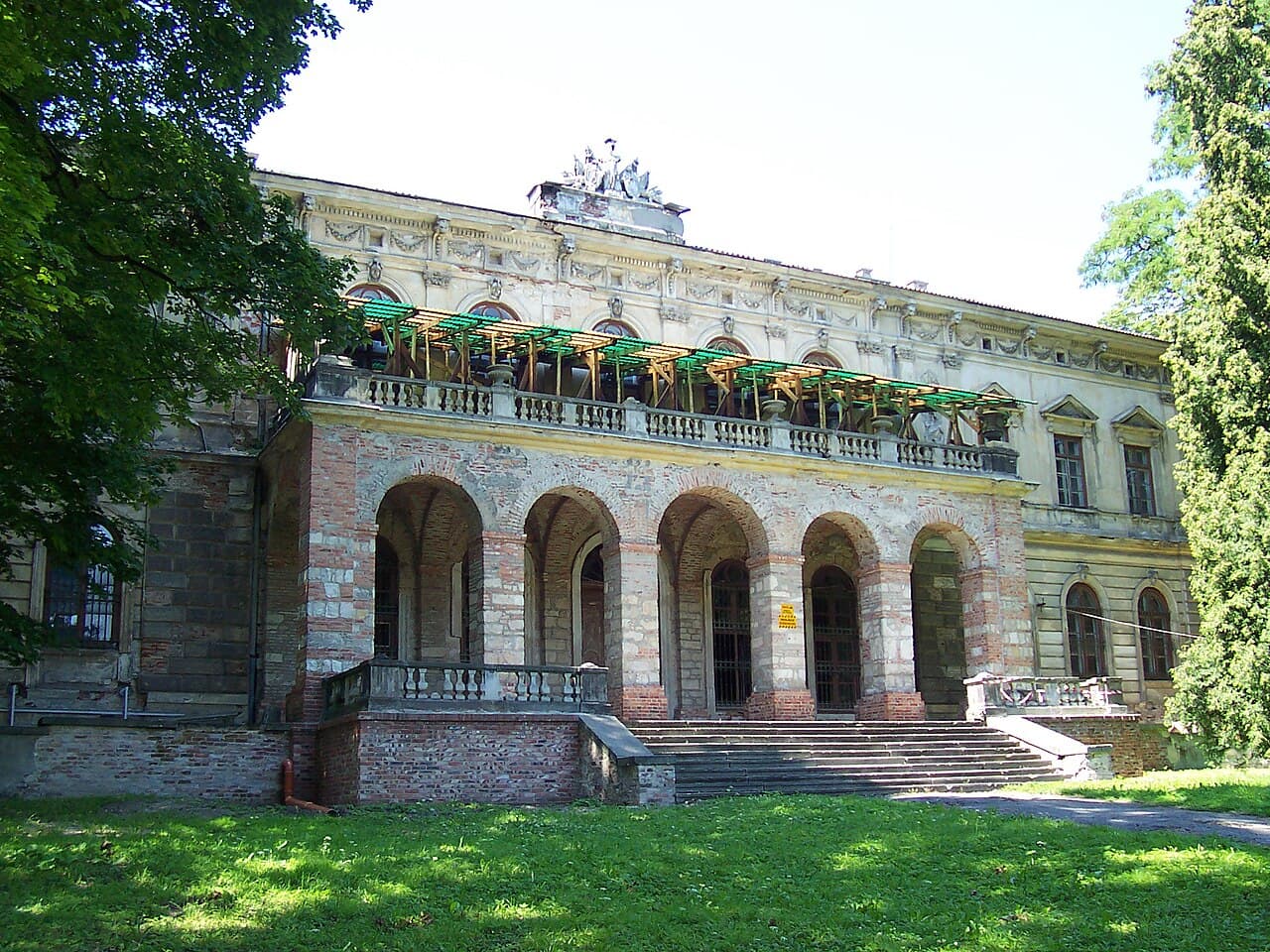
In 1852, industrialist Krystyn August Moes purchased the abandoned residence and undertook restoration efforts. Unfortunately, soon after the renovations, a devastating fire severely damaged the palace. In 1876, Leon Epstein acquired the burnt ruins and conducted a thorough reconstruction, adding a Neo-Gothic romantic flair to the fortress's fortifications, notably through decorative turrets that gave the complex a fairy-tale appearance.
20th-century use and current state
Between 1906 and 1945, the castle belonged to the Arkuszewski family. After World War II, the building was repurposed as a children's home and later as a juvenile detention center. By the late 20th century, the palace was heavily dilapidated.
In 1989, philanthropist Barbara Piasecka-Johnson purchased the property with the intention of restoring its former glory. However, restoration efforts have been slow and the castle remains far from its historical splendor as described in pre-war guides.
Architectural features and visitor experience today
Today, Pilica Castle is not open for interior tours, but visitors can explore the surrounding park and observe the remains of the bastioned fortifications. The Neo-Gothic turrets added in the 19th century, while somewhat whimsical, contribute to the castle's unique silhouette. The scale and complexity of the surviving earthworks and stone walls still impress visitors, offering a tangible connection to the castle's storied past.
Although in ruins, Pilica Castle remains a significant cultural and architectural landmark in the region, illustrating the evolution of Polish fortress design from the Renaissance through the Romantic period. Its history reflects the turbulent military and political events of Poland, as well as the tastes and ambitions of its noble owners.
Frequently asked questions (FAQ)
- How do I get to Pilica Castle?
- Pilica Castle is located in the town of Pilica, Silesian Voivodeship, Poland. It is accessible by local roads and can be reached by car or regional bus services from nearby cities.
- What is the best time to visit Pilica Castle?
- The best time to visit Pilica Castle is during the late spring to early autumn months when the weather is favorable for walking around the park and exploring the outdoor remains of the fortress.
- Is Pilica Castle open for tours inside?
- Currently, Pilica Castle is not open for interior tours due to its condition and ongoing restoration efforts. Visitors can explore the surrounding park and view the exterior fortifications.
- What architectural style characterizes Pilica Castle?
- Pilica Castle primarily exhibits Renaissance architecture with later Neo-Gothic modifications to its fortifications added in the 19th century.
- What are the main historical events associated with Pilica Castle?
- Pilica Castle was notably involved in the Swedish Deluge and the Great Northern War, during which it was captured and damaged by Swedish forces.
Photo gallery

Information
Current owner
Private owner
Loading map...
Visitor reviews
No reviews yet. Been here? Write the first review and help other travelers!
Write the first reviewVisited this castle? Share your experience
Your review helps other travelers and adds first-hand knowledge to our encyclopedia.