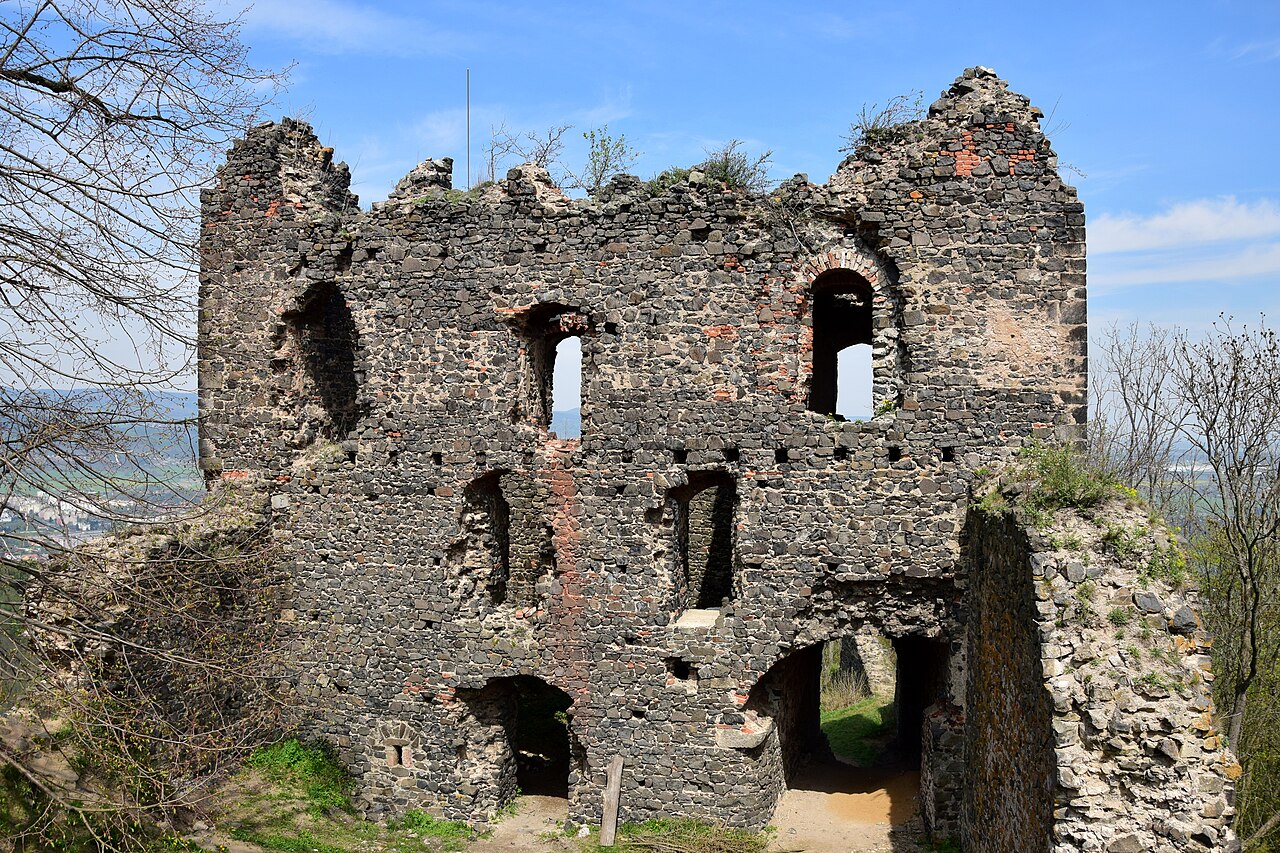
Perštejn Castle
Perštejn Castle stands as a remarkable example of a medieval hill castle in the Czech Republic, perched atop a steep rocky promontory at 466 meters above sea level. Founded in the second half of the 13th century, it reflects the turbulent history and architectural evolution characteristic of Bohemian castles during the High and Late Medieval periods. The castle's strategic location and defensive features illustrate the military and noble ambitions of its builders and successive owners.
The origins and historical context of Perštejn Castle
Perštejn Castle was most likely constructed by the lords of Šumburk or their relative Boreš of Rýzmburk, who is documented between 1248 and 1276. The earliest direct written mention of the castle dates to either 1338 or 1344, naming Bedřich of Šumburk as its lord. This situates the castle firmly within the expansion of Bohemian noble estates during the reign of the Přemyslid and early Luxembourg dynasties.
By 1352, the Šumburk family had secured their holdings, including Perštejn, as fiefs granted by King Charles IV, a pivotal figure in Bohemian and Holy Roman Empire history. The castle's ownership and political alignment became particularly significant during the Hussite Wars in the early 15th century, a period marked by religious and dynastic conflicts that deeply affected the region.
Internal disputes fractured the Šumburk estates in 1431, with Aleš of Šumburk inheriting Perštejn. His alliance with the Saxon margrave Frederick in 1446 placed the castle in opposition to the supporters of King George of Poděbrady. Following Aleš's death in 1451, his sons' guardianship under Bedřich led to continued hostilities, culminating in the castle's capture in July 1451. Despite orders to demolish Perštejn, it remained standing and functionally relevant into the early 16th century.
Throughout the late 15th and early 16th centuries, the castle changed hands multiple times, often due to political and financial upheavals. By 1537, Perštejn was described as a ruin, and in 1539 it was incorporated into the Šumburk estate, with administrative functions transferred to the nearby Klášterec nad Ohří chateau. Since 1963, the castle's remains have been protected as a cultural monument, preserving its historical legacy.
Architectural features and defensive structures
Location and natural defenses
Perštejn Castle's site on a steep rocky promontory provided a naturally defensible position, a common strategic choice for hill castles in medieval Europe. The elevation and rugged terrain limited access and enhanced the castle's defensive capabilities against attackers.
Outer defenses and courtyards
Approaching from the north, visitors would have crossed a double moat to reach the castle's first courtyard, known as the lower castle area. This courtyard was enclosed on the west by a tall wall featuring a small gate leading into a narrow zwinger, a defensive passage designed to trap and expose attackers. This zwinger was further fortified by a square bastion opening inward at the corner, enhancing the defensive perimeter.
The east side of this courtyard once held a building, now mostly reduced to small wall sections, indicating the presence of auxiliary structures supporting the castle's function.
Core castle and bergfried tower
To the south, beneath the main core of the castle, a second square bastion was integrated into an outer defensive wall that extended westward toward the bergfried, a tall tower typical of Central European castles. The bergfried stood north of the core area and was part of the enclosure of the first courtyard. Access to this tower was likely via a drawbridge connecting from the wall walk atop the castle's core, a defensive feature allowing control over movement between the tower and the main castle body.
Between the bergfried and the main castle structure lies a partially buried gateway, suggesting a controlled and limited access point, critical for defense and internal security.
The castle's core occupies the highest point of the rocky outcrop and has an oval shape. Archaeological evidence suggests it was a towerless fortification enclosed by a curtain wall, a continuous defensive barrier typical of medieval castles designed to protect the inner bailey and residential quarters.
Associated siege camp and military significance
Approximately 450 meters north of the castle, on a ridge extending from Vysoká hill, lies an enclosed siege camp covering about 0.69 hectares. This camp features an oval fortification with a small square redoubt measuring 11 by 11 meters. The fortification is surrounded by an earthwork rampart approximately 1.5 meters high and a ditch up to 3 meters wide and 1 meter deep, indicating significant military engineering.
The camp's natural defenses include steep slopes on its flanks, supplemented by a linear fortification running 95 meters along one side. This line incorporates two bastions, providing additional protection and defensive firepower. Such a camp would have been essential for besieging forces to maintain position and control during military operations against Perštejn Castle.
Nearby, on Perštejnský Špičák hill at 407 meters elevation, a surface feature possibly related to siege operations commands approach routes. Although unsuitable for direct artillery bombardment, this position likely held strategic importance during the documented military events involving the castle.
Construction materials and preservation state
Most surviving structures at Perštejn Castle are constructed from stone masonry, a durable material typical of medieval fortifications in the region. Remains include large sections of defensive walls, bastions, the bergfried tower, and the zwinger area. The preservation state varies, with some walls recently documented to have partially collapsed, reflecting the ongoing challenges of conserving such historic ruins.
The castle today is classified as ruins, with its remains protected as a cultural monument since 1963. These ruins offer valuable insights into medieval castle architecture, defensive strategies, and the historical conflicts that shaped the region.
Perštejn Castle in the context of Czech medieval heritage
Perštejn Castle exemplifies the typical features of a 13th-century hill castle in Bohemia, combining natural topography with carefully planned fortifications. Its history reflects the complex feudal allegiances, military conflicts, and political changes that characterized the region from the High Middle Ages through the Renaissance.
Despite its ruinous state, Perštejn remains an important cultural and historical site, attracting scholars, historians, and visitors interested in medieval architecture and Czech history. Its association with notable families like the Šumburks and its role in the Hussite Wars highlight its significance in Central European medieval history.
Visitors to the site can explore the remains of its defensive walls, bastions, and bergfried, gaining a tangible sense of medieval military architecture and the strategic importance of hill castles in the Czech lands.
Frequently asked questions (FAQ)
- How do I get to Perštejn Castle?
- Perštejn Castle is located in the municipality of Perštejn in the Ústí nad Labem Region of Czechia. It is accessible by local roads, and visitors typically reach it by car or hiking from nearby towns.
- What is the historical significance of Perštejn Castle?
- Perštejn Castle played a key role in the medieval history of Bohemia, especially during the Hussite Wars and the conflicts involving the Šumburk family. Its strategic location and fortifications reflect its importance as a defensive stronghold.
- Can I explore the ruins of Perštejn Castle?
- Yes, visitors can explore the ruins, including the remains of the defensive walls, bastions, and the bergfried tower. However, as the site is classified as ruins, some areas may be unstable, so caution is advised.
- When was Perštejn Castle built?
- Perštejn Castle was constructed in the second half of the 13th century, likely by the lords of Šumburk or Boreš of Rýzmburk.
- Is there an entrance fee to visit Perštejn Castle?
- There is no information about an entrance fee, and typically, ruins like Perštejn Castle are open to the public free of charge, but visitors should check locally for any updates.
Information
Loading map...
Visitor reviews
No reviews yet. Been here? Write the first review and help other travelers!
Write the first reviewVisited this castle? Share your experience
Your review helps other travelers and adds first-hand knowledge to our encyclopedia.