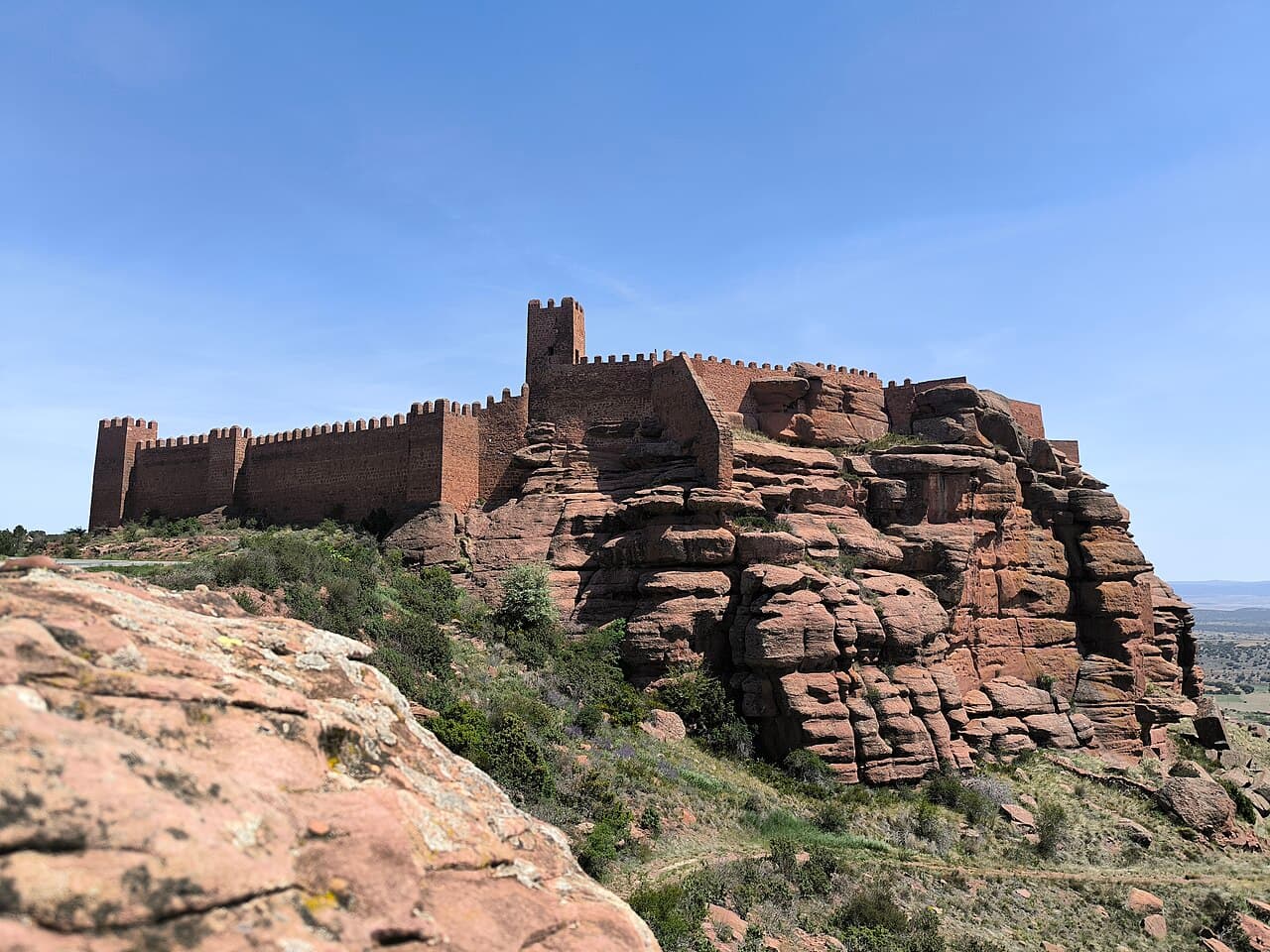
Peracense Castle
Peracense Castle stands as a remarkable example of medieval military architecture in the region of Aragón, Spain. Perched atop a prominent red sandstone outcrop in the southern foothills of the Sierra Menera, the castle commands sweeping views over the Jiloca valley. Its strategic location and distinctive reddish hue, derived from the local sandstone called rodeno, make it a striking landmark that blends naturally with the rugged landscape.
The site of Peracense Castle has a long history of occupation dating back to the late Bronze Age, as evidenced by archaeological findings of handmade and burnished ceramics. This early use underscores the importance of the site as a natural defensive position long before the medieval fortress was constructed. During the 10th and 11th centuries, the location was reoccupied under Muslim control, with a small building likely crowning the rock spur. This early structure marked the site’s role within a frontier zone amid the shifting powers of Muslim rulers in the Iberian Peninsula.
Medieval origins and strategic importance
By the mid-12th century, the Kingdom of Aragón expanded southward, incorporating the territory including Peracense. The castle’s position became critical as a border fortress separating Aragón from the Kingdom of Castile. It also lay near the boundaries of several important lordships, including Albarracín, Molina de Aragón, and the Community of Daroca. Until around 1170, Peracense was part of the defensive network of the Taifa of Albarracín. That year, the castle was ceded by Muhammad ibn Mardanís, known as the “Wolf King” and Emir of Murcia, to Pedro Ruiz de Azagra, lord of Estella, as payment for military support against the Almohad dynasty. The castle then remained under Navarrese control until King Pedro III of Aragón conquered it in 1284.
14th-century expansions and military role
The castle underwent significant expansions and renovations mainly in the 14th century, particularly during the War of the Two Peters (1356–1375), a prolonged conflict between Aragón and Castile. During this time, Peracense Castle was reinforced as a key defensive stronghold along the Aragón-Castilla frontier. New walls and fortifications were added to meet the evolving military demands of the period, including adaptations to withstand siege warfare and the use of archers.
Architectural layout and defensive features
Outer enclosure and albacar
The castle’s design features three concentric walled enclosures, each adapting to the rugged terrain of the red sandstone rock. The outermost enclosure forms a robust defensive barrier with a crenellated wall arranged at right angles and reinforced by multiple towers. Narrow arrow slits punctuate these walls, allowing defenders to fire upon attackers while remaining protected. This outer space enclosed a large open courtyard known as an albacar, originally used as a service area. Remnants of former stables remain here, and archaeological excavations have uncovered a quarry used to extract rounded sandstone pieces for millstone production.
Middle enclosure and living quarters
The middle enclosure lies within the shelter of the rocky outcrop and features a wall that follows the irregular shape of the natural rock. Built mainly in the second half of the 14th century during the War of the Two Peters, this section contained living quarters for troops. Today, these spaces have been adapted for exhibition and activity rooms. Access to the castle passes through a main gate protected by a tower, emphasizing defense. The nearby Hospital Tower functioned as a watchtower overseeing both the outer and inner defenses. A large cistern inside this enclosure collected and stored water, essential for withstanding sieges.
Inner enclosure and false keep
At the highest point of the fortress lies the inner enclosure, perched atop the steepest part of the rock and arranged as three terraces leading to the upper roof. From here, commanding views extend over the Jiloca valley to the northeast. Originally, entry to this uppermost stronghold was achieved via a retractable wooden ladder spanning a nearly four-meter vertical gap from the middle enclosure. This ladder could be pulled up during attacks to prevent enemy access. Inside, the most prestigious rooms feature pointed vaults, architectural elements that provide both strength and height. Additional cisterns ensured a reliable water supply for the castle’s noblest occupants. Instead of a traditional keep tower, the inner enclosure is protected by a false keep, a powerful screen wall designed to shield the critical core of the fortress.
Later history and preservation
Following the 14th century, Peracense Castle gradually lost its primary military role. The Community of Daroca repurposed it as a prison, reflecting a shift in its function. In the early 19th century during the First Carlist War, the fortress underwent partial reconstruction to accommodate artillery, resulting in modifications to its walls and the removal of some interior buildings. These changes reflected advances in military technology and altered the castle’s original medieval character.
Between 1987 and 1990, archaeological excavations uncovered remains including a quarry used to extract round sandstone pieces for millstones, shedding light on local craftsmanship and the source of building materials. Restoration efforts initiated in the late 20th century have preserved the site, which was officially recognized as a monument of cultural interest in Aragón from 2006 onward. Today, Peracense Castle remains one of the best-preserved and most authentic medieval fortresses in the region, offering valuable insight into medieval frontier defense and military architecture adapted to challenging terrain.
The castle’s distinctive reddish sandstone walls, concentric defensive design, and layered enclosures illustrate the ingenuity of medieval fortification strategies. Visitors can explore the well-preserved walls, towers, cisterns, and vaulted chambers, gaining a deeper understanding of the castle’s historical significance and architectural evolution through centuries of conflict and change.
Frequently asked questions (FAQ)
- What is the historical significance of Peracense Castle?
- Peracense Castle, dating back to the 11th century, is an important example of medieval military architecture in Spain. It played a strategic role in the defense against Muslim invasions and showcases the evolution of fortification techniques over the centuries.
- When was Peracense Castle built?
- Construction of Peracense Castle began in the late 10th century and continued into the 11th century. The castle was primarily built during the period of the Reconquista, reflecting the architectural styles and defensive needs of that era.
- Can I visit Peracense Castle year-round?
- Yes, Peracense Castle is open to visitors throughout the year, but it's advisable to check specific opening hours before your visit. Seasonal hours may vary, especially in winter months.
- What are the opening hours for Peracense Castle?
- Peracense Castle typically opens at 10 AM and closes at sunset, although specific hours may vary by season. It's recommended to verify the current hours on the official website or local tourist information prior to visiting.
- Is it possible to access Peracense Castle with limited mobility?
- Access to Peracense Castle can be challenging for visitors with limited mobility due to its rugged terrain and uneven pathways. However, there are areas that can be reached with assistance, and it's best to contact the site in advance for detailed accessibility information.
- What is the best time to visit Peracense Castle?
- The best time to visit Peracense Castle is during the spring and autumn months when the weather is mild and pleasant. This allows for comfortable exploration of the castle and the surrounding natural beauty.
- Are there any nearby attractions to visit along with Peracense Castle?
- Yes, nearby attractions include the picturesque village of Peracense and the stunning landscapes of the Sierra de Albarracín. Visitors can also explore other historical sites in the region, enriching their experience of the area.
- How much do tickets to Peracense Castle cost?
- Ticket prices for Peracense Castle are typically very affordable, with discounts available for children, seniors, and groups. Prices may vary, so it’s a good idea to check the official website for the latest information.
Photo gallery

Information
Website
Visit websiteSources & official resources
Verify the information above using these authoritative references.
Loading map...
Visitor reviews
No reviews yet. Been here? Write the first review and help other travelers!
Write the first reviewVisited this castle? Share your experience
Your review helps other travelers and adds first-hand knowledge to our encyclopedia.



