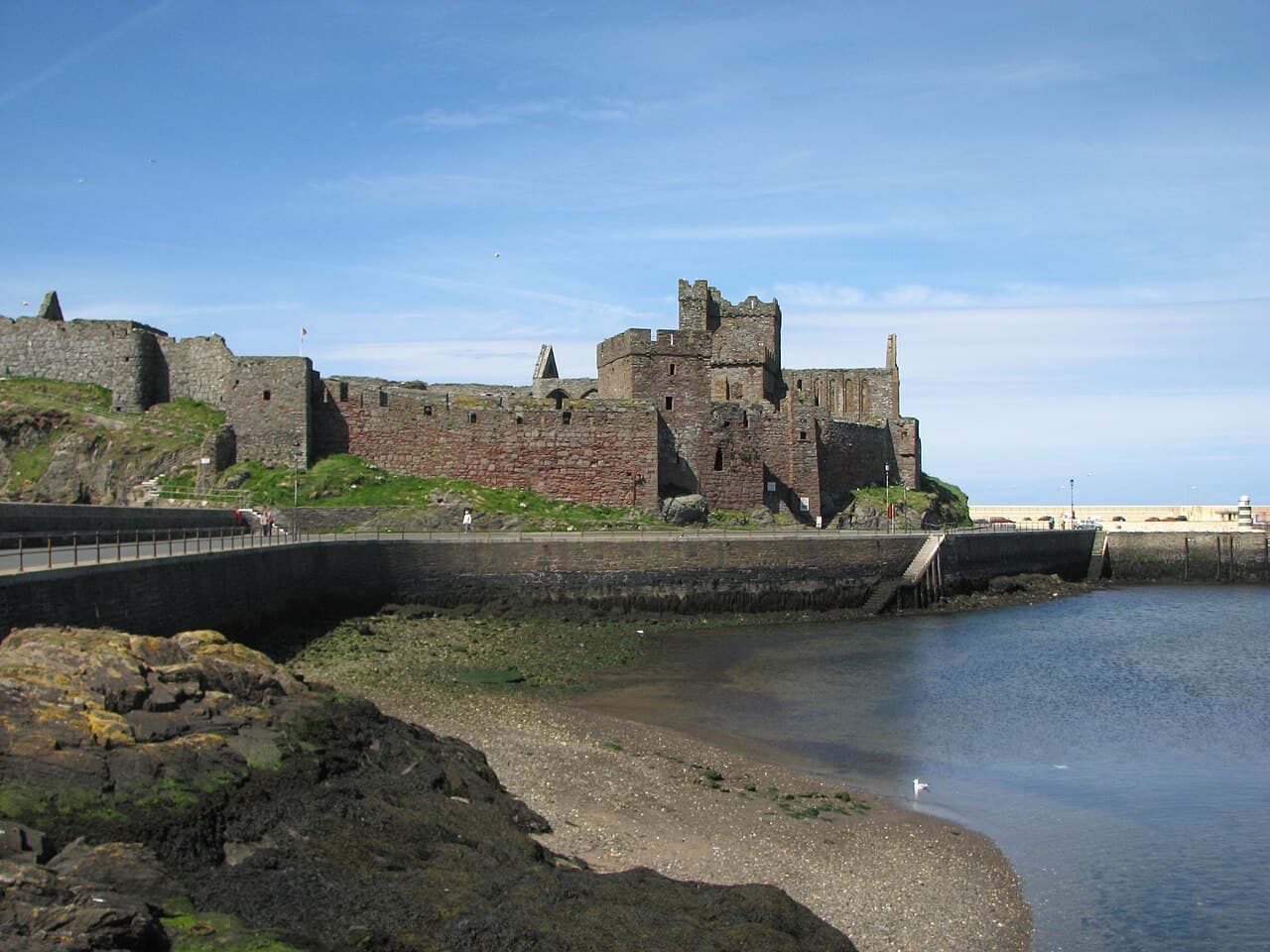
Peel Castle
Peel Castle (Cashtal Phurt ny h-Inshey in Manx Gaelic) is a historic fortress located on St Patrick's Isle, connected to the town of Peel on the Isle of Man by a narrow causeway. This castle, originally constructed in the 11th century by Norwegian settlers under the reign of King Magnus Barefoot, occupies a strategic position overseeing the Irish Sea. The site combines elements of early medieval monastic architecture with later military fortifications, reflecting the island's complex history of Norse, Celtic, and later English influence.
Early history and construction
The location of Peel Castle was initially home to Celtic monastic buildings predating the Norse arrival. The most prominent surviving feature from this period is a round tower that originally belonged to the monastery complex. This tower was later adapted for defensive purposes with the addition of battlements, illustrating the site's transition from religious to military use.
The first Norse fortifications on St Patrick's Isle were constructed primarily of wood, a common practice during the Viking Age. These wooden structures were part of King Magnus Barefoot's efforts to consolidate control over the Isle of Man and surrounding territories. Archaeological excavations conducted between 1982 and 1987 uncovered remains of these early wooden defenses, shedding light on the castle's initial form and strategic importance.
Medieval stone fortifications
By the early 14th century, Peel Castle underwent significant reconstruction using local red sandstone, which is abundant in the region. The stone walls and towers built during this period replaced the earlier wooden structures, providing enhanced protection against attacks. The castle's layout includes curtain walls, towers, and a gatehouse, typical features of high medieval military architecture.
The castle also served as an ecclesiastical center, housing the cathedral of the diocese of Sodor and Man. This dual role as both a fortress and a religious site is reflected in the architecture and historical records. The castle remained an important stronghold and religious seat until its gradual abandonment in the 18th century.
Later history and archaeological discoveries
Despite its decline as a religious center, Peel Castle continued to be fortified and adapted for defense. Notably, new defensive positions were added as late as 1860, reflecting ongoing military concerns in the region. Today, while many of the internal buildings lie in ruins, the outer walls remain largely intact, offering visitors a glimpse into medieval fortification techniques.
Excavations at the site revealed an extensive graveyard and significant artifacts, including the remarkable 10th-century burial known as the "Pagan Lady". Her grave contained a finely crafted Norwegian necklace and a cache of silver coins dating to around 1030, providing valuable insight into the cultural and economic connections of the Isle of Man during the Viking period.
Architectural features and layout
Peel Castle's architecture reflects a blend of medieval defensive design and earlier monastic elements. The castle is characterized by its curtain walls constructed from red sandstone, punctuated by several towers that provided vantage points for surveillance and defense. The round tower from the monastery stands out as a unique feature, illustrating the site's layered history.
The castle's position on St Patrick's Isle, surrounded by water and accessible only via a causeway, enhanced its defensibility. The natural moat created by the surrounding sea was supplemented by man-made fortifications, making Peel Castle a formidable stronghold in its time.
Legends and cultural significance
Peel Castle is associated with local folklore, most famously the legend of the "Moddey Dhoo" or "Black Dog" ghost. This spectral hound is said to have haunted the castle's corridors, adding a layer of myth to the site’s rich history.
The castle also holds a place in literature and popular culture. It appears on the reverse side of the £10 banknotes issued by the Isle of Man Government, signifying its importance as a cultural and historic symbol. Occasionally, Peel Castle is confused with Piel Castle on Piel Island in England, partly due to references in poetry by William Wordsworth, who visited the Isle of Man and wrote about the region.
Some scholars have proposed Peel Castle as a possible location for the legendary Arthurian Avalon, although this theory remains speculative and is not widely accepted among historians.
Visiting peel castle today
Currently managed by Manx National Heritage, Peel Castle is open to visitors during the summer months. The site offers a combination of historical ruins, scenic views of the Irish Sea, and opportunities to explore the castle’s varied architectural features. The causeway connecting the castle to Peel town provides easy access, allowing visitors to experience this remarkable medieval fortress firsthand.
Interpretive signage and guided tours help illuminate the castle's complex history, from its Norse origins to its later ecclesiastical and military roles. The castle remains a prominent landmark on the Isle of Man, attracting tourists and scholars interested in medieval history, Viking heritage, and castle architecture.
Frequently asked questions (FAQ)
- How do I get to Peel Castle?
- Peel Castle is located in Peel, Isle of Man, easily accessible by car and public transport. If you're driving, follow the A1 road to Peel, where you'll find parking nearby. The local bus service also provides routes to Peel from various parts of the island, making it convenient for visitors.
- What is the historical significance of Peel Castle?
- Peel Castle has a rich history dating back to the 11th century and is one of the most important medieval structures on the Isle of Man. It was originally built as a fortress by the Norse and later became the seat of the Kings of Mann. The castle played a vital role in the defense against invaders and has witnessed many significant historical events.
- When was Peel Castle built?
- Construction of Peel Castle began in the 11th century, with significant renovations and expansions occurring over the following centuries. The castle was strategically built on St. Patrick's Isle, taking advantage of its elevated position for defense. Its architecture reflects various periods, showcasing the evolution of medieval military design.
- Can I take guided tours of Peel Castle?
- Yes, Peel Castle offers guided tours that provide in-depth insights into its history and architecture. These tours are led by knowledgeable guides who share fascinating stories and facts about the castle and its surroundings. It's an excellent way to fully appreciate the significance of the site.
- Why is Peel Castle a popular tourist attraction?
- Peel Castle attracts visitors due to its stunning coastal views, rich history, and impressive architecture. The site provides a unique glimpse into the medieval past of the Isle of Man and is a great spot for photography and exploration. Additionally, its location near the charming town of Peel adds to its appeal.
- Is it possible to access all areas of Peel Castle?
- While many areas of Peel Castle are accessible to visitors, some sections may be restricted for safety reasons. The main grounds and significant features are open for exploration, allowing guests to enjoy the historic atmosphere. Always check with the staff for the latest accessibility information during your visit.
- What are the opening hours for Peel Castle?
- Peel Castle is generally open to visitors from March to October, with varying hours depending on the season. During peak tourist season, the castle may have extended hours to accommodate more visitors. It’s best to check the official website before planning your visit to confirm current opening hours.
- What are the ticket prices for Peel Castle?
- Ticket prices for Peel Castle are typically modest, with discounts available for children, seniors, and families. Admission fees help maintain the site and support its preservation. Check the official website for the most accurate and up-to-date pricing information before your visit.
- When is the best time to visit Peel Castle?
- The best time to visit Peel Castle is during the warmer months, from late spring to early autumn, when the weather is more favorable for outdoor exploration. This period also offers longer daylight hours, allowing you to enjoy the scenery and take part in various events. However, the castle is open year-round, so you can plan your visit based on your preferences.
- What nearby attractions can I visit while at Peel Castle?
- While visiting Peel Castle, you can explore the picturesque town of Peel, known for its beautiful harbor and sandy beaches. Nearby attractions include the Manx Museum and the historic St. German's Cathedral. These sites complement your visit to the castle and provide a deeper understanding of the Isle of Man's history and culture.
Photo gallery

Photo by Finn Bjorklid•Public domain
Information
Loading map...
Visitor reviews
No reviews yet. Been here? Write the first review and help other travelers!
Write the first reviewVisited this castle? Share your experience
Your review helps other travelers and adds first-hand knowledge to our encyclopedia.



